• TalkBass has been independent since 1998. Add your voice.
    Create a free account to reply to discussions, view embedded media, and browse with fewer display ads.
    Join freeLog in
    Want zero display ads or expanded classifieds tools? Compare plans.

Need info on EV Speaker

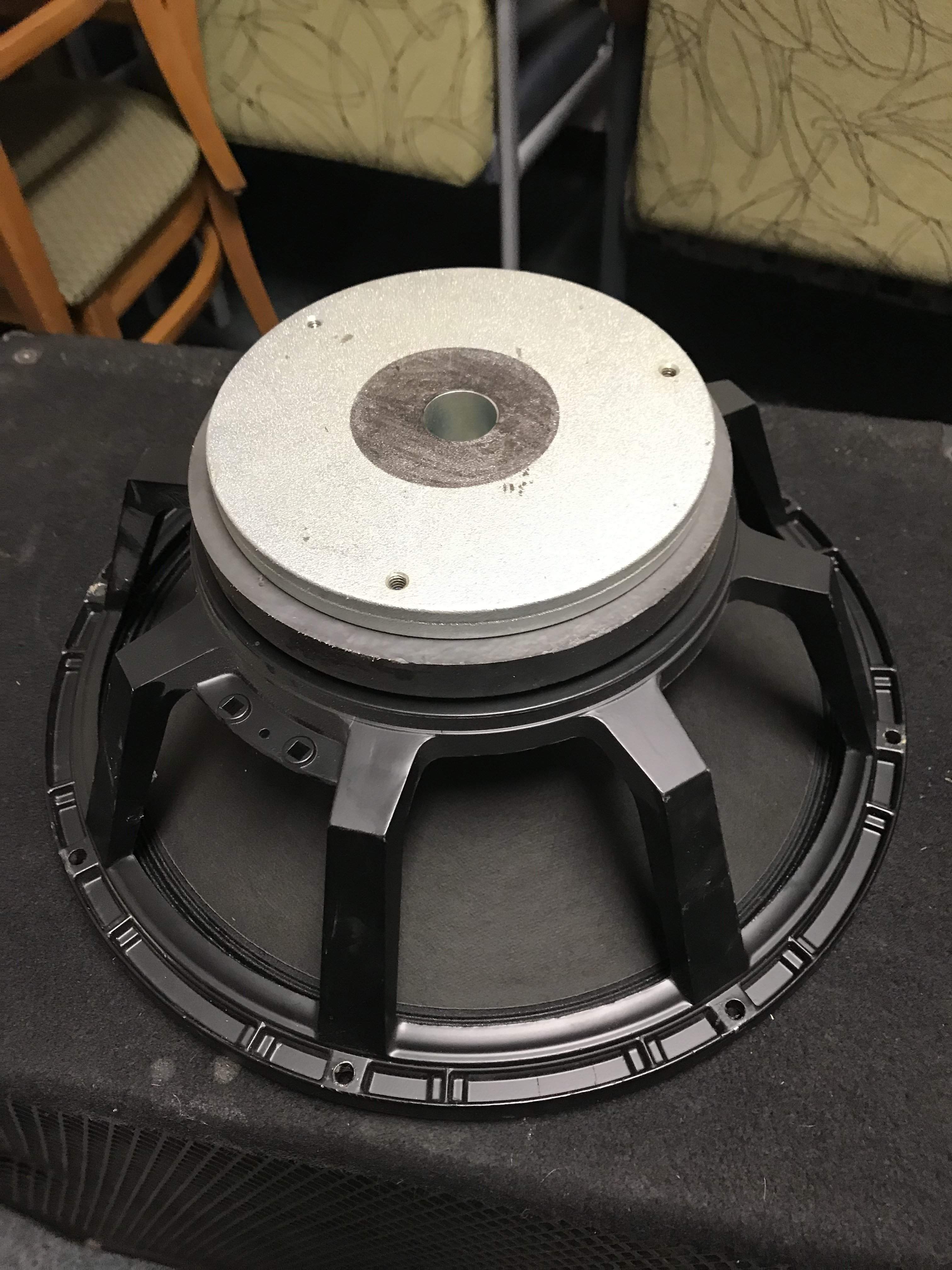
I just took in an old Peavey 115 cab loaded with a 15” Black Widow speaker. The plan is to strip off the old rat fur and recover cabinet. I also have another weird Trace Elliot 1510 cab that someone replaced the 15 with an EV 15” speaker.
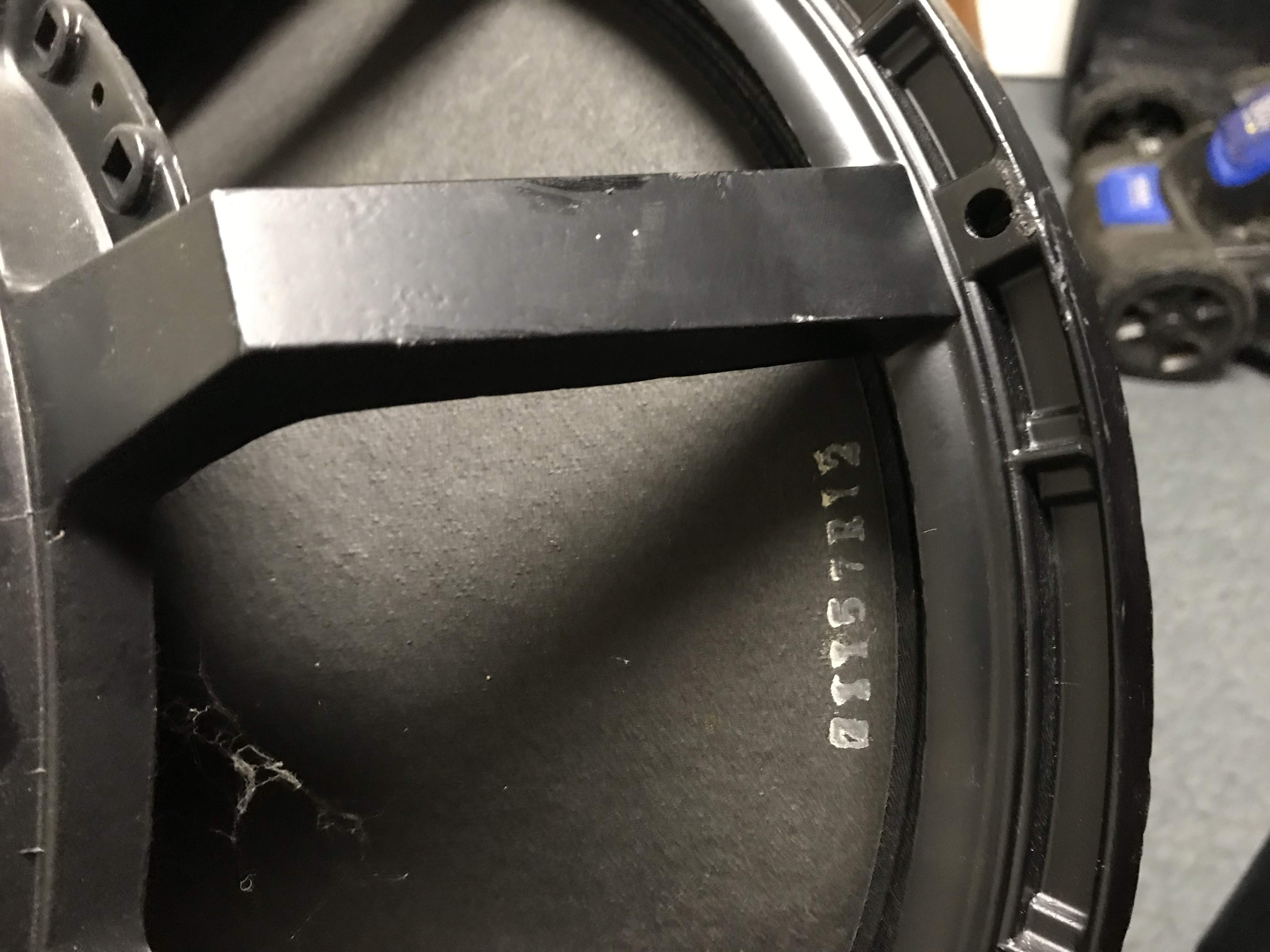
The issue is I’m thinking of putting the EV 15 in the Peavey cab but I have no info as to ohms or power handling of Ev speaker. I emailed Electra Voice and they said it must be some OEM replacement speaker but they could not give me any other info. I am posting pics of speaker with stamp on cone. If anyone could shed light on this speaker it would be great.
383F6D86-49E7-4146-A857-8DF2872822C5.jpeg
82AB3C96-7552-4A94-8D69-8F5BD1AC4303.jpeg
 
If it's been reconed with aftermarket parts there's no way to know. I don't recognize the number.

As an educated guess, if the cabinet and driver are well matched, somewhere around 200 watts (RMS) above 50Hz.
 
DCR will be slightly lower than nominal impedance

So 8ohm nominal might read anywhere between 5 to 7 ohms

Most likely a 8ohm
And I'm resisting any further comments that you did say 4x10 and 1x15 lol ;)
 
It certainly appears to be an EV driver...whether it's EVM-15L or EV-15B, or some other such thing is a subject for conjecture. OP, do you have the ability/capability to sweep the speaker to get an idea of it's resonant frequency(ies)? That would give you some idea of it's potential appropriateness for use in a bass rig. Chances are, (and in IMHO) it's probably fairly similar to the Black Widow that you're swapping it with.
 
IF the driver uses factory recone part, it's going to be VERY different from any Black Widow I'm familiar with.

The problem here is that we have no idea what parts are in the driver. Just because the metalwork is EV doesn't mean that it will match up with the factory specs.

A quick DCR and Fs test might show up deviations.
 
Sorry, I didn't mean to imply that they would sound the same, just that they are likely to be similar in power-handling capability. AND...IMHO, just about as likely to be appropriate to the poster's intended purpose, whatever it is. My advice to the OP is: before you put any effort into rehab-ing the cab, stick the replacement driver in it and play through it by itself. Then at least you would have some idea if the combination of those two elements is going to give you any sort of usable results. Swapping drivers in and out of cabs willy-nilly typically doesn't yield an improvement to anything. Presuming that your "EV" driver is a bass driver, and presuming that the Peavey cab is a ported, bass-reflex box (both huge presumptions), then you still have a big unknown factor in what resonant frequency the box is tuned to. I suppose one could do a little reverse-engineering and suss that out, but that couldn't possibly be worth the effort, and I doubt the OP has the expertise. Hence, the brute force method...just stick the driver in the box, turn it up and see if you like what you hear at all. Even if you do, you then have to figure out how to integrate it into your rig, which is likely to be a formidable task. Given that you have a 4-ohm box already, it doesn't seem likely that you could just plug the two cabs in parallel. If you already have a second channel of amplification available to you, I guess that wouldn't be an unsurmountable problem, but at some point one needs to figure out what the ultimate objective is. If the OP's goal in pairing a 15" speaker with his 4x10 box is to get "better low end", (again, a big presumption) then this sort of crap-shoot approach to isn't likely to lead to the desired result . But it won't take much effort to stick the driver in the box to see what happens, presuming it's just simple bolt-in swap. I certainly wouldn't invest much time or effort in it until you know what the combination of speaker and box sounds like. And BTW, then you'll know if the other driver will even fit in the box...IIRC, I have run into problems putting EV drivers in cut-outs for other speakers, at least when front-mounting them. OP, I wish you luck but I wouldn't get your hopes up too much.
 
I picked this cab up in a trade and I am just messing around with it for the fun of it. I will most likely not be using it playing out as the ampeg 410 I have will cover whatever I play. I also have a Hartke 210 hydrive Neo if I need a really portable rig. I run a sansamp version 2 pedal as a pre into a crown xls 1002. I normally run the Crown in bridged mode. I just didn’t want to blow my amp up while I was playing around. The crown amp stereo rating will cover all ohm ratings at lower power but only has a 4 or 8 ohm rating bridged.
I planned on a/b the speakers in 15’ cab. If the EV sounds better it would also help to have ohm and power rating for resale.
 
My apologies, OP, for giving a $20 answer to your $2 question. I kinda think somewhere in all the responses is your actual answer. Measure the DC resistance of the voice coil and round it up to find the nominal impedance. To a certain extent, power-handling ratings are also 'nominal' numbers, so why worry about it too much? agedhorse's guess-timate of 200 watts is a good one. I'd probably 'massage' that number for marketing purposes and call it a 200-250 watt driver. So that's like, what...1000-MW (Marketing Watts)? And again, you can't run it (or anything else) in parallel with your 4-ohm cab from your power amp in bridged mode. Even if you did, you're not likely to hurt anything; that amp is well protected and it won't let you burn itself up with too heavy a load. (That may or may not be true of some of the glorified car-stereo amps that are discussed on this board.) I second Red Planet's comment--there's no harm in trying the suspect 'EV' to see what happens. You could run the 15 and the 4x10 box off your amp in 2-channel mode, but there's not a lot of power that way.

Just FYI, no ordinary commercial power amps are rated to drive anything lower than a 4-ohm load in bridged/mono mode...it's a direct function of the rated per-channel output impedance. 4-ohm total bridged output=2 ohms/channel. I don't think any manufacturer rates amps to anything lower than a 2-ohm/channel load, hence a 4-ohm output in bridged/mono mode. Although, in olden days, some of the old, big Crown amps could drive a near-dead-short all day and not shut themselves down...that's never going to happen with modern, Class-D amps.
 
  • Like
Reactions: flr82