• TalkBass has been independent since 1998. Add your voice.
    Create a free account to reply to discussions, view embedded media, and browse with fewer display ads.
    Join freeLog in
    Want zero display ads or expanded classifieds tools? Compare plans.

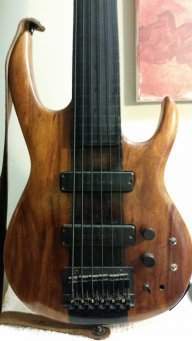
Neutral fret on a multiscale fretboard!

I am about to draw a multiscale fretboard. I think I have decided on the different scale lenghts that I’ll use.

Now that I play a Dingwall, I noticed that there is a neutral fret. I thought that it would make Sense to use the 12th fret as the neutral one, but every multiscale basses company uses a different neutral fret (7, 8, or 9th fret, most of the time)

Why is that? I’d like to understand why
 
I am about to draw a multiscale fretboard. I think I have decided on the different scale lenghts that I’ll use.

Now that I play a Dingwall, I noticed that there is a neutral fret. I thought that it would make Sense to use the 12th fret as the neutral one, but every multiscale basses company uses a different neutral fret (7, 8, or 9th fret, most of the time)

Why is that? I’d like to understand why

That choice is about player preference, particularly why they want to go multi-scale. For many players, it's about having the longer strings on the bass side, for the increased tension and potentially clearer sound. They may like the neutral at the 12th, so the fret angle is evened out between the two ends.

Others want help with a shoulder problem; they have difficulty extending their arm away from their body, and angling the frets mostly at the headstock allows them to keep their elbow in tighter. They may prefer the neutral at the 20th.

Others have a problem bending their wrist when playing up high. They may prefer the neutral at the 7th, to keep their wrist straighter at both ends, while holding their elbow out.

Sheldon has built them of different geometries, based on what he hears from his customers. Other companies make their choice based on their research of likely customers.
 
I am about to draw a multiscale fretboard. I think I have decided on the different scale lenghts that I’ll use.

Now that I play a Dingwall, I noticed that there is a neutral fret. I thought that it would make Sense to use the 12th fret as the neutral one, but every multiscale basses company uses a different neutral fret (7, 8, or 9th fret, most of the time)

Why is that? I’d like to understand why

I think we can put aside the tonal benefits of longer scales for lower notes - they are well understood and based on solid scientific and empirical evidence (the grand piano isn't built that way just to use up excess lumbar).

In terms of geometry, having the neutral closer to the nut reduces the reach difference for your left hand, but might make playing in upper regions more difficult (are the highest frets on the low strings of a Combustion even accessible through normal means?) whilst also creating potential timbral challenges for the right hand*. Moving the neutral fret up solves the right hand and upper region challenges but might easily put the lower stops of the big strings too far away, depending on the scale lengths selected. Bottom line is its a compromise between a lot of significant variables - by doing your own design you can at least choose your own priorities.

* if you play 'normally' across the strings the right hand will naturally move towards the centre of the longer strings leading to thicker warmer tones compared to brighter snappier tones on upper strings - to keep it consistent you will need to modify your right-hand technique to cross strings parallel to some imaginary fret line.
 
  • Like
Reactions: bassman1974
On a 24-fret neck the 8th fret is nearest to the middle, so the angle of the 24th fret will be pretty close to the inverse of the angle of the nut -- the splay of the frets is balanced.

There's probably some matter of not wanting the angle of the bridge to be too extreme either -- but I'll trust Dingwall to have spent more time thinking about that than I have.
 
Wow, thank you for all of that information, I totally understand the neutral fret reasoning now.

May I ask for your opinion now. I really enjoy my Dingwall because of its clearer tone (i have bad hearing) and string tension feel.

Unfortunately, because of wrist discomfort. I moved from Dingwall’s long scale to medium scale and it solved my wrist problem.

The tone is still a little clearer and tension is nice but not as much as the long scale. The 32 inch scale G string also feels short. I am a tall and Big Guy.

I wanted to go with 33 to 35 inch scale for a 4 string bass. It looks like Dingwall’s string will fit.

I am afraid that going with 1/2 inch difference in scale lenght between each of the strings may not have the same string tension eveness as 3/4 of an inch.

Finally, do you think that a 35 inch E string will sound that much clearer than a 34,25’’?
 
  • Like
Reactions: Beej
If you never play above the 12th fret (I have wandered up to the 16th on occasion, but that's pretty rare), and the first few frets get used by me sparingly as well, then having the neutral fret in the middle of where you play (7 seems like a nice lucky number) makes perfect sense.

I understand when people talk about pianos being the justification for a longer B string, but a piano really uses string lengths to its advantage, a Dingwall is just dipping a toe in the water when you get down to it. A Dingwall has a scale on the B string that is 8.8 percent longer than a traditional Fender P bass. Wow, 8.8 percent..... sorry, that's not at all impressive to me. If string makers made B strings right AND put those strings in 5 string packs (there are some that work very well if you buy the right gauges, but you have to buy singles to make it work well) then the extra length is not really needed.
 
  • Like
Reactions: bassman1974
Finally, do you think that a 35 inch E string will sound that much clearer than a 34,25’’?
No. Note what @SteveCS mentioned above with regards to grand pianos: low pitch strings need to much longer to have the effect. There are many different sizes of grand pianos, ranging from baby grands to concert grands, and while their treble side largely stays the same depth, the bass side extends significantly. They wouldn't make concert grand pianos that long if there was no benefit in that.

Doubling the length of the string for every octave step down to achieve the same tonal balance is obviously impractical, so you need to compromise.

Then again, precision pickups are staggered only slightly and still manage to achieve better tonal balance, so there's clearly some benefit in that extra ¾" length. There's just not that much.
 
  • Like
Reactions: MonetBass
Then again, precision pickups are staggered only slightly and still manage to achieve better tonal balance, so there's clearly some benefit in that extra ¾" length. There's just not that much.
These are unrelated. The influence the position of a pickup has on its tone can be replicated on any scale of bass (within reason). The inharmonicity of a string is a function of its length and mass* and is going to be closer to unique for any combination of scale and string size.

And "better" is subjective... some people prefer reverse-P :smug:

*...as well as other factors, like construction and material, which we can mostly ignore because they're going to be fairly consistent when comparing bass strings at different scales.
 
  • Like
Reactions: Flamingo21
Do you really think 0.75 inches is going to radically change things?
Personally I don't.

Also on my multiscale builds, I just take equal offset at each end of the layout.
For instance 36" to 32", layout -2" each end, makes the 12th fret about parallel.
I have not much experience with multiscale and definitely less with building basses, that is why I am asking knowledgeable people for their opinion.
 
Wow, thank you for all of that information, I totally understand the neutral fret reasoning now.

May I ask for your opinion now. I really enjoy my Dingwall because of its clearer tone (i have bad hearing) and string tension feel.

Unfortunately, because of wrist discomfort. I moved from Dingwall’s long scale to medium scale and it solved my wrist problem.

The tone is still a little clearer and tension is nice but not as much as the long scale. The 32 inch scale G string also feels short. I am a tall and Big Guy.

I wanted to go with 33 to 35 inch scale for a 4 string bass. It looks like Dingwall’s string will fit.

I am afraid that going with 1/2 inch difference in scale length between each of the strings may not have the same string tension evenness as 3/4 of an inch.

Finally, do you think that a 35 inch E string will sound that much clearer than a 34,25’’?
You can use D'Addario's string tension calculator to get ballpark examples on how much tension changes with different scale lengths given a particular string thickness: Guitar String Tension Calculator | String Tension Pro | D'Addario Even if you don't use these strings, you can get a sense of how much tension increases or decreases with scale length. For example, an increase from 34.25" to 35" translates to roughly 2 lbs of tension increased. Going from a 32" to 34" increases tension by about 5lbs. 2lbs might not sound like much, but it could feel different under your fingers. The same tension increase can be had by going up in thickness from 0.105 to 0.107.

Secondly, if you want to visualize the different 'neutral fret' positions, you can enter more than one set of parameters into FretFind2d ( ekips.org - FretFind2D ) in order to get a printable full-size template of the fretboard. You can use this full size template to get a sense of how the layout changes with the movement of the neutral fret. Like Dingwall, you don't have to have the neutral fret exactly on a fret, it can land between frets as it's entered into the tool as a ratio. :thumbsup:
 
You can use D'Addario's string tension calculator to get ballpark examples on how much tension changes with different scale lengths given a particular string thickness: Guitar String Tension Calculator | String Tension Pro | D'Addario Even if you don't use these strings, you can get a sense of how much tension increases or decreases with scale length. For example, an increase from 34.25" to 35" translates to roughly 2 lbs of tension increased. Going from a 32" to 34" increases tension by about 5lbs. 2lbs might not sound like much, but it could feel different under your fingers. The same tension increase can be had by going up in thickness from 0.105 to 0.107.

Secondly, if you want to visualize the different 'neutral fret' positions, you can enter more than one set of parameters into FretFind2d ( ekips.org - FretFind2D ) in order to get a printable full-size template of the fretboard. You can use this full size template to get a sense of how the layout changes with the movement of the neutral fret. Like Dingwall, you don't have to have the neutral fret exactly on a fret, it can land between frets as it's entered into the tool as a ratio. :thumbsup:
Thank you, I’ll
Have a look at these tools for sure
 
  • Like
Reactions: Beej
This is not going to make any since but have you reached out to Dingwall?
I sold my Ng3, and bought an SP1 4 string. My goal is to build a modern looking medium scale multiscale bass because dingwall doesn’t make any.

I assembled many instruments in my life but never build one. I am starting Wood working classes next week, and have acquired many wood working tools. I am finalizing the specs of my build and plan to start building it soon.
 
Last edited:
I think which parallel fret you choose changes the bridge angles to some degree. Not sure if it's enough to matter, unless you want a 3" spread of scale length and the 1st fret being your parallel.
 

Latest posts