• TalkBass has been independent since 1998. Add your voice.
    Create a free account to reply to discussions, view embedded media, and browse with fewer display ads.
    Join freeLog in
    Want zero display ads or expanded classifieds tools? Compare plans.

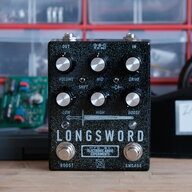
New 0xEAE Bass Driver

After doing some more extensive A/B’ing between the two yesterday I’ve come back around to finding the Bass Driver more appealing to the ears overall. Seems like it’s “quieter” and less prone to hissy interference noise in comparison to the Greathammer when the Gain and Attack are pushed high. Cleaner Grind.

I’m not one to usually care about this sort of thing (they’re gnarly dirt circuits lol) but the difference is substantial and worth pointing out. I’m not sure of how test this or if it is even the case but perhaps the enclosure / construction of the Driver itself could have something to do with what I’m hearing.

And while having the Hammer’s external + extra toggle (down) option is rad, I find myself keeping the toggle UP, which is the default setting of the Driver.

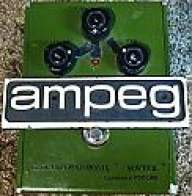
It’s been said by a few already that the Rusty is still top dog and if we’re turning comparison into competition then sure, the Rusty reigns supreme IMO. It handles more like an actual preamp IMO. John at EAE knocked these pedals out of the dang park though and I’m glad to see them exist.

As an aside I’m currently neck deep in a Music Man bass journey where all of my instruments sound better just played clean into my boosted to holy Hell 400RB. So I dunno lol. I might just buy another Rusty Box and call it a day.
 
IMG_9873.jpeg
 
I didn't play enough with the Greathammer and Bass Driver to be certain, but turning the setting intuitively, I still think the old model Rusty Box cuts through better through the mix.

I placed the Bass Driver and Greathammer last in chain, in lieu of the Rusty, and I still prefer the Rusty Box's own boost, and also thought it handled being fed by other dirt better (using Mastotron, BB Preamp and ssbs mini).

I think the Greathammer and Bass Driver would however shine in a very light pedal setup as a single dirt pedal for example. Don't get me wrong, I'm keeping them all :)

Did you guys figure out exactly how the 3-way toggle acts exactly?
Not confirmed, but I suspect it is just taking the place of the Mid control from the TS50B with 3 fixed values. The Mid from the original amp functions pretty similar to a Fender tonestack where it basically is only capable of cutting mids and is somewhat interactive (which seems in line with the post above, when you cut Mid the frequency of the center frequency of the mid notch drops with a typical passive EQ tonestack).
 
After doing some more extensive A/B’ing between the two yesterday I’ve come back around to finding the Bass Driver more appealing to the ears overall. Seems like it’s “quieter” and less prone to hissy interference noise in comparison to the Greathammer when the Gain and Attack are pushed high. Cleaner Grind.

I’m not one to usually care about this sort of thing (they’re gnarly dirt circuits lol) but the difference is substantial and worth pointing out. I’m not sure of how test this or if it is even the case but perhaps the enclosure / construction of the Driver itself could have something to do with what I’m hearing.

And while having the Hammer’s external + extra toggle (down) option is rad, I find myself keeping the toggle UP, which is the default setting of the Driver.

It’s been said by a few already that the Rusty is still top dog and if we’re turning comparison into competition then sure, the Rusty reigns supreme IMO. It handles more like an actual preamp IMO. John at EAE knocked these pedals out of the dang park though and I’m glad to see them exist.

As an aside I’m currently neck deep in a Music Man bass journey where all of my instruments sound better just played clean into my boosted to holy Hell 400RB. So I dunno lol. I might just buy another Rusty Box and call it a day.
My Greathammer is not as quiet as the BD at home, but it’s acceptable. At my friend’s house it was fairly noisy, but that’s just the power in his house. Still not an issue for me.
 
  • Like
Reactions: cataract
After doing some more extensive A/B’ing between the two yesterday I’ve come back around to finding the Bass Driver more appealing to the ears overall. Seems like it’s “quieter” and less prone to hissy interference noise in comparison to the Greathammer when the Gain and Attack are pushed high. Cleaner Grind.

I’m not one to usually care about this sort of thing (they’re gnarly dirt circuits lol) but the difference is substantial and worth pointing out. I’m not sure of how test this or if it is even the case but perhaps the enclosure / construction of the Driver itself could have something to do with what I’m hearing.

And while having the Hammer’s external + extra toggle (down) option is rad, I find myself keeping the toggle UP, which is the default setting of the Driver.

It’s been said by a few already that the Rusty is still top dog and if we’re turning comparison into competition then sure, the Rusty reigns supreme IMO. It handles more like an actual preamp IMO. John at EAE knocked these pedals out of the dang park though and I’m glad to see them exist.

As an aside I’m currently neck deep in a Music Man bass journey where all of my instruments sound better just played clean into my boosted to holy Hell 400RB. So I dunno lol. I might just buy another Rusty Box and call it a day.

A typical pedal enclosure should be plenty for high-frequency shielding (just a single layer of copper tape is plenty for high-frequency noise, extra layers wouldn't have any additional effect), assuming the enclosure itself is actually grounded (would be crazy if it wasn't, but I've had a few mass manufactured pedals that weren't including a DOD pedal!)
 
I'm a broken record on this thread, but for context, I'm coming from years of using a 9V Rusty Box on low gain setting with a Damntion Loop Blender. This has been my main, always-on tone for a long while. (Using an MIA Jazz with rounds, FWIW.)

I really dig the simplicity and alternative approach that the Greathammer offers. I feel like quickly dialing in usable tones is very intuitive with the GH, and I appreciate being able to goose the lows as needed, which can be more of a balancing act (or compromise at times?) with a standalone RB. I also really like the moderate-to-heavily-distorted tones I can dial in with the GH. Maybe it's just me, but the noise floor seems lower than the RB at high gain settings on the GH, and the attack knob is very nicely voiced.

That said, I think the RB is still my preference and significantly more versatile for lower-gain and fairly subtle grindy tones. There's also something about the mid voicing on the RB that just punches exactly where I want it to on my jazz basses. This is kind of nuanced, but the 'punch zone' of the RB the way I dial it in is super balanced up and down the neck. With a lot of drive pedals, I'll dial the punch/feel in for what I want in first and second position, and then it's unbalanced as I move up the neck (either it gets boomy or starts too sound too thin). The RB is very even in this regard. The GH isn't out of balance by any means, but I think the RB has the edge here. On that note, there's a pretty significant low gain range on the RB where the lowest range of notes stay pretty clean and punchy. My pickups aren't notably hot, but I'm getting a little breakup on the open E and D, even with the gain at minimum settings on the GH. I realize this isn't necessarily a selling point for everyone, since the TS50B is known for more breakup.

Stacking - forgot to mention this. My main super-chunky tone is a DG Alpha Omicron into the RB. I dialed in the GH to approximate my RB/Bloop combo and A/B'ed them with Alpha Omicron hitting each. The attack setting on GH needed to try and roughly match my RB was a little too harsh for my tastes once I kicked on the AO. So if I dial in the GH to where I want it when the AO is stacked into it, it's a little darker than I'd like when I am using it on its own. I'm still toying around with finding a sweet spot that suits both scenarios, but I prefer the RB for versatility here.

To end on a positive, I love how interactive the GH is when shifting the mid-switch. It's kind of like having three pedals in one, since the mid voicings really change how the breakup, lows, and high end sound. I'm also finding that you can still get some healthy midrange punch in the scooped mid settings by rolling the bass back and boosting the level. In general, the GH sounds fantastic, and it's making me kind of rethink a circuit that I was very familiar with coming in. As always, EAE makes excellent stuff and seems to always bring something unique when they pay homage to a classic circuit.
 
Last edited:
  • Like
Reactions: kazuhank
Hey folks! Been a while since I dusted off this account.

Very grateful for the interest in the Greathammer and thoughtful comments thus far. I think everything we make has utility on bass, but I'm also glad we got to make something bass-specific.

If you want to learn about what we kept and did not keep from the TS50B, the manual is a good place to start. The Attack knob is all that's left of the original Treble/Bass controls—it's basically the Treble control with a wider range. We fixed the midrange notch filter into 3 toggle positions because I didn't want to use a mini pot.

Also, the Greathammer does have a hair more gain than the Bass Driver. Partly because we juiced up the tri-comp a few dB. Both have significantly more gain than the Rusty Box. I'm not sure how that pedal does its boost, but we basically took the brakes off the original Traynor design and rounded up.

As for noise: the noise floor is mostly due to the idiosyncratic gain staging of the TS50B circuit, the aggressive treble boost, and the drawbacks of the TL072. I love the 072 (its phase reversal distortion contributes to the sound of this preamp at high gain) but it's not exactly quiet. Plus the voicing means any noise problems upstream are really brought to the forefront.

The Greathammer and 0xEAE Bass Driver noise floors measure within a dB on our audio analyzer with a Cioks DC10 and a lab power supply. It comes in around -55dB with all knobs cranked (which, I should note, is loud to the point of absurdity). This is pretty comparable to other high-gain overdrives. With really dynamic pedals the extra output means you can get high volume at cleaner settings, but the gained-up settings can be downright scary!

With different setups, YMMV. There's nothing particularly unique about the grounding scheme in either pedal, both have 4-layer PCBs and a robust chassis ground via the top jacks. If any particular brand of power supply is causing problems that is helpful information to send our way so we can improve in the future.

One of our engineers has a 9V Rusty Box and just for the hell of it I put them both on the analyzer for a noise test. The RMS noise floor integrated from 20-20kHz measures comparably when the pedals are dialed in to sound the same, within about 2dB. I don't think that's particularly surprising. Any differences beyond that would depend on voicing and EQ choices. Subjectively, the Rusty Box seemed more noisy at low gain compared to the Greathammer, which I thought was interesting.

I made a point to avoid the Rusty Box during development of the Bass Driver and Greathammer. That pedal is an icon, and we weren't seeking to dethrone it or anything like that. Instead I wanted to riff on the TS50 circuit in a way that felt meaningful and had stylistic continuity with our other pedals.

Anyway, thanks for your time and interest!

Got a few random responses below:
With that issue out of the way, the pedals are more different from each other than I thought. The Greathammer stayed cleaner earlier in the gain sweep like before, but also has a higher ceiling, topping out a bit shy of fuzz territory and sound smoother and thicker overall. The Halberd gets hairy faster, but never really gets past overdrive. Both the gain ceilings and the clipping character sounded much more similar on the main board, so I think the Elementary might be covering up those differences (might be time to try some lower-gain tubes). Both have tons of headroom and respond well to your finger/pick attack.

I mentioned the tone controls behaving differently, which is true, but the Greathammer has much more low end on tap if you boost the bass. The toggle switches on each obviously do very different things. The attack controls feel more or less the same.
Stoked that folks are enjoying the Halberd on bass! Architecturally they're quite different but I think they can fill a similar niche in some setups.
Spent several hours playing yesterday. Halberd into Greathammer. Good combo.
Halberd eats low end though on 2 of 3 switch positions. I don’t use it alone though. I use greathammer as always on, and halberd to push it.
I also have a Glaive, but I don’t like it on bass that much, so it’s out of picture for now.

Well, this IS the sound I was after. (Note: i play only nps or pure nickel strings, I hate SS, so it’s harder to achieve that sound for me).

It can get very heavy and nasty (yet pleasant to the ear unlike Darkglass tone). But it’s pretty clean, JC/Tool like with low gain.
Previously I used blend-rat-glue-compressor into BDDI to get similar sound, but it was still quite different.

What’s really different is dynamics. Just reacts so nicely to my playing, pick or fingerstyle, like a real amp. A nice clang without annoying clank as I call it.

Preamp search is over for now. Still experimenting with different boosts into it and board placement, but so far it sounds best as a last pedal before time/chorus effects to me.View attachment 7426303
This pedalboard is so nice! The empress paraEQ and comp are great choices, I think they're totally crushing it on the utility front.
I didn't know i needed the Greathammer but it's absolutely never coming off my board.
Mine arrived with a rattle inside the box, anyone else? It seems to work perfectly despite this.

Also, i'm not sure how to tackle gain stacking. I would love to use the dagger, but i find that it sucks the low-end too much, compared to the GH. I would ideally like the Dagger to be low drive, and GH to be high gain. Does it make a difference if i place the dagger before the GH?
The rattle might be a spring inside the footswitch. If you ever have any concerns on the QC front, please email us and we'll be happy to help.
After doing some more extensive A/B’ing between the two yesterday I’ve come back around to finding the Bass Driver more appealing to the ears overall. Seems like it’s “quieter” and less prone to hissy interference noise in comparison to the Greathammer when the Gain and Attack are pushed high. Cleaner Grind.

I’m not one to usually care about this sort of thing (they’re gnarly dirt circuits lol) but the difference is substantial and worth pointing out. I’m not sure of how test this or if it is even the case but perhaps the enclosure / construction of the Driver itself could have something to do with what I’m hearing.
This is interesting—we A/B tested the Greathammer and Bass Driver pretty extensively during development. It's possible your Bass Driver is on some end of a tolerance stackup that's working better for you. Those sliders had much wider tolerances than the pots we normally use.
 
I made a point to avoid the Rusty Box during development of the Bass Driver and Greathammer. That pedal is an icon, and we weren't seeking to dethrone it or anything like that. Instead I wanted to riff on the TS50 circuit in a way that felt meaningful and had stylistic continuity with our other pedals.

Awesome work, dude - this thing is sweet, and I think this comment kind of crystalized how I was reframing my brain over the last week with the Greathammer. My instinct is always, 'these circuits are similar - lets see if they can sound identical'. In reality, that outlook from builders, musicians, and artists more generally, would just yield clones and stall progress. Doing your own inspired take on a thing is a much more interesting approach, and the Greathammer feels like a new entry into this realm - rather than a clone of what's already available. Excited to keep exploring this pedal and see what other cool ways it might fit into my setup...
 
Hey folks! Been a while since I dusted off this account.

Very grateful for the interest in the Greathammer and thoughtful comments thus far. I think everything we make has utility on bass, but I'm also glad we got to make something bass-specific.

If you want to learn about what we kept and did not keep from the TS50B, the manual is a good place to start. The Attack knob is all that's left of the original Treble/Bass controls—it's basically the Treble control with a wider range. We fixed the midrange notch filter into 3 toggle positions because I didn't want to use a mini pot.

Also, the Greathammer does have a hair more gain than the Bass Driver. Partly because we juiced up the tri-comp a few dB. Both have significantly more gain than the Rusty Box. I'm not sure how that pedal does its boost, but we basically took the brakes off the original Traynor design and rounded up.

As for noise: the noise floor is mostly due to the idiosyncratic gain staging of the TS50B circuit, the aggressive treble boost, and the drawbacks of the TL072. I love the 072 (its phase reversal distortion contributes to the sound of this preamp at high gain) but it's not exactly quiet. Plus the voicing means any noise problems upstream are really brought to the forefront.

The Greathammer and 0xEAE Bass Driver noise floors measure within a dB on our audio analyzer with a Cioks DC10 and a lab power supply. It comes in around -55dB with all knobs cranked (which, I should note, is loud to the point of absurdity). This is pretty comparable to other high-gain overdrives. With really dynamic pedals the extra output means you can get high volume at cleaner settings, but the gained-up settings can be downright scary!

With different setups, YMMV. There's nothing particularly unique about the grounding scheme in either pedal, both have 4-layer PCBs and a robust chassis ground via the top jacks. If any particular brand of power supply is causing problems that is helpful information to send our way so we can improve in the future.

One of our engineers has a 9V Rusty Box and just for the hell of it I put them both on the analyzer for a noise test. The RMS noise floor integrated from 20-20kHz measures comparably when the pedals are dialed in to sound the same, within about 2dB. I don't think that's particularly surprising. Any differences beyond that would depend on voicing and EQ choices. Subjectively, the Rusty Box seemed more noisy at low gain compared to the Greathammer, which I thought was interesting.

I made a point to avoid the Rusty Box during development of the Bass Driver and Greathammer. That pedal is an icon, and we weren't seeking to dethrone it or anything like that. Instead I wanted to riff on the TS50 circuit in a way that felt meaningful and had stylistic continuity with our other pedals.

Anyway, thanks for your time and interest!

Got a few random responses below:

Stoked that folks are enjoying the Halberd on bass! Architecturally they're quite different but I think they can fill a similar niche in some setups.

This pedalboard is so nice! The empress paraEQ and comp are great choices, I think they're totally crushing it on the utility front.

The rattle might be a spring inside the footswitch. If you ever have any concerns on the QC front, please email us and we'll be happy to help.

This is interesting—we A/B tested the Greathammer and Bass Driver pretty extensively during development. It's possible your Bass Driver is on some end of a tolerance stackup that's working better for you. Those sliders had much wider tolerances than the pots we normally use.
I love when manufacturers chime in here! Great info, and matches my suspicions. Did you just leave the original TS50B “Bass” control parameters essentially fixed at minimum or a different setting with resistors or some other way of dealing with tuning that part of the circuit?

Awesome work, dude - this thing is sweet, and I think this comment kind of crystalized how I was reframing my brain over the last week with the Greathammer. My instinct is always, 'these circuits are similar - let’s see if they can sound identical'. In reality, that outlook from builders, musicians, and artists more generally, would just yield clones and stall progress. Doing your own inspired take on a thing is a much more interesting approach, and the Greathammer feels like a new entry into this realm - rather than a clone of what's already available. Excited to keep exploring this pedal and see what other cool ways it might fit into my setup...
It can be hard not to have familiarity bias when you have heard a certain something a certain way for so long for sure. I tend to use pretty “voiced” pedals as well and often have the same issue when trying something new unless I try to consciously avoid direct comparisons when initially dialing things in- that way you can focus on dialing the new thing in to the best of its abilities rather than trying to match the limitations of something else (and in many cases your ears will grow used to or even come to prefer the new thing if you let them!). Of course you must let the mix decide ultimately!
That said, it sounds like the Attack control has more on tap than the Rusty and the Notch should match settings on the original Mid control, plus both of these come before the main part of the clipping circuit, so you might try different settings there to decrease the gain when the Gain control is all the way down.
 
Last edited:
Good. It wasn't just me. They were both tight but one more than the other. It performed pretty well at practice tonight, so it may not be moving any time soon.
This is something that comes up periodically, but the jacks loosen pretty quickly over time.

I love when manufacturers chime in here! Great info, and matches my suspicions. Did you just leave the original TS50B “Bass” control parameters essentially fixed at minimum or a different setting with resistors or some other way of dealing with tuning that part of the circuit?
If memory serves, we left the original Bass control more or less at max. But there are lots of other factors at play, especially with a fixed version of the TS50B boost circuit which also cuts lows.
 
I’ve listed my Greathammer in the classifieds if anyone’s interested. I’m set with the OxEAE Bass Driver + Boost combo. Thought about holding on to it but figured it’d be a shame to keep this one sitting in its box here. Might throw down the coin for a Fuzz to complete the Trio hehehe
Edit: and it’s sold! That was quick.
 
Last edited:
I had a chance to try the Greathammer in a band context on Monday, and it rules! It was very easy to dial in and kind of hard to get a bad sound out of it. Way easier to get "my sound" out if it than the Rusty or other TS50B-based pedals I have tried. I was checking out some other new drives, but just kept going back to the Greathammer.