• TalkBass has been independent since 1998. Add your voice.
    Create a free account to reply to discussions, view embedded media, and browse with fewer display ads.
    Join freeLog in
    Want zero display ads or expanded classifieds tools? Compare plans.

New Amp Day - Hilgen Basso Grande B2503

dougazbass

Supporting Member
May 6, 2011
957
220
Mesa, AZ
Picked this up today and thought that I would share to see if anyone else is familiar. 1960s Tube Bass amp. Cab as 2 12" speakers. Looks never to have been worked on. I cleaned it up a bit. Missing two knobs.
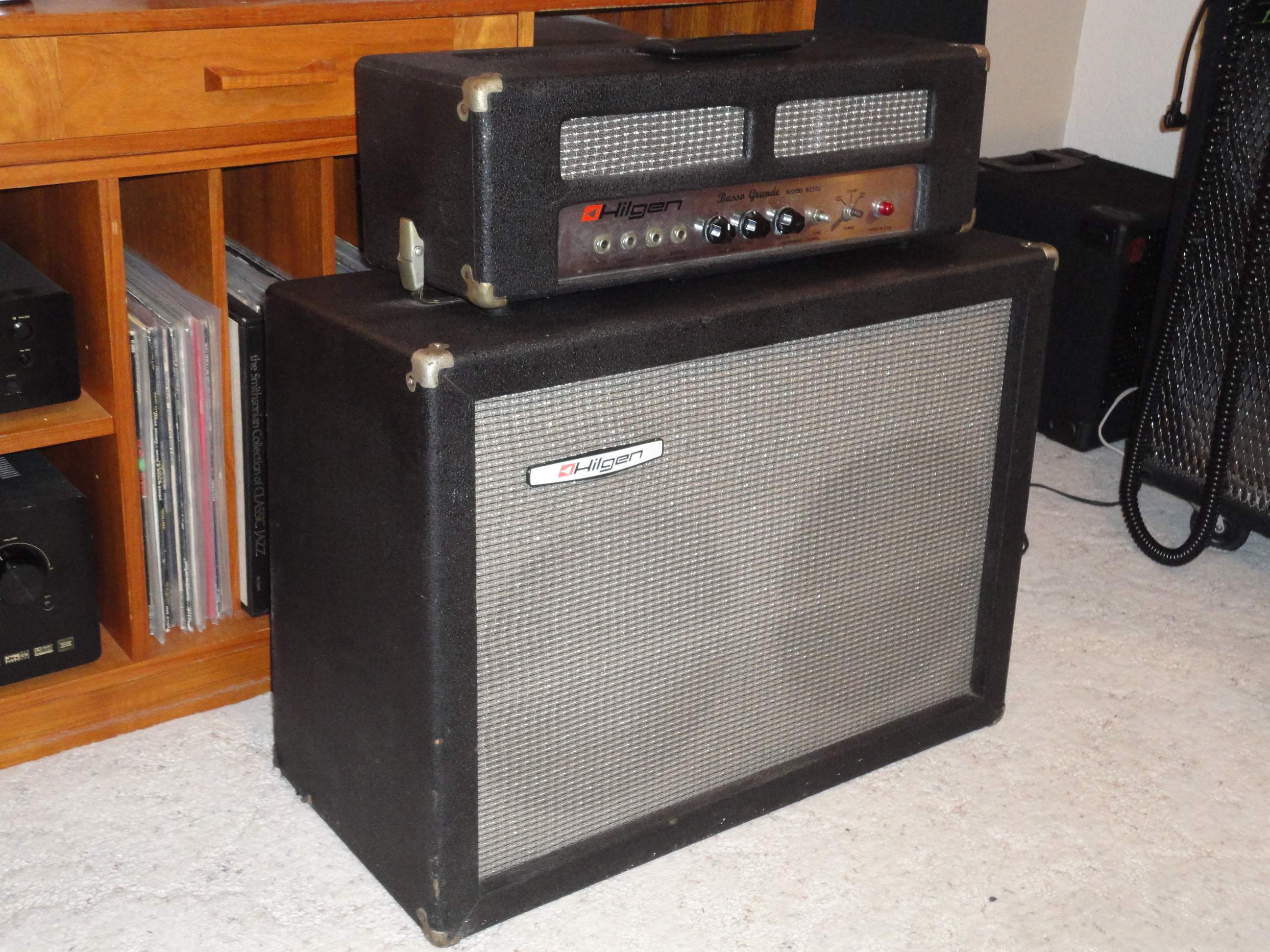
DSC08130.JPG
DSC08133.JPG
 
  • Like
Reactions: Stealth Fighter
Lonely place being a Hilgen owner, but I like this amp and cab. Needs a little love. Sounds very real or like it is a very accurate representation of what the guitar is putting out. Very simple, of course compared to new amps. Four separate inputs for different sounds with a volume and tone knob for each. Has a slight hum. Might benefit from a ground plug and a filter cap change. I plan on looking into that. I am not real knowledgeable about amps. Maybe I will learn on this one.
I guess that I just enjoy vintage stuff. Not as much love for vintage amps as guitars, I think. Except for a select few.
It looks like Hilgen only existed for 3 years. USA hand made old school stuff.
DSC08135.JPG
DSC08136.JPG
 
I think it is supposed to be 40 watt. I have no idea which tubes the "output" tubes are. One tube made in Great Briton, 2 in USA and 2 small one in Holland. Pretty funky stuff inside, but nothing looks fried or bulged out.
DSC08138.JPG
DSC08139.JPG
DSC08140.JPG
 
Reading further down on the page...

The wattages reported for the amplifiers are "peak power," as was common in the 60's. Because "peak power" denotes the maximum amount of power an amplifier can possibly handle for an instant without damage, it exaggerates by about 30% the amplification power produced under typical operating conditions. In 1974 the Federal Trade Commission issued a rule requiring that amplification be expressed as "continuous" or "RMS" power, which basically represents the maximum output of the amplifier before total harmonic distortion exceeds 2%. The rule is found at 16 CFR Part 432. It's interesting if you are a geek. To convert peak power to approximate RMS power, multiply the peak power figure by .707. Thus the Hilgen guitar amps ranged from about 18 watts RMS for the Troubador and Challenger to 53 watts RMS for the most powerful of the line, the Swingaway.

So you probably hit it just right B-string.
 
  • Like
Reactions: B-string