• TalkBass has been independent since 1998. Add your voice.
    Create a free account to reply to discussions, view embedded media, and browse with fewer display ads.
    Join freeLog in
    Want zero display ads or expanded classifieds tools? Compare plans.

New player looking for strings to help with full warm sound

4stringdave suggestion of Fender 9050 is a good starting point. LaBella flats are excellent too. Many others. Basically try a few, make sure they are broken in before you decide they aren't for you, and if taken off, label and save for later. There was a thread a few days ago asking about flats that would be worth checking.

Oh ya, and if a 2x2 headstock don't cut the strings ends if just trying so they will fit an inline headstock later. I said bad words about my logic the other day on some Ti flats that I cut and the G would not reach the G on a Fender.

 
A T-40 was my main bass for years my 1st real Bass. I played SS Roto's & GHS Boomers I'm not a flats is king guy.
If I was going to use my T-40 it would get a good set of Nickle rounds Dean Markley or Ernie Ball Slinky's.
Flats is not the be all and end all for an authentic 70's/80's tone many of the popular players of that era used SS strings.
 
Last edited:
I will stick with these flats for now and work on other things. It does not sound bad by any means just not quite where I was targetting, but much could be the settings and techniques mentioned.

just chiming in again to say there is no wrong answer, anything you try will be interesting and give you experience. The T40 can cop a Ray sound, a P sound and a bunch of funky out of phase sounds and the Tone Controls are Unique. Are you aware of what positions of the control equals different pickup configurations?
I forget the details, but the info is out there.
This is my favorite T40 tone in historical recording

Yeah it definitely has lot of options for configuration, some of it at the sacrifice of tone adjustment with how it spin-a-splits the pickups with the tone knobs. There is a bit of info out there about converting that pickup selection to push/pull pots which gains back full range of tone control, but another thread topic and one I have been researching. :-p
 

Attachments

  • GEFCvEP.jpeg
    GEFCvEP.jpeg
    1.5 MB · Views: 21
I can’t imagine being so wrong.
I'm not saying you can't hear a difference between flats, tapes and roundwounds, but that's about it. They feel different, and different gauges will sound ever so slightly different. When you hear an A/B, especially in a mix, you can't hear the difference.
The question was what kind of strings people would suggest, and I don't think it's a good idea to just suggest a string brand saying: "this is the best, I've been using that for the past 30 years!!!!!11!!1!1!". I know people want an easy way out, and I know people really love to justify their purchases, but it's just not that easy. It's so incredibly subjective in fact, that one person could suggest a string brand, OP purchases that string brand, and feels so uncomfortable playing it, that he will assume they just sound awful.
There's nothing wrong at all with the suggestion to just test different string brands, and with the fact that the best way to get warm sounding strings, is to just play them, because they will lose their brightness as they become dirty essentially. Which doesn't make them actually warmer sounding, but rather make them less top endy, which makes it seem like they sound warmer and basically acts like a little filter.

If you still disagree with anything I said, I would really appreciate if you gave me some sort of reasoning, instead of just saying "I can't imagine being so wrong.", because that does literally nothing in changing my mind, or helping the OP. All that does is aggravate me, which might actually be your goal.
 
If you are looking for a flat that sounds like a flat but can still rock when you need them to, Rotosound RS77 Monel Flats are great... I have my P-Basses strung with them and that would be my go to for what you describe.
 
welcome to bass, OP. My first bass was also a T40, though I have long since moved on. Not that the T40 should be seen as a stepping stone, it's a pro level instrument and should never let you down. Two things I want to bring to your attention, one is the tone knob pickup split thing... I ended up particularly liking it. Not just for it's utility, but also for it's uniqueness. It's part of the charm. The other thing to know is that when you change strings ont the T40, be mindful of the string length. Some set marked as "long scale" might not fit the T40 as the bridge is a bit odd. D'addario chromes for example end up with the silks on the nut.

As mentioned above, welcome to a life of tone chasing. Hope you never find what you are looking for, and hope you learn to enjoy the adventure.
 
In my experience, strings make the biggest difference of any piece of music gear....
I would argue that the speaker cabs have a considerably bigger impact on the overall sound. Afterall, a speaker is basically just a very complex filter. More so than most amps and the strings. The pickups are just picking up how fast and in what kind of way the strings vibrate back and forth. The disruption of the magnetic field of the pickups makes the sound. Potentially a bigger mass in strings would create more disturbance, meaning potentially different output? But I don't know too much about that. I just know that all the strings vibrations is very very similar. And in my experience having done no research at all the first couple years, basically just testing different strings with different gauges on the exact same bass, with the exact same amp, would result in no considerable difference.
 
  • Like
Reactions: 4StringDave
I would argue that the speaker cabs have a considerably bigger impact on the overall sound. Afterall, a speaker is basically just a very complex filter. More so than most amps and the strings. The pickups are just picking up how fast and in what kind of way the strings vibrate back and forth. The disruption of the magnetic field of the pickups makes the sound. Potentially a bigger mass in strings would create more disturbance, meaning potentially different output? But I don't know too much about that. I just know that all the strings vibrations is very very similar. And in my experience having done no research at all the first couple years, basically just testing different strings with different gauges on the exact same bass, with the exact same amp, would result in no considerable difference.
I agree that the cab makes a huge difference too, depending on how it's voiced. For me though, the switch from rounds to flats was the one change that transformed my sound in the right direction, more than anything else. The difference between two sets of SS rounds might be slight, but noticeable, but the difference between those and flats is huge in terms of attack, sustain, tone and feel.
 
  • Like
Reactions: Fynn
I would argue that the speaker cabs have a considerably bigger impact on the overall sound. Afterall, a speaker is basically just a very complex filter. More so than most amps and the strings. The pickups are just picking up how fast and in what kind of way the strings vibrate back and forth. The disruption of the magnetic field of the pickups makes the sound. Potentially a bigger mass in strings would create more disturbance, meaning potentially different output? But I don't know too much about that. I just know that all the strings vibrations is very very similar. And in my experience having done no research at all the first couple years, basically just testing different strings with different gauges on the exact same bass, with the exact same amp, would result in no considerable difference.

Having played bass now for 27 years, I can tell you that the amp should not fully dictate the sound you get. Before you ever plug that bass into an amp, the tone/sound starts with your fingers, string choice, and how it all interacts. It's wire and wood even before it's plugged in. I always encourage that people listen to what their bass sounds like going direct to a mixing board, in headphones and/or proper studio monitors, to know exactly what it sounds like independent of an amp. Get that sound in your head. Listen to what the bass sounds like UNPLUGGED even. THEN you can decide what needs to be adjusted on the amp, if anything. You will definitely notice differences in string types even acoustically. Yes, the amp itself is a 'filter' and each one will sound a bit different, but after a while you learn what needs to be cut/boosted in a given situation.... and you can make pretty much any amp work.
 
New player here. I like and plan to learn lot of Eagles, Earth Wind & Fire, Fleetwood Mac, 70's classic rock and the like. They all tend to have what I consider a full, round, warm bass tone to them, maybe what people refer to as dark? I know T. Schmidt uses Jazz bass for the most part. J McVie has used J and P basses.

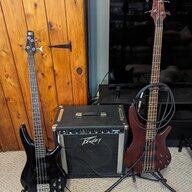
GAS has hit a bit and already have 2 basses; 1980 T-40 & 2009 Ibanez SR500.
I am hoping to get one of them to sound similar to the above artists and others of that era. I know I should just get a J, JP or P bass, but I have what I have for now.

The SR500 is pretty modern and aggressive sounding to my ear and should be a great fit for my other taste in hard rock/metal genres. It has a nice hard hitting sound to it as is. It has round wounds that are in good shape and good sound so I want to leave it alone.

The T-40 however is supposed to be the chameleon of basses and it has visibly worn flatwounds that need to be replaced. So I was thinking of changing strings to help it fill the classic rock niche. I am wondering what strings folks would recommend to help take some of the highs out and warm up the sound a bit. I was thinking tape wounds maybe? I have ready they are warmer/darker, last a long time and lighter tension might also help me play longer with my untrained fingers?
Daddario chromes