• TalkBass has been independent since 1998. Add your voice.
    Create a free account to reply to discussions, view embedded media, and browse with fewer display ads.
    Join freeLog in
    Want zero display ads or expanded classifieds tools? Compare plans.

Double Bass New Pre-amp for Blending Mic and Piezzo

Rick,
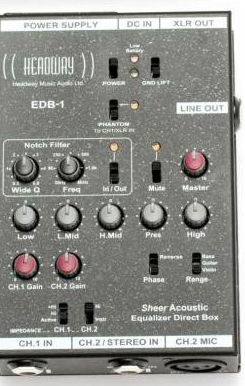
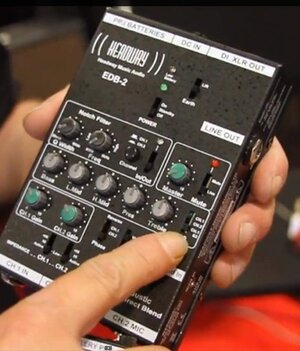
Here's a picture of the Headway EDB-2from the summer NAMM show in Nashville alongside the EDB-1. There are many nice improvements, such as a mute, Channel assign switch for the Notch Filter and 5 Band EQ section and a iPod input.

Ric
 

Attachments

  • Headway EDB-2.jpg
    Headway EDB-2.jpg
    95.9 KB · Views: 140
  • Headway EDB-1.png
    Headway EDB-1.png
    139.9 KB · Views: 132
This unit seems like it would be a great tool for mixing a mic and a pickup.

I have the Acoustic Image Series III Coda with 2 channels which I use in all of my gigs precisely to do that, mix pickup and mic, and it works really nicely.

Would there be any difference in using the AI or this Abox? What could be the potential benefits from using the Abox? Maybe in bigger venues? with bigger amps? or...
 
I have sort of a hierarchy going as far as optimum tone/needed volume is concerned. Best sound by far and easiest setup is playing acoustically, but the conditions have to be right for it.

This is exactly the direction I'm heading. I'm hoping to build one modular system to cover all these situations rather than run different rigs. Sometimes you don't know what a room is going to be like until you get there. The system will need mic inputs with phantom power, flexible EQ, plenty of power and I'm now convinced elevating a reasonably flat sounding speaker is the key to using a mic on louder gigs.

I can't tell you how many times I've brought my small amp to the gig only to leave it sitting there unplugged. Guess I'm not brave enough to leave the house without at least my GK MB150.
 
I have sort of a hierarchy going as far as optimum tone/needed volume is concerned. Best sound by far and easiest setup is playing acoustically,but the conditions have to be right for it. I could say that about every one of these setups though...
Next is mic only, whether through a bass amp, a QSC K10, or the P.A.
Louder than that I add a pickup to the mix, and sometimes swap the mic for the Ehrlund pickup. The Ehrlund will go louder with less bleed than the mic while most agree still keeping a mic like feel to the sound.

I played a quiet acoustic rehearsal yesterday (even acoustic vocals) in my practice room yesterday with guitar, piano, bass and vocals (hardwood floors, vaulted ceiling). Wow - my bass, which I love anyway, sounded like a million bucks! There is a character that is so physical, so visceral, that I have really just about accepted that it can't be replicated electronically. I am still searching for the closest facsimile, though.

After rehearsal, Steve Boltchek (BOLO to you TBers) was kind enough to have me over to his house and demo his DPA 4099 on my bass thru my new Phil Jones Bass Cub. We A-B'd it with my AT Pro-35 and, at least under those circumstances and with that amp neither one of us felt there was a tremendous difference between the 2 mics. As Steve said: "That's definatedly the SOUND OF YOUR BASS" At one point with Steve playing my bass I gradually turned the volume up and down. You couldn't even tell when the mic (Pro 35) was there or not until the volume difference made it obvious.

I feel like my Lifeline PU accurately reproduces 80-90% of the sound of my bass. It's a perfectly 'fine' sound for most any gig, BUT when I am in a quiet, acoustic situation if I can get that last 10-20% of the unique sound, that's what I'm after. Apparently the best way to do that is with the mic.
 
after reading this thread and having no luck in the past blending a mic and pickup into a regular bass amp i decided to try it again with fresh ears and a different goal. so here in my house, ive had some success. im not relying on the mic for most of my sound like i always wanted to in the past. id say that the pickup is doing 90% of the work and the mic is providing that little bit of "air" to the sound on top that gives it a very acoustic quality, even though most of the sound is from the pickup. also im using a very low output dynamic mic. all the condensers ive tried (and im a dps endorser) feedback too easily. the low output dynamic seems to be the best so far
 
all the condensers ive tried (and im a dps endorser) feedback too easily. the low output dynamic seems to be the best so far

Steve,

What amp are you playing through and is it on the floor or elevated?

Many posters have commented that once they elevated their speaker the feedback issue largely disappeared. If you can't elevate the speaker at least play with the placement relative to your bass/mic (I imagine you've already done this).

Just as an aside, I asked my buddy to bring his AI amp to rehearsal one day. We were playing very quietly in the dining room of the house (with hardwood floors). My mic started to feedback almost immediately - even at low volume. I attributed this to the down-firing speaker which was doing what it's designed for - spreading the sound all around.

By contrast, I've been using my mic through my Phil Jones Bass Cub on a trio gig with NO FEEDBACK WHATSOEVER. The amp was sitting on a table the first time, and on a music stand the second time. (On advantage of a 13 pound amp is I can just lay the music stand 'table' flat and put the amp on it - I do make sure it's tightened down well first!)

The other day BOLO and I were trialing my Pro-35 mic against his DPA 4099. We were in his practice room and didn't turn the volume up much, but even with the Bass Cub on the floor we had no feedback. It's possible that because the Bass Cubs 5" speakers only go down to perhaps 80hz fundamental that it acted as it's own High Pass Filter.

You might check out the thread on the new thread "New EDB-2 and EDM-1 from Headway For Trial". These should be arriving here today or Monday and I will be posting results and impressions.

Rick
 
Great topic! After a year of the DPA,I retired it in favor of the Eurlund.Head to head the DPA sounded better,but on the gig,it is another story especially going into an amp. Each room was always diffrent.With the feed back and the dampening of the strings,(afterlengh) with the DPA,I found the EAP to be more usable.I agree the DPA,or any Mic gives that bit of air that we are all looking for. This is not to say that one day I will return to adding a Mic. For now the DPA with the combination of the Full Circle,seems to be working...For the gigs I play...
 
Just as an aside, I asked my buddy to bring his AI amp to rehearsal one day. We were playing very quietly in the dining room of the house (with hardwood floors). My mic started to feedback almost immediately - even at low volume. I attributed this to the down-firing speaker which was doing what it's designed for - spreading the sound all around.

That's an interesting observation Rick. Hard to say just what is causing that. When feedback starts to rear it's ugly head, it's always centered around a couple of frequency ranges, it may just be that the AI with your particular microphone, pickup, and bass isn't a good match.

By contrast, I've been using my mic through my Phil Jones Bass Cub on a trio gig with NO FEEDBACK WHATSOEVER. The amp was sitting on a table the first time, and on a music stand the second time. (On advantage of a 13 pound amp is I can just lay the music stand 'table' flat and put the amp on it - I do make sure it's tightened down well first!)

It's quite possible that the difference in speaker size between the BG-100 and the AI is why the Bass Cub has better feedback resistance. The dispersion of the BG-100 would be narrower than the AI, and due to the Acoustic Image down-firing 10 you can't raise it of the ground. The down-firing 12 has great presence standing right next to it, but each individual room's acoustics, really determine whether that sound gets to the audience or not.

The other day BOLO and I were trialing my Pro-35 mic against his DPA 4099. We were in his practice room and didn't turn the volume up much, but even with the Bass Cub on the floor we had no feedback. It's possible that because the Bass Cubs 5" speakers only go down to perhaps 80hz fundamental that it acted as it's own High Pass Filter.

Makes perfect sense, you may, I try to never raise my FDeck higher than 40 Hz, you're loosing quite a bit of the instruments character, even at 61 Hz with the QSC K8 there's a distinct difference.
 
The AI combo uses a down-firing 10" speaker, and you can raise it off the ground by placing it on a chair or table (as long as there's a surface to reflect the sound). You can also raise the front to decouple it from the floor.

+1 I forgot that the speaker was a 10 and not a 12. IME, the contras tend to work best when their on the floor, that may not be true for others. Just my take.

Ric
 
We got 'em in! It's a nice piece of kit, and does what it's supposed to. The EQ's are voiced well, and the phase switch (master phase, plus a "between channels" phase) is also useful for getting the best tone vs. feedback. Nicely made, power supply built in (no wall wart!) - it's a nice piece. Does everything you need, nothing you don't.

Plugged in a Realist and a DPA mic, worked a treat. We found that cutting the mids a bit on the Realist, (parametric at about 10 o'clock) and the master EQ with the bass cut a smidge (everything else flat) sounded quite good.

Should be a real contender for those wishing to blend a high-end condenser (or dynamic) mic and a pickup - though I'd be wary of using it on a ribbon mic; it doesn't look like you can turn off phantom power (which should be NBD for most dynamics, but phantom can damage most ribbons). Probably doesn't have the right gain/impedance structure to do a ribbon well anyway...