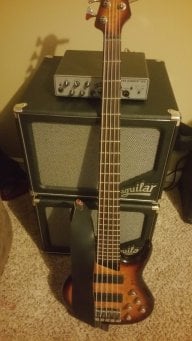
Quilter Bass Block 800 observations. I've had one for a week and a half now, have used it for bass guitar four gigs, and as a PA subwoofer amp twice. In over 50 years of playing bass, I've had many of the most normal bass amps, as well as a few screwball rigs. Since 2013 my go-to amplifier is an Aguilar Tonehammer 500. It is an excellent amp, and I absolutely love it. I use the Aguilar TH with either one or two Aguilar SL 12 cabinets. It is an ideal pairing. For the few occasions when I have to play louder, I have an Aguilar SL 410 rated at 1200 watts. On paper, this should be another step up, volume wise, but in fact it is only slightly louder. Turning the 500W solid state amp up, it simply runs out of headroom, and the lowest notes start to sound flabby. The four Aguilar 10s are very power hungry. The newest generation of SL 410 (newer than mine) uses a different, more efficient driver. The 800W Quilter addresses the power issue nicely.
Both the Aguilar and Quilter are made in the USA, and exhibit excellent build quality. This explains their fairly high price, about $600 for the Quilter, $700 for the Aguilar. Keeping the jobs in the US, and keeping the reliability built in are worth the price for me. My modern Ampeg and Fender gear is not built to their old standards. If price is your biggest concern, and you are ok with sending more dollars out of the country, TC and Mark Bass make good gear too. In my opinion, cost driven production methods in low wage counties are apt to lead to more service problems over time.
The Quilter's tone controls are conspicuously different than most contemporary bass amps. Instead of bass and treble, maybe middle, along with a graphic or semi parametric EQ, the Quilter uses just two tone controls. One knob is more or less a bass control, one a notch filter. It doesn't look like enough, but I find it very intuitive, and have no trouble at all dialing in exactly what I want to hear for any of my basses. I don't know if that would work for everybody.
It has two instrument inputs, one with a 10 DB pad, and both can be used at the same time. It has a headphone output jack, that can be used whether or not a speaker load is present. It has a mute switch. It has an XLR direct out, post EQ only. No ground lift, potentially a problem, maybe not. It has an XLR input that goes directly to the power section, bypassing the preamp. It has two 1/4 output jacks, and one speakon jack, all in parallel. One more speakon would be nice. Since these four lb. amps don't have a lot of square inches of panel space, there just isn't room for too many connections. My Aguilar has speakon outputs only. Neutrik and Switchcraft both make combination speakon-1/4 jacks. Both manufacturers ought to consider these. Maybe they have, and don't consider them sufficiently reliable. When the speakon jacks were first introduced, I was very skeptical that they were any better than phone jacks, but experience has shown that Neutrik was right.
It does not have a separate silent tuner output, which I consider a design flaw. A practical work-around is using the second input jack to send a signal to your tuner, and push the mute switch while tuning. Okay, but I would prefer a true tuner output anyway. Same as the Aguilar, the Quilter has a cooling fan. The Quilter is rated for 4 to 8 ohms speaker impedance. They say that a 2 ohm load is safe, but a poor choice. It does not have an effects loop.
Like many class D amplifiers on the market, Aguilar bundles their own preamp and housing with a Bang & Olufsen ice power module. The B & O design is a well-proven industry standard. Quilter on the other hand, is the instrument amplifier company of Patrick Quilter, the founder of QSC power amps, relied on by many big sound contractors as well as too many weekend warrior bands to count. Their products are designed in-house by a team with extensive experience working directly with musicians and sound techs. QSC's quality reputation is unmatched.
Which amp do I like better? I love them both, would feel very confident recommending either. Dollar for dollar, the Quilter is 75¢ per watt compared to the Aggie's $1.40, advantage Quilter. Since my most-used configuration is two SL12 cabinets, the TH 500's two speakon outputs are distinctly better, advantage Aguilar. For the 90% of the time that the SL 12s are adequate for the job, I will stick with the Aguilar amp. I don't know how damping factor is supposed to be expressed, but the Quilter is the tightest sounding bass amp I have heard, and together with the way the SL410 is voiced, it sounds like the Fender Dual Showman with D140Fs that I love, but orders of magnitude louder. I like the sound of this Quilter/ SL 410 combination very slightly better than the TH with the smaller speaker cabinets, but not enough to justify the extra weight and floor space. Hey, give me a break, me and my back are 65. When I really need more volume, the Quilter with the bigger, heavier cabinet gets the nod. Also, there are a lot of times, not necessarily on stage, when I simply want two inputs. Advantage Quilter.
While it seems like quite a stretch to use a Bass Block 800 with the 410 cabinet as a PA subwoofer, crossed over at 140 Hz, it is plenty strong enough to match a pair of Mackie 450s, indoors at least. Sounds very punchy, gets plenty of kick drum out there to put dancers on the floor. Don't expect a professional sound tech to give that concept any respect, but if you are on a bar band budget, it's a hell of a good way to get a lot of bang for the buck. Having several uses for this new piece of gear makes it easier to justify the expense.
Both the Aguilar and Quilter are made in the USA, and exhibit excellent build quality. This explains their fairly high price, about $600 for the Quilter, $700 for the Aguilar. Keeping the jobs in the US, and keeping the reliability built in are worth the price for me. My modern Ampeg and Fender gear is not built to their old standards. If price is your biggest concern, and you are ok with sending more dollars out of the country, TC and Mark Bass make good gear too. In my opinion, cost driven production methods in low wage counties are apt to lead to more service problems over time.
The Quilter's tone controls are conspicuously different than most contemporary bass amps. Instead of bass and treble, maybe middle, along with a graphic or semi parametric EQ, the Quilter uses just two tone controls. One knob is more or less a bass control, one a notch filter. It doesn't look like enough, but I find it very intuitive, and have no trouble at all dialing in exactly what I want to hear for any of my basses. I don't know if that would work for everybody.
It has two instrument inputs, one with a 10 DB pad, and both can be used at the same time. It has a headphone output jack, that can be used whether or not a speaker load is present. It has a mute switch. It has an XLR direct out, post EQ only. No ground lift, potentially a problem, maybe not. It has an XLR input that goes directly to the power section, bypassing the preamp. It has two 1/4 output jacks, and one speakon jack, all in parallel. One more speakon would be nice. Since these four lb. amps don't have a lot of square inches of panel space, there just isn't room for too many connections. My Aguilar has speakon outputs only. Neutrik and Switchcraft both make combination speakon-1/4 jacks. Both manufacturers ought to consider these. Maybe they have, and don't consider them sufficiently reliable. When the speakon jacks were first introduced, I was very skeptical that they were any better than phone jacks, but experience has shown that Neutrik was right.
It does not have a separate silent tuner output, which I consider a design flaw. A practical work-around is using the second input jack to send a signal to your tuner, and push the mute switch while tuning. Okay, but I would prefer a true tuner output anyway. Same as the Aguilar, the Quilter has a cooling fan. The Quilter is rated for 4 to 8 ohms speaker impedance. They say that a 2 ohm load is safe, but a poor choice. It does not have an effects loop.
Like many class D amplifiers on the market, Aguilar bundles their own preamp and housing with a Bang & Olufsen ice power module. The B & O design is a well-proven industry standard. Quilter on the other hand, is the instrument amplifier company of Patrick Quilter, the founder of QSC power amps, relied on by many big sound contractors as well as too many weekend warrior bands to count. Their products are designed in-house by a team with extensive experience working directly with musicians and sound techs. QSC's quality reputation is unmatched.
Which amp do I like better? I love them both, would feel very confident recommending either. Dollar for dollar, the Quilter is 75¢ per watt compared to the Aggie's $1.40, advantage Quilter. Since my most-used configuration is two SL12 cabinets, the TH 500's two speakon outputs are distinctly better, advantage Aguilar. For the 90% of the time that the SL 12s are adequate for the job, I will stick with the Aguilar amp. I don't know how damping factor is supposed to be expressed, but the Quilter is the tightest sounding bass amp I have heard, and together with the way the SL410 is voiced, it sounds like the Fender Dual Showman with D140Fs that I love, but orders of magnitude louder. I like the sound of this Quilter/ SL 410 combination very slightly better than the TH with the smaller speaker cabinets, but not enough to justify the extra weight and floor space. Hey, give me a break, me and my back are 65. When I really need more volume, the Quilter with the bigger, heavier cabinet gets the nod. Also, there are a lot of times, not necessarily on stage, when I simply want two inputs. Advantage Quilter.
While it seems like quite a stretch to use a Bass Block 800 with the 410 cabinet as a PA subwoofer, crossed over at 140 Hz, it is plenty strong enough to match a pair of Mackie 450s, indoors at least. Sounds very punchy, gets plenty of kick drum out there to put dancers on the floor. Don't expect a professional sound tech to give that concept any respect, but if you are on a bar band budget, it's a hell of a good way to get a lot of bang for the buck. Having several uses for this new piece of gear makes it easier to justify the expense.