• TalkBass has been independent since 1998. Add your voice.
    Create a free account to reply to discussions, view embedded media, and browse with fewer display ads.
    Join freeLog in
    Want zero display ads or expanded classifieds tools? Compare plans.

Newb question on jazz bass truss rod

Holdsg

Father of Pugs
Gold Supporting Member
Sep 10, 2009
39,457
90,302
Mesquite, NV
Is my truss rod broken? Or just maxed out?

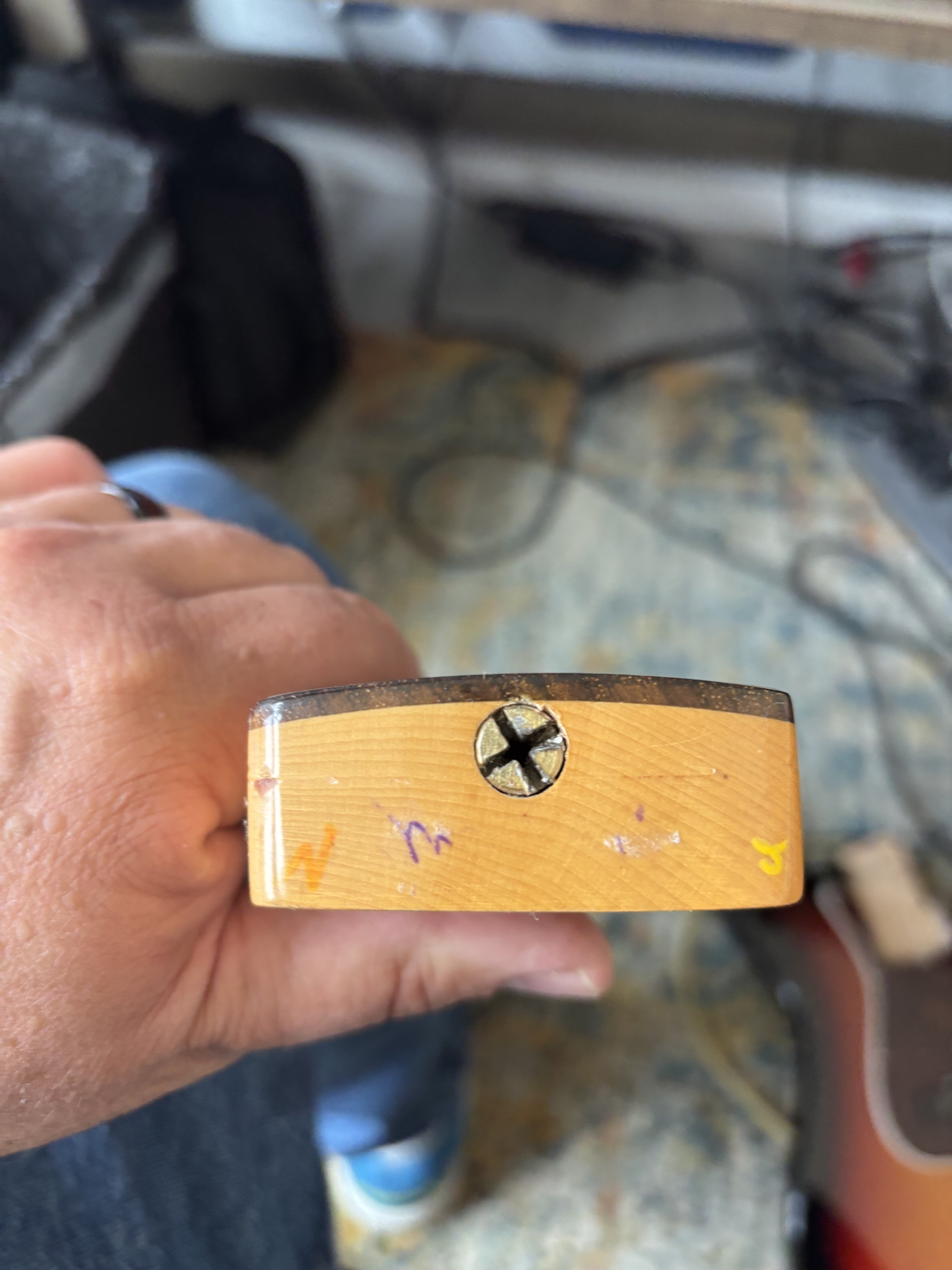
Here's the business end of the neck of my American Fender Jazz bass. When I try to turn the screw to the right (righty tighty), it moves to the right but reverts right back where we started once I let go of the screwdriver. Does this mean it is maxed out? Simply. Or should I be worried about a broken rod (which I suppose would just spin freely. It doesn't do that).

Thanks for addressing my newb question.
IMG_9849.jpeg


I'm trying to achieve a flatter fretboard. There is too much relief for my liking at present.
 
Last edited:
Is my truss rod broken? Or just maxed out?

Here's the business end of my American Fender Jazz bass. When I try to turn the screw to the right (righty righty), it moves to the right but reverts right back where we started once I let go of the screwdriver. Does this mean it is maxed out? Simply. Or should I be worried about a broken rod (which I suppose would just spin freely. It doesn't do that).

Thanks for addressing my newb question.

View attachment 7192384

I'm trying to achieve a flatter fretboard. There is too much relief for my liking at present.

If it springs back like that, it means the truss rod nut is bottomed out on the threads. You are twisting the rod, and then it springs back. Don't keep doing that, or you will break the truss rod.

If you stop now, and don't break the truss rod, you can probably fix the neck without major surgery. Have it heat-straightened by someone like Warpednecks.com, then back the truss rod nut out and put a washer or two in there under it.

If you snap the truss rod, then neck has to be cut open to replace it. Serious surgery.
 
What’s the condition of the neck with no string tension and the truss rod loose? Ideally it should be completely flat. If it’s not you might be able to make things work by manually flexing the neck into a backbow and tightening the truss rod, adding washers if needed. As Bruce said, this isn’t ideal as the truss rod isn’t supposed to fix a bowed neck, just counter string tension. If the neck is significantly bowed with the strings and truss rod loose you’d want to look at your options. They can range from leveling the frets taking the bow into account, pulling the frets, leveling the board and refretting, heat straightening, or a new neck.
 
What's the condition of the neck with no string tension and the truss rod loose? Ideally it should be completely flat. If it's not you might be able to make things work by manually flexing the neck into a backbow and tightening the truss rod, adding washers if needed. As Bruce said, this isn't ideal as the truss rod isn't supposed to fix a bowed neck, just counter string tension. If the neck is significantly bowed with the strings and truss rod loose you'd want to look at your options. They can range from leveling the frets taking the bow into account, pulling the frets, leveling the board and refretting, heat straightening, or a new neck.
Not if the threads are all used up. First things first; get the thing out of there and figure out where you need to stack some washers and/or shorten something to get some room for adjustment.
 
Do you happen to know what size of washer is used?

It's not a standard size washer. It needs to be 0.365" OD x 0.190" ID x 0.100" thick. Some of the guitar supply places sell them. Some folks have taken #8 steel washers and drilled out the hole to 3/16". When I need one for a Fender truss rod repair job, I machine it up from brass.

The important thing to understand is that your neck has already been damaged. The reason the truss rod ran out of threads is that it has already been overtightened enough that it crushed the wood inside the neck. The anchor end of the rod, back near the nut, has been crushed forward about 1/4". The whole rod has moved that far toward the heel. That's why it ran out of threads. And that still wasn't enough force to flatten the neck.

So now, if you put a washer behind the truss rod nut, the nut will be spaced back, and you'll have a few more threads available. But it won't be any stronger or be able to apply more force than before. Even if you physically bend the neck backward while tightening it. It will probably continue crushing the wood around the anchor, like it was before. And the neck may not get any straighter than it is now.

That's why I recommend that you address the real problem: The neck is warped and needs to be straightened out. Then you can put a washer under the truss rod nut and it should work okay.
 
The reason the truss rod ran out of threads is that it has already been overtightened enough that it crushed the wood inside the neck. The anchor end of the rod, back near the nut, has been crushed forward about 1/4"
I was given one in this condition. Squashed so much that the whole 1st fret area was push up. It took some wood repair and neck straightening but I got it under control. I haven't mounted it yet, soon I think.
 
update:
received the washers and set about to take the truss rod nut off (lefty loosey) and it won't turn more than 1/4 turn. Tried working it ever so gently, then it snapped. yep, nut must have seized and the truss rod is now broken. damn.
I now I have a bigger problem.

Replacing truss rod, or just get a new neck?
 
Last edited:
  • Sad
Reactions: versalog