• TalkBass has been independent since 1998. Add your voice.
    Create a free account to reply to discussions, view embedded media, and browse with fewer display ads.
    Join freeLog in
    Want zero display ads or expanded classifieds tools? Compare plans.

No open strings?

I was told when I started playing bass (many years ago)
"A good bass player never uses open strings."
I still find that odd after 37 years playing.
Any opinions on this?


This is idiotic. And it's something I have seen echoed in youtube videos from clowns that don't know anything, just want a clickbait title. Certain types of lines and/or riffs are designed around open strings. Open strings can also be good for giving your left hand a break every now and then on a long gig. Certain arpeggios in flat keys feel best using open strings. If a song uses a lot of open strings, I can play with one hand and take a drink with the other.
 
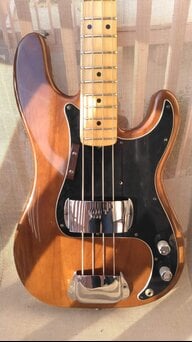
If we can't play open notes, then why do brass nuts exist?!?
Brass nuts were developed in the sustain-crazed 1970s where you couldn't have too much brass on your instrument.

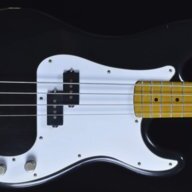
A zero fret is the solution for getting open strings to sound fretted...because they are.

Screen Shot 2023-09-04 at 5.05.44 PM.png
 
Fully utilizing the benefits of a 5er, I play no open strings.

My fifth fret takes care of what would be the open-string notes, and playing a bit higher up on the neck I enjoy the closer fret spacing, kinda like playing a short scale at times. :D

Having been doing this for many years, if I tried to play a song using open strings here and there, it would be a train wreck.

Oh, that definitely doesn't make me a good player. :D
 
Without open strings I'd never get a chance to play one handed or keep my eyes forward while playing fretless...but there will always be people that give bad advice. I've heard many talk about the poor right hand technique Geddy Lee uses.
 
Upright players use open strings all the time. When I'm playing simple R-3-5-6-oct walking patterns for 1-4-5 in F, I'll do this:

For the F chord:

F fretted (E string) index finger
A open
C fretted (A string) pinky
D open
F (octave) fretted (D string) pinky

For the Bb:

Bb fretted (A string) index finger
D open
F fretted (D string) pinky
G open
Bb (octave) fretted (G string) pinky

For the C:

C fretted (A string) pinky
E open
G fretted (E string) pinky
A open
C fretted (A string) pinky

Notice that I can play all three chords without any position change. I can use the b7 or maj7 in the chords, or play a ii-V7 turnaround without leaving position.

In addition to F, I can transpose that same 1-4-5 to A, Bb, C, D, Eb or G without position shifts if I use open strings. That's 7 out of 12 major keys. I can play other diatonic chord tones in those same keys just by adding the middle finger:

Em7:

E open
G fretted (E string) pinky
B fretted (A string) middle
D open
E (octave) fretted (D string) middle

Am7 is the same fingering shifted up to the A, D and G strings. Etc.

That's because with just those three fingers I can reach these notes in the lowest position:

E string: E, F, F#, G
A string: A, Bb, B, C
D string: D, Eb, E, F
G string: G, Ab, A, Bb

What chromatic notes are missing? Only one: C#/Db
 
Last edited:
  • Like
Reactions: Dust2Dust