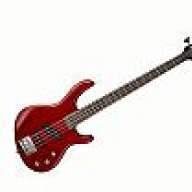
Bass Patterns based upon the Major Scale box.
Major Scale Box.
Code:
G|---2---|-------|---3---|---4---| 1st string
D|---6---|-------|---7---|---8---|
A|---3---|---4---|-------|---5---|
E|-------|---R---|-------|---2---|4th string
Have a D chord coming up in the music. Place the R of your box on a D note, 4th string - then play the R-3-5-X of the pattern on your fretboard. What's with the "X"? If you are in 4/4 time you need a forth beat, rest, or something. Yes you could play root on 1 and the 5 on the 3rd beat, but, back to the X -- an 8 would fit nicely as the 8 is just another R in the next octave. Repeat the 3 for R-3-5-3 or repeat the 5 for R-5-R-5 or R-5-8-5 and as the 6 is neutral a R-3-5-6 sounds great with major chords. Minor chord try R-b3-5-b7. Keep reading.......
Basic Chords
• Major Triad = R-3-5
• Minor Triad = R-b3-5
• Diminished Chord = R-b3-b5
7th Chords
• Maj7 = R-3-5-7
• Minor 7 = R-b3-5-b7
• Dominant 7 = R-3-5-b7
• ½ diminished = R-b3-b5-b7
• Full diminished = R-b3-b5-bb7
See a chord and play it's chord tones. As every key will have two major, one major dominant seven, three minor and one diminished chord it's a good idea to get your major, dominant, minor and diminished bass line chord tones patterns into muscle memory so when you see a chord your fingers just know what will work. Now the song may only give you enough room for the root, or root five - adapt and get as many chord tones into your bass line as needed. Root on 1 and a steady groove from the other chord tones plus something to call attention to the chord change will keep you gigging.
Scales
• Major Scale = R-2-3-4-5-6-7 Home base
• Major Pentatonic = R-2-3-5-6 Leave out the 4 & 7
• Natural Minor Scale = R-2-b3-4-5-b6-b7 Major scale with the 3, 6 & 7 flatted.
• Minor Pentatonic = R-b3-4-5-b7 Leave out the 2 & 6.
• Blues = R-b3-4-b5-5-b7 Minor pentatonic with the blue note b5 added.
• Harmonic Minor Scale = R-2-b3-4-5-b6-7 Natural minor with a natural 7.
• Melodic Minor Scale = R-2-b3-4-5-6-7 Major scale with a b3.
Let the major scale be your home base then change a few notes and you have something different. No need to memorize a zillion patterns. Let the major scale pattern be your go to pattern - then adapt/adjust from there.
Generic Notes - for your bass line.
• The root, five and eight are generic and fit most any chord. Remember the diminished has a flatted 5.
• The 3 is generic to all major chords. So R-3-5-3 will fit under any major chord.
• The b3 is generic to all minor chords. And R-b3-5-8 will fit under any minor chord. Why the 8? Well the 8 is just another root in the next octave.
• The 7 is generic to all maj7 chords. Yep, R-3-5-7 fits nicely.
• The b7 is generic to all dominant seventh and minor seventh chords. G7 = R-3-5-b7 or Gm7 = R-b3-5-b7.
• The 6 is neutral and adds color, help yourself to 6’s. Love the sound of R-3-5-6 with a major chord.
• The 2 and 4 make good passing notes. Don’t linger on them or stop on them, keep them passing.
• In making your bass line help yourself to those notes, just use them correctly.
• Roots, fives, eights and the correct 3 & 7 will play a lot of bass.
Hope that helps.