• TalkBass has been independent since 1998. Add your voice.
    Create a free account to reply to discussions, view embedded media, and browse with fewer display ads.
    Join freeLog in
    Want zero display ads or expanded classifieds tools? Compare plans.

Noob Soliciting Advice on Technique

in some bass parts, when you rake down, you end up turning the order of your plucking fingers around. For efficiency I always rake when going down, but I had to learn to be more versatile with my alternate plucking because of that. Meaning that I need to learn to groove starting with my index finger or with my middle finger equally well. That way I won't be surprised when I'm in the middle of playing and suddenly I have to play that groove starting on the other finger.
 
(please go down to the HERE'S THE QUESTION SECTION if you don't have time for the preamble)

Happy Sunday all. I've been playing (overwhelmingly electric) guitar for about 35 years and recently picked up bass in a serious way a few months back (I've been devoting 99% of my playing time on it). I'm a hobbyist only and it's been enormously rewarding. I'm still in the "newbie gains" phase which is to say, literally every time I play (I play ~45 min a day on average), I'm playing better. At this point, I'm just learning a variety of songs that interest me, generally in the rock/pop vein and not taking lessons.

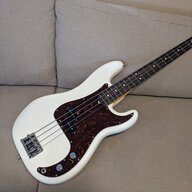
I should mention I have a p bass that currently has round wounds on it. I had some flats on it for a while as well and they were awesome, but rounds sound better for slapping so those are what I'll stick with until I get good enough to play some Jamerson.

I am playing with fingers only as I find it more satisfying that playing with a pick.

So I guess I'm a traditionalist? lol

Anyway what I've found is that, most of focus has been on my left (fretboard) hand in terms of making sure I'm using efficient fingerings. In terms of my right hand, it's just doing its thing. If I pay attention to what I'm doing, I'm generally using a floating thumb technique, playing rest strokes and only using two finger. If I have to play something above a certain speed, I will use free strokes, but I prefer the more "solid" tone and better muting that I am able to get out of rest strokes.

HERE'S THE QUESTION
=======================================
I've noticed that when I play free strokes, I strictly alternate my fingers. However, when I play rest strokes, I strictly alternate when I am ascending and switching strings but "sweep" when descending. So if I am playing a 3-note-per string descending pattern it would be m i m, m i m with rest strokes and m i m, i m i with free strokes. This is completely automatic and interestingly, although I play guitar with a pick, I do the same thing when descending there, also unconsciously. If I try to strictly alternate with rest strokes, I can literally not play a descending major scale at any tempo because I have to consciously focus on everything both hands are doing and everything gets thrown off.

So my question is, is this "normal" with free strokes vs rest strokes or should properly trained players strictly alternate regardless?

I'm aware that there are all sort of players better than I can ever hope to be who play "incorrectly" in one way or another. But all things being equal, I'd rather start off doing things the "right" way if I can.

Austin

Rake = Jamerson. He wrote the book and plucked with his index finger, known as ‘the hook”. Now, give a listen to Bernadette and just remember all those notes came from the index finger of his right hand.

Rounds and Motown. No need to switch back to flats to cover Jamerson parts. I been gigging and recording his material for over 50 years, 46 years using round wound strings exclusively. I’ve never had a band mate or a sound engineer suggest I need flat wound strings.

Technique, 45 minutes a day on technique is enough time. Like any new skill, it takes time and effort to perfect. My advice is to start a slow as you need to be smooth.

I’m sure there are some lesson books that will walk you through it. Me? No lesson books, just about a month of running scales up and down the strings over and over again for hours at a time until I figured it out.
 
  • Like
Reactions: atquinn
in some bass parts, when you rake down, you end up turning the order of your plucking fingers around. For efficiency I always rake when going down, but I had to learn to be more versatile with my alternate plucking because of that. Meaning that I need to learn to groove starting with my index finger or with my middle finger equally well. That way I won't be surprised when I'm in the middle of playing and suddenly I have to play that groove starting on the other finger.

I'm lucky in that I generally don't have problems with differences in plucking order. So when raking results in that sort of plucking finger turnaround, it doesn't bother me.

...Things I couldn’t play smoothly with raking were much smoother and better sounding with SA...

I think that might be the key. If I run into a situation like that, I'll have to be honest with myself, reevaluate my approach and take the necessary steps to remedy the problem. At this point though, I think I would probably be better off focusing my concentrated practice time on learning how to create walking basslines as there is no doubt in my mind that that will benefit me enormously going forward.
 
...At this point though, I think I would probably be better off focusing my concentrated practice time on learning how to create walking basslines as there is no doubt in my mind that that will benefit me enormously going forward.

Indeed, walking bass is very beneficial. You're constantly improvising while making sure to outline the harmony. For years, I sat in on any jazz jam I could find. In the beginning it was hard but I learned a lot.
 
  • Like
Reactions: atquinn