uh, no! doesn't matter if it is vol vol or vol blend, when a single coil is paired with a humcan it will always hum (unless it is turned down)If I were running V-V-TS perhaps, but with the blend, I expect noise-free operation. I never use a soloed bridge J in my real-world playing.

Enjoy the benefits of a premium membership!
Upgrade Account
-
TalkBass has been independent since 1998. Add your voice.
Create a free account to reply to discussions, view embedded media, and browse with fewer display ads.
Join free Log in
Want zero display ads or expanded classifieds tools? Compare plans.
You are using an out of date browser. It may not display this or other websites correctly.
You should upgrade or use an alternative browser.
You should upgrade or use an alternative browser.
Nordstrand BigRig Pickups
- Thread starter 3rdcurve
- Start date
-
- Tags
- nordstrand pickups
More options
Who Replied?
+1
Big Rig in the neck, Big Split in the bridge, full stop.
Thanks for your suggestion. Always an option going to a Big Split.
However, I feel the need to start with what Nordstrand considers a steroid injected J coil that they are very proud of...MORE of what you KNOW ya like!
(IF, 60 cycle hum is an issue with the Big Rig and a good blending control, then I think that is the way to go, too.)
IIRC; the blend control that Don has available with the Stellartone Tonestyler Bass 10 (2 pickup + 1 Tone) mixes input 80/20 @ the extremes. Not like a stereo mix control knob that is commonly used, with 100/0 Full LEFT or Full RIGHT. This would likely be sufficient to cancel 60 cycle hum in this type of wiring scenario.

The Nordstrand folks suggested the Big Split to pair with my BigRig, so that's what I have. Amazing pairing.
Do be aware, with the BigRig in series (which is how I have mine) it will slightly over power the bridge pickup. The BigRig is very big in series. It with the Big Split is brilliant though!
Do be aware, with the BigRig in series (which is how I have mine) it will slightly over power the bridge pickup. The BigRig is very big in series. It with the Big Split is brilliant though!
If one wants hum-cancelling with a Big Single (or any single coil), Audere makes (or did, last I checked) a hum-cancelling "dummy coil" of sorts, tailored to different pickups (so you have to tell them what you'll be using when you order), that can be used with their preamp. It's supposed to hum-cancel without tone loss. I don't know if it can be used solo (with some sort of buffer?) or in a passive circuit -- that'd be a question for them.
Big Rig at the neck and Big Split at the bridge sounds like a tempting pairing (and probably what I would try, for the sake of simplicity-with-hum-cancelling), but I understand the single-coil temptation, too.
Big Rig at the neck and Big Split at the bridge sounds like a tempting pairing (and probably what I would try, for the sake of simplicity-with-hum-cancelling), but I understand the single-coil temptation, too.
uh, no! doesn't matter if it is vol vol or vol blend, when a single coil is paired with a humcan it will always hum (unless it is turned down)
Q: Will a 20%+ engagement of the Big Rig in a blend potentially be sufficient to reduce to a tolerable level, any 60 cycle noise with a Big Single paired with it?
If not, what % would you expect to be sufficent? Or is a pair of Big Singles the only useable purpose of the pickup?
Single coils are designed to be run in matched pairs with opposite polarity (one forward, one reverse wound) to be hum cancelling. You can bias toward either pickup but don’t solo if you want hum free operation. A Big Rig will not provide hum cancelling for a single coil pickup. I would take maurilio’s statement at face value. He knows his stuff.
Fitting a Big Single with a dummy coil would get the job done but why. If you want Big Singles, get a pair. Otherwise the Big Rig/Big Split would be the ticket. They will have different voicing so you have to choose your flavor. You could buy both sets of pickups, try them both, and keep the ones you like better. Should be fun.
Fitting a Big Single with a dummy coil would get the job done but why. If you want Big Singles, get a pair. Otherwise the Big Rig/Big Split would be the ticket. They will have different voicing so you have to choose your flavor. You could buy both sets of pickups, try them both, and keep the ones you like better. Should be fun.
Last edited:
Single coils are designed to be run in matched pairs with opposite polarity (one forward, one reverse wound) to be hum cancelling. You can bias toward either pickup but don’t solo if you want hum free operation. A Big Rig will not provide hum cancelling for a single coil pickup. I would take maurilio’s statement at face value. He knows his stuff.
Fitting a Big Single with a dummy coil would get the job done but why. If you want Big Singles, get a pair. Otherwise the Big Rig/Big Split would be the ticket. They will have different voicing so you have to choose your flavor. You could buy both sets of pickups, try them both, and keep the ones you like better. Should be fun.
I don't want to question anyone's orthodoxy, but, if a Big Rig is a series or parallel option wired dual coil pickup (similar to a P coil pickup) how does a P/J function, in a V-V-T "classic" wiring combination, prior to the various "humbucking" style "single coils" and still be able to be used by a Kat like Rob Grange who is credited with coming up with the idea?
I just follow diagrams, not a pickup builder..
I can say I used to drop my P pickup down from the strings a bit and run it wide open and then blend J coil in to taste and bite with no soloing of the J pickup (why?).
I'm not following most of what you're saying here, but I think that you should do whatever you feel is right for you. Period. I'm sure it'll sound great.I don't want to question anyone's orthodoxy, but, if a Big Rig is a series or parallel option wired dual coil pickup (similar to a P coil pickup) how does a P/J function, in a V-V-T "classic" wiring combination, prior to the various "humbucking" style "single coils" and still be able to be used by a Kat like Rob Grange who is credited with coming up with the idea?
I just follow diagrams, not a pickup builder..
I can say I used to drop my P pickup down from the strings a bit and run it wide open and then blend J coil in to taste and bite with no soloing of the J pickup (why?).
I'm not following most of what you're saying here, but I think that you should do whatever you feel is right for you. Period. I'm sure it'll sound great.
True...
I'm just saying; how did an old school P/J wiring function, back in the late 60's, when Rob Grange (the Amboy Dukes/Ted Nugent) got his '62 P fitted for the first time with a Jazz Bass single coil pickup, in the bridge location and actually use it, before the advent of humbucking "single coil" pickups like a Big Split or Duncan Apollo or DiMarzio??
(In fact, there are split coil, dual coil and linear humbucker "single coil" pickups, all designed to be quieter, but with other sonic qualities that may or may not be a better trade off tone-wise, for dead quiet at all times, while being soloed.)
My money is on Don @ Stellartone having devised a best practices for a two pickup Bass, with a blend control, to enhance the ToneStyler performance with any reasonably expected industry offering like a passive P/J.
Last edited:

Without knowing anything at all about Rob Grange - he could have used the p pickup exclusively in the studio and in a live setting any hum got drowned.True...
I'm just saying; how did an old school P/J wiring function, back in the late 60's, when Rob Grange (the Amboy Dukes/Ted Nugent) got his '62 P fitted for the first time with a Jazz Bass single coil pickup, in the bridge location and actually use it, before the advent of humbucking "single coil" pickups like a Big Split or Duncan Apollo or DiMarzio??
(In fact, there are split coil, dual coil and linear humbucker "single coil" pickups, all designed to be quieter, but with other sonic qualities that may or may not be a better trade off tone-wise for dead quiet at all times while being soloed.)
My money is on Don @ Stellartone having devised a best practices for a two pickup Bass, with a blend control, to enhance the ToneStyler performance with any reasonably expected industry offering like a passive P/J.
I personally would use words like "mitigate" or "reduce" to describe what's happening with the hum rather than words like "cancel"
Without knowing anything at all about Rob Grange - he could have used the p pickup exclusively in the studio and in a live setting any hum got drowned.
I personally would use words like "mitigate" or "reduce" to describe what's happening with the hum rather than words like "cancel"
I'm sure that he had a reason for doing it...he didn't see the idea on TalkBass!
I will see how it goes...I want the meanest Jazz coil and this Big Rig sounds like my cup of tea, too!
#Peace
Please share your thoughts on how it goes!I'm sure that he had a reason for doing it...he didn't see the idea on TalkBass!
I will see how it goes...I want the meanest Jazz coil and this Big Rig sounds like my cup of tea, too!
#Peace
Please share your thoughts on how it goes!
In the interest of some clarity, to what I was talking about. (I was working off memory, but knew I had a solid avenue to proceed.)
I went to the source @ Stellartone:
Thanks for your question. This is a very interesting subject (to me) so please excuse this verbose reply!
Volume - Blend - ToneStyler / 2 Pickup Bass
"100% + 100%" in the center detent.
However, there is no "80%-20%" mix at the extremes of rotation...
It's always "100%-0%". If the pot is wired normally, with each deck grounded, one pickup will reach zero volume at either end of rotation - while the other pickup stays at 100% volume, from the center detent to the end of rotation.
MONO BLEND POTS, which is the type under review, are built with linear taper on 1/2 of rotation of each deck. The other half is not made of a carbon resistive strip, but is instead made of solid copper foil. So, there is zero change in loudness across 1/2 of rotation of each deck, followed by a 100% - 0% linear change in volume on the opposite 1/2 of rotation.
There is a lot of misinformation on the internet regarding "blend pots", "pan pots" and "balance pots". All of these devices are not "the same but with different names". They do not perform the same tasks! I'll suggest that widespread confusion about the differences between these three types of dual-deck pots has caused the majority of published misinformation.
Please be confident that installing a Bourns MONO BLEND POT is the right solution to controlling a pair of passive pickups in a guitar or bass! When set to either extreme of rotation, and in the center detent, a MONO BLEND POT will duplicate the function of a Switchcraft 3-way toggle switch: solo neck PUP at 100% volume... BOTH PUPS at equal 100% volumes... and solo bridge PUP at 100% volume. Only when set to any intermediate position between maximum and center will you hear an uneven blend. The important factor is that the blend will ALWAYS connect one pickup at 100% volume... with the other pickup blended in any loudness between 100% and 0%.
In other words, it's totally impossible to dial in a 80% + 20% mix. However, if the goal was simply to achieve a 4:1 loudness ratio, that would be accomplished by setting the knob slightly off-center, to produce THIS RATIO: 100% + 25%
The beauty part of using a MONO BLEND POT? Since at least one pickup is constantly connected to the master volume pot's input lug at 100% volume, this means there is NEVER any resistance between one pickup and a master tone pot, such as a ToneStyler wired to the blend pot's output / master volume pot's input. The absence of any resistance creates the perfect tonal connection between the tone control and the louder pickup; this will be heard at all blend levels and all master volume levels.
CONVERSELY... if a STEREO PAN POT was mistakenly installed in a bass, the ToneStyler would not work at full strength in the center "both pickups" detent, because that pot is not designed to produce zero ohms to both channels in the center. Pan pots are designed for an entirely different task: maintaining constant loudness in a mixing board channel, as the source is "panned" from maximum left, to center of field, to maximum right. If the pot produced zero ohms to both left & right speakers in the center notch, the source would become twice as loud when panned to the center, since both speakers would be receiving the same full-volume signal.
The STEREO PAN POT solves this engineer's dilemma by never reaching zero ohms on both channels at once, when set to the center. For example, one common type of pan pot used in mixing boards only reaches 70.7% loudness on both channels simultaneously in the center detent... because 70.7% loudness + 70.7% loudness = 100% loudness... that's the same 100% loudness heard, if panned fully left or right. As a result, the engineer can literally "walk" the musician's mono sound source from the far left speaker... to the "center" between the speakers... to the far right speaker in the stereo sound field... without ANY CHANGE in loudness. It's quite clever!
However, this is the exact opposite of what's called for in a bass. Instead of one signal being sent to two speakers, you have two signals sent to one speaker. If a pan pot was used in error, the center "both pickups" loudness would be considerably lower than either soloed pickup. So, to produce the desired equal loudness no matter how the two pickups are combined, you need a MONO BLEND POT. Only the tone should change as the two pickups are blended!
I hope this answer is informative, and not too confusing! Let us know if you have any questions during your upcoming tech session? Have a great week -
Best regards,
Don Campbell
Last edited:
Thank you -- I learned something reading this.
I still don't think that it address (at least not directly) the fact of potential hum-issues with a single-coil used with a humbucker, but the question then becomes, "How much hum, and is it enough to bother you?" Many people have used a single-coil J with a split-coil P, particularly before packaged P/J sets became a thing -- that doesn't mean there wasn't hum. There was less interference in the air a few decades ago -- how noisy the room is, the susceptibility of a particular pickup to hum, how well-shielded your bass is, and, of course, how much of that pickup you're blending in (which the post you shared does touch on) all will affect how much hum you're dealing with. I've heard some relatively quiet single-coil setups and some humbuckers that don't seem to buck as much hum as they should. Still, I'd expect more noise with a single.
My experience with Nordie pickups is primarily with their standard dual coils. I've listened to demos of the Splits and the Big Singles and there is something attractive of about the Singles (though the Splits have their own thing going on). I guess the thing will be to try them, see what you can do to mitigate the hum (good shielding, etc.), and see how they work out in your usage case -- see if any tradeoffs in terms of noise are worth it.
If it doesn't work as you'd hoped, you can rest content knowing you tried, sell the Single, and order a Split. No great harm.
I look forward to reading your impressions, in any case.
EDIT: I think I'm conflating different sources of interference (RF from cel phones, etc., vs. 60-cycle hum) above, but the practical considerations as far as using a split, hum cancelling pickup vs. a single coil in your case remain, as far as I can see, the same.
I still don't think that it address (at least not directly) the fact of potential hum-issues with a single-coil used with a humbucker, but the question then becomes, "How much hum, and is it enough to bother you?" Many people have used a single-coil J with a split-coil P, particularly before packaged P/J sets became a thing -- that doesn't mean there wasn't hum. There was less interference in the air a few decades ago -- how noisy the room is, the susceptibility of a particular pickup to hum, how well-shielded your bass is, and, of course, how much of that pickup you're blending in (which the post you shared does touch on) all will affect how much hum you're dealing with. I've heard some relatively quiet single-coil setups and some humbuckers that don't seem to buck as much hum as they should. Still, I'd expect more noise with a single.
My experience with Nordie pickups is primarily with their standard dual coils. I've listened to demos of the Splits and the Big Singles and there is something attractive of about the Singles (though the Splits have their own thing going on). I guess the thing will be to try them, see what you can do to mitigate the hum (good shielding, etc.), and see how they work out in your usage case -- see if any tradeoffs in terms of noise are worth it.
If it doesn't work as you'd hoped, you can rest content knowing you tried, sell the Single, and order a Split. No great harm.
I look forward to reading your impressions, in any case.
EDIT: I think I'm conflating different sources of interference (RF from cel phones, etc., vs. 60-cycle hum) above, but the practical considerations as far as using a split, hum cancelling pickup vs. a single coil in your case remain, as far as I can see, the same.
In the interest of some clarity, to what I was talking about. (I was working off memory, but knew I had a solid avenue to proceed.)
I went to the source @ Stellartone:
Thanks for your question. This is a very interesting subject (to me) so please excuse this verbose reply!
Volume - Blend - ToneStyler / 2 Pickup Bass
"100% + 100%" in the center detent.
However, there is no "80%-20%" mix at the extremes of rotation...
It's always "100%-0%". If the pot is wired normally, with each deck grounded, one pickup will reach zero volume at either end of rotation - while the other pickup stays at 100% volume, from the center detent to the end of rotation.
MONO BLEND POTS, which is the type under review, are built with linear taper on 1/2 of rotation of each deck. The other half is not made of a carbon resistive strip, but is instead made of solid copper foil. So, there is zero change in loudness across 1/2 of rotation of each deck, followed by a 100% - 0% linear change in volume on the opposite 1/2 of rotation.
There is a lot of misinformation on the internet regarding "blend pots", "pan pots" and "balance pots". All of these devices are not "the same but with different names". They do not perform the same tasks! I'll suggest that widespread confusion about the differences between these three types of dual-deck pots has caused the majority of published misinformation.
Please be confident that installing a Bourns MONO BLEND POT is the right solution to controlling a pair of passive pickups in a guitar or bass! When set to either extreme of rotation, and in the center detent, a MONO BLEND POT will duplicate the function of a Switchcraft 3-way toggle switch: solo neck PUP at 100% volume... BOTH PUPS at equal 100% volumes... and solo bridge PUP at 100% volume. Only when set to any intermediate position between maximum and center will you hear an uneven blend. The important factor is that the blend will ALWAYS connect one pickup at 100% volume... with the other pickup blended in any loudness between 100% and 0%.
In other words, it's totally impossible to dial in a 80% + 20% mix. However, if the goal was simply to achieve a 4:1 loudness ratio, that would be accomplished by setting the knob slightly off-center, to produce THIS RATIO: 100% + 25%
The beauty part of using a MONO BLEND POT? Since at least one pickup is constantly connected to the master volume pot's input lug at 100% volume, this means there is NEVER any resistance between one pickup and a master tone pot, such as a ToneStyler wired to the blend pot's output / master volume pot's input. The absence of any resistance creates the perfect tonal connection between the tone control and the louder pickup; this will be heard at all blend levels and all master volume levels.
CONVERSELY... if a STEREO PAN POT was mistakenly installed in a bass, the ToneStyler would not work at full strength in the center "both pickups" detent, because that pot is not designed to produce zero ohms to both channels in the center. Pan pots are designed for an entirely different task: maintaining constant loudness in a mixing board channel, as the source is "panned" from maximum left, to center of field, to maximum right. If the pot produced zero ohms to both left & right speakers in the center notch, the source would become twice as loud when panned to the center, since both speakers would be receiving the same full-volume signal.
The STEREO PAN POT solves this engineer's dilemma by never reaching zero ohms on both channels at once, when set to the center. For example, one common type of pan pot used in mixing boards only reaches 70.7% loudness on both channels simultaneously in the center detent... because 70.7% loudness + 70.7% loudness = 100% loudness... that's the same 100% loudness heard, if panned fully left or right. As a result, the engineer can literally "walk" the musician's mono sound source from the far left speaker... to the "center" between the speakers... to the far right speaker in the stereo sound field... without ANY CHANGE in loudness. It's quite clever!
However, this is the exact opposite of what's called for in a bass. Instead of one signal being sent to two speakers, you have two signals sent to one speaker. If a pan pot was used in error, the center "both pickups" loudness would be considerably lower than either soloed pickup. So, to produce the desired equal loudness no matter how the two pickups are combined, you need a MONO BLEND POT. Only the tone should change as the two pickups are blended!
I hope this answer is informative, and not too confusing! Let us know if you have any questions during your upcoming tech session? Have a great week -
Best regards,
Don Campbell
Last edited:
Thank you -- I learned something reading this.
I still don't think that it address (at least not directly) the fact of potential hum-issues with a single-coil used with a humbucker, but the question then becomes, "How much hum, and is it enough to bother you?" Many people have used a single-coil J with a split-coil P, particularly before packaged P/J sets became a thing -- that doesn't mean there wasn't hum. There was less interference in the air a few decades ago -- how noisy the room is, the susceptibility of a particular pickup to hum, how well-shielded your bass is, and, of course, how much of that pickup you're blending in (which the post you shared does touch on) all will affect how much hum you're dealing with. I've heard some relatively quiet single-coil setups and some humbuckers that don't seem to buck as much hum as they should. Still, I'd expect more noise with a single.
My experience with Nordie pickups is primarily with their standard dual coils. I've listened to demos of the Splits and the Big Singles and there is something attractive of about the Singles (though the Splits have their own thing going on). I guess the thing will be to try them, see what you can do to mitigate the hum (good shielding, etc.), and see how they work out in your usage case -- see if any tradeoffs in terms of noise are worth it.
If it doesn't work as you'd hoped, you can rest content knowing you tried, sell the Single, and order a Split. No great harm.
I look forward to reading your impressions, in any case.
EDIT: I think I'm conflating different sources of interference (RF from cel phones, etc., vs. 60-cycle hum) above, but the practical considerations as far as using a split, hum cancelling pickup vs. a single coil in your case remain, as far as I can see, the same.
You are correct, if the intent is to beable to solo or near soloing a non-humbucking single coil pickup. However, for my taste, the mix of J to P in a P/J configuration is about how the J is used to compliment the P at full throttle, then rolling in some J on the edge, that has some edge, in a heavier mix.
In this application, not a Bass for every application, there is a tolerance for less than dead quite operation, that has a tone quality edge that is obtained.
I would not recommend it when the clear choice is available for hum-free operation and flexibility to solo the bridge pickup for the overwhelmingly vast number of Basses attempting to do all things, with an acceptable trade off of noise-free operation with loss of some tonal qualities associated with true single coil J Bass pickups.
On one side you have more options, but on the other side, you get a more limited, but desired, workable option.
Last edited:
You are correct, if the intent is to beable to solo or near soloing a non-humbucking single coil pickup. However, for my taste, the mix of J to P in a P/J configuration is about how the J is used to compliment the P at full throttle, then rolling in some J on the edge, that has some edge, in a heavier mix.
In this application, not a Bass for every application, there is a tolerance for less than dead quite operation, that has a tone quality edge that is obtained.
I would not recommend it when the clear choice is available for hum-free operation and flexibility to solo the bridge pickup for the overwhelmingly vast number of Basses attempting to do all things, with an acceptable trade off of noise-free operation with loss of some tonal qualities associated with true single coil J Bass pickups.
On one side you have more options, but on the other side, you get a more limited, but desired, workable option.
Yeah, whether you're talking about edge or noise or whatever the quality in question is, "the proof of the pudding is in the eating" (and might be different for every eater). Ultimately, you've got to try it and see how it works for you.
The same tradeoffs might lead to different conclusions for different people (You see people losing sight of this a fair bit in the amps forum.) and, beyond a certain (and perfectly valid) point, arguments of degree (how much this vs. how much that and how much it matters) have to be settled by practical, individual application.
I totally get the appeal of single coils -- might even use some myself, someday -- and hope the setup rocks your socks off.
Definitely keep us posted!

I think of the Big Rig as more like a P than it is like a J or a dual coil, so it kinda gets that definition. In my experience it has the full mid profile of a P, but more refinement and less wool/edge to its sound than a classic P pickup.
I've had a plan to build a six string headless with hollow chambers in the body (to reduce weight) for some time and it might well be my next build project. My pickup choice is a pair of Big Rigs, so I can get a good P bass tone out of it (as well as a lot of other tones). So my plan is to fit both PU's with single coil / series / parallel 3 ways switches. Going passive with the electrics, leaving pre-amp options to my pedal board.

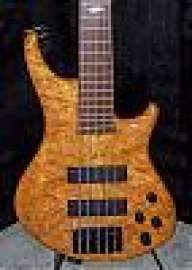
i went a similar route with my most recent project. it is an MTD KZ5 that i disassembled, refinished, and upgraded. the pickups are Big Rigs and i kept it passive. the controls vol/vol/tone with a 3 way toggle for each pickup that are series/single/parallel. i just got it back together a few weeks ago andI've had a plan to build a six string headless with hollow chambers in the body (to reduce weight) for some time and it might well be my next build project. My pickup choice is a pair of Big Rigs, so I can get a good P bass tone out of it (as well as a lot of other tones). So my plan is to fit both PU's with single coil / series / parallel 3 ways switches. Going passive with the electrics, leaving pre-amp options to my pedal board.


 so far i am loving this bass!
Yep, I love MTD basses. His basses have had a huge influence on a number of my builds.i went a similar route with my most recent project. it is an MTD KZ5 that i disassembled, refinished, and upgraded. the pickups are Big Rigs and i kept it passive. the controls vol/vol/tone with a 3 way toggle for each pickup that are series/single/parallel. i just got it back together a few weeks ago and View attachment 3944965 View attachment 3944965 View attachment 3944966 View attachment 3944967 so far i am loving this bass!


