• TalkBass has been independent since 1998. Add your voice.
    Create a free account to reply to discussions, view embedded media, and browse with fewer display ads.
    Join freeLog in
    Want zero display ads or expanded classifieds tools? Compare plans.
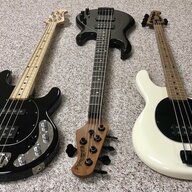
Not a poll, but do you prefer active or passive & why,,

Good answers, I am big on having the perfect tone but don't want the pedal to deal with. Between the EQ on the guitar & adjusting the amp I can get the sound I am looking for. Plus, I am leaning to small venues now & like a different sound to different songs. Seems more noticeable. Also, on a few songs when I play without a drummer, I like a little 'click' in the strings , easily done by adding a little treble. This is just me,,,everyone plays different & likes a different sound.
 
Passive 100%. I do not think I will even own an active bass. I have played them, and I feel the response is unnatural, and the fact that I have to change batteries just bothers me. Aside from that, my preamp's EQ has so many knobs that I already don't know what to do with them. I don't need more knobs.
 
Yes. My exact setup. Passive B string are RARELY, but not NEVER, as good as active bass b strings.

Honestly, I've just never used a passive 5 before so I have nothing to go on. Since it is my main bass (Carvin LB75) I like having all the tonal control at my fingertips. Sometimes our mix will be weird in a different room and it's nice to be able to boost or cut frequencies without going into my pedal to change settings.
 
I have 4 or 5 active basses and 1 passive bass in my rotation. I have no pre-disposition one way or the other; basses either sound good and have useful tones or they don't.

IMO, this question is kind of pointless, because the responses will reflect whatever bass the players happen to own. The majority of players play passive basses for one of two reasons: either they a) prefer a P (or perhaps a Ric or Hofner), which does not require an active preamp to get it's tone across, or b) are playing a more affordable budget level bass, which does not include a preamp. What you see in the responses is that the majority of TB'ers fall into one of these categories. Which is not intended as any slight in either case. Plenty of highly talented players in both categories. Just the way it is.

That's all well and good. The part that gets laughably entertaining are all the comments about those unreliable batteries which supposedly make the bass apt to fail regularly on the gig. ROFLMAO. Anyone stating that as fact quite clearly has zero experience with actual quality on board preamps. Anyhow, for all those who are dead certain that batteries render a bass unreliable, high maintenance, and prone to failure on the gig, please continue with the entertainment.

Ron Wickersham had solid technical reasons for creating the active onboard preamp. One might note that Leo Fender used the idea immediately upon getting past his CBS contractual limitations. I only mention this to point out that there is a technically sound basis for an active circuit in some basses. That does not mean that all active circuits are created equal. Another fallacy that is found in this thread are the posts stating, "oh, I played an active bass once, and it sounded unnatural." QED. Got it.

No; one needs to evaluate basses one at a time. A bit like people. What is true is that quality active basses tend to be sold at higher price points. This does not necessarily mean they are better basses than passive. That simply reflects the efforts that have gone into providing an instrument with a more complex signal chain. Some of those are VERY good instruments.
 
Last edited:
Actives come out sterile. It's by nature a weak signal boosted by a preamp. They don't capture character and color like a hot pickup. That's why passive pickups and active preamp is the best route for people wanting to go active.
Don't most "active" basses have passive pickups? I had always thought that active meant onboard preamp with boost/cut options instead of cut only.

I think I like active. I've only owned actives, but when I play Passover I store they just don't do it for me. They sound dead. Of course, that's not exactly a lot of experience, but I also just like the tone controls on my bass instead of the amp. I can set the amp for "my tone", and tweak the bass for anything else I may need for a quick fix of the room or something.

 
  • Like
Reactions: wcriley
Don't most "active" basses have passive pickups? I had always thought that active meant onboard preamp with boost/cut options instead of cut only.

I think I like active. I've only owned actives, but when I play Passover I store they just don't do it for me. They sound dead. Of course, that's not exactly a lot of experience, but I also just like the tone controls on my bass instead of the amp. I can set the amp for "my tone", and tweak the bass for anything else I may need for a quick fix of the room or something.
Most active circuits are just passive pickups with an onboard preamp. The only exception is EMG where the pickups themselves are active I believe.
 
Active without question for a few reasons. The main on is that when I'm gigging, I can tweak the mids or bass depending on the song. I play in a cover band and we cover a wide variety of genres. My new V7 Marcus Miller has a switch that goes to passive if needed, but I never use it. I kind of have it as a safety net if my battery dies.
I get the first reason, but I have trouble understanding the second. Batteries don't just die on the spot. Like they were working and then all of a sudden it doesn't. You can hear batteries starting to die plenty of time in advance before you need to replace it.