• TalkBass has been independent since 1998. Add your voice.
    Create a free account to reply to discussions, view embedded media, and browse with fewer display ads.
    Join freeLog in
    Want zero display ads or expanded classifieds tools? Compare plans.

Novak Multiscale Patent "Superceded"

seanm said:
Does anybody know how big the error is with "normal" straight frets? I realize it depends on where you fret but maybe an average or a max/min.
There may be some confusion developing due to the multiple uses of the word "intonation." Normal frets are perfectly positioned. Yes, there are intonation adjustments to be made, due to the fact that a real string gets stretched out of a straight line as you press it to the board to fret it. But the frets are in the "ideal" positions.

A multiscale instrument also requires intonation adjustments, due to the same reason of string-stretching.

But on a Novak-patent-designed instrument, if it is a common instrument with the bridge spacing wider than the nut spacing, the frets are not properly placed to begin with!
 
I think the more obvious question is, "how can this be patented?"

I can't stand reading the lingo of a patent.

From Booker's website:
"Actually the patent is for a novel step in the development of splayed fretting; the first examples were seen over 500 years ago, in instruments such as the orpharion."

I'd like to understand how this is a novel step in the development of "splayed" fretting. I would say that there is no development and that this whole concept is prior art and that nobody should be granting patents on it.

I guess the guy saw the problem with the Novax patent and capitalized on correcting it (at least that's how it looks, especially with the part about "non-parallel strings" in the patent).

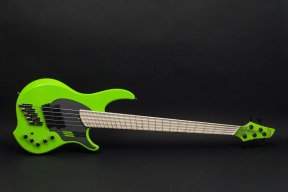
My confusion on this is as follows. How can this patent be enforced? If I have a bass with two different scale lengths on two different strings, then is this in bass in violation of this patent? My Dingwall basses have exactly that. While they are licensed by Novax, they don't exactly follow his method of determining the fret locations.

Can I patent a compound angled headstock in order to have straight string pull right off the nut on a fanned fret instrument? I'll ever write up an equation to calculate it based on the angle of the nut ;).
 
Geoff St. Germaine said:
I think the more obvious question is, "how can this be patented?"

I can't stand reading the lingo of a patent.

From Booker's website:
"Actually the patent is for a novel step in the development of splayed fretting; the first examples were seen over 500 years ago, in instruments such as the orpharion."

I'd like to understand how this is a novel step in the development of "splayed" fretting. I would say that there is no development and that this whole concept is prior art and that nobody should be granting patents on it.

I guess the guy saw the problem with the Novax patent and capitalized on correcting it (at least that's how it looks, especially with the part about "non-parallel strings" in the patent).

My confusion on this is as follows. How can this patent be enforced? If I have a bass with two different scale lengths on two different strings, then is this in bass in violation of this patent? My Dingwall basses have exactly that. While they are licensed by Novax, they don't exactly follow his method of determining the fret locations.

Can I patent a compound angled headstock in order to have straight string pull right off the nut on a fanned fret instrument? I'll ever write up an equation to calculate it based on the angle of the nut ;).
Geoff

Thought you might be thinking some thoughts about this.

I'll tell you how I would answer your questions-- and remember kiddies, this is my opinion, I'm not a lawyer, etc.

Patents can protect an invention that is an end product. Patents can also protect a process that produces an end result. In this case, the process must be original and unique. The end result may be ordinary, but it's the process which is the protected invention.

Knowing about orpharions, and about the Edgren patent, and seeing Novak's patent, I have always suspected that Novak's patent protected the process or method of laying out the frets by using a single conventional fret scale on the midline, and an exterior point, and drawing the lines between them. In my opinion, this <coincides with> / <is mutually reinforced by the idea that> Booker's patent protects his method of laying out the frets by using a two conventional fret scales, (either one on the midline and one perpendicular, or two on the outsides beyond the fretboard) and drawing the lines between them. I believe that multiscale or f*nned or splayed fretboards are not protected by either patent, unless you use one of the protected methods to produce them.

The "claims" portions of both patents specifically make claim to a method or methods, to a fingerboard produced by these method(s), and to an instrument incorporating such fingerboard.


As far as your last paragraph, my understanding is that equations are not patentable. However, use of equations in a unique process is. This would apply to Booker's patent, and to the Gibson patent that I'll probably start a thread on this weekend. You should get a kick out of that one.
 
pilotjones said:
I'm thinking I should patent the process of printing out a fretboard using fretfind, gluing it to a fretboard, and cutting through it!

:eek:

;)


:ninja:

See, that's the thing. I can't see how this is a patentable process. In what other way can you layout a fanned fretboard correctly? Can I patent the process of laying out three scales, or laying out the scale for each string independently? I guess the question is if there is any way to have a properly fretted fanned fretboard without infringing on this patent? I can't see how. The fretboard I have slotted for a fanned frets is done in this manner. I can't see any other way to do it.

FYI, I forwarded the link and this thread to Sheldon Dingwall to see what he thinks.
 
pilotjones said:
Booker's patent protects his method of laying out the frets by using a two conventional fret scales, (either one on the midline and one perpendicular, or two on the outsides beyond the fretboard) and drawing the lines between them.

Yes, but patents must be non-obvious to those skilled in the art. I'm not skilled in the art, and it's obvious to me, so how in the world did he get that patent granted?
 
Geoff

Maybe you're right-- maybe since both the Novak and Booker methods are simple consequences of geometry, they might not be defensible as patents. I don't know. But at least I'm now pretty sure that fanned fretboards themselves aren't protected, at least not unless produced by those specific methods.

There's a patent requirement that a claimed invention be "non-obvious," or something close to that. To me, at least one of Booker's methods easily pass the non-obvious test. I think that the fretfind thing I jokingly suggested above, or the simple two-outer-scales method, do not pass this test.

Plus, the two-outer-scales method might be considered prior art, based on the orpharion.
 
fookgub said:
Yes, but patents must be non-obvious to those skilled in the art. I'm not skilled in the art, and it's obvious to me, so how in the world did he get that patent granted?

Have you seen Booker's patent? I think coming up with the two-perpendicular-scales method is pretty outrageous, and far from obvious. The two-outside-the-fretboard-scales method is more debatable as to its obviousness.
 
I have pretty strong opinions on this thread. However Patent law has it's own specific logic developed to deal with the thousands patent claims made each year. Since I'm not qualified to comment on the validity of Booker's or Novak's patents, I won't.

I'm pretty bummed about the potential fallout this will cause. I think Novak already gets a lot of undeserved bashing.

Another consern is that I've already seen one post on another forum where someone has jumped to the conclusion that since we use the Novax system (or at least our interpretation of it), Dingwall basses have flaw in their fret placement. This is simply not the case. I spent a great deal of time working out our fret placement. They are very accurately placed although at this point I cannot disclose the method I used.