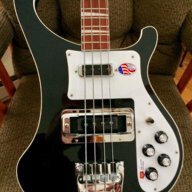
Checked around, and located this rare specimen. Long story short, the company was maybe 4 guys in Wisconsin, folded up shop in 2011, sold it, then the second owner folded two years later. They built reeeeaaally nice basses, and possibly the best assymetrical neck ever made, so it's a true shame that they weren't noticed much. Guessing this bass was made at some point in the 00s.
According to my research, it belonged at one point, to a Philly studio/gig vet that was actually Lisa Lopes' uncle (she was 1/3 of 90s/00s female r&b trio, TLC). She sadly died from a car accident in '02 (RIP). Her uncle (previous bass' owner) also worked with Stevie Wonder, Al Green, and others...cool, eh?
Anyway, this is the easiest 19mm neck I've ever played, and I prefer 17mm. Even with a 35" scale neck, as opposed to my Carvin/Kiesel Icon's 34", it's not that much of a difference (only one inch stretched from bridge to nut). It's a thicker neck, but it's just easier to play than most. The compound/asym radius seems like 10" that gradually flattens to 16". The finish is oil/urethane (think US Peavey Cirruses). After God knows how many gigs and sessions, the neck didn't need to be touched...it's flat. The setup was easy, and the upper-fret access is the easiest ever. Granted, it a longer reach to the first few frets, due to the upper horn length, but at waaaaaay less money than my previous Spector, I'm not complaining. The neck is a VERY solid piece of flamed maple, vintage tinted, more tint on the headstock, and supposedly has graphite bars inside, too. Pau ferro is the fretboard wood. The nickel frets have no marks that I can see, so yay! I'm a stainless guy, so bonus points here for these frets being in good shape. The Sperzels look goofy in pics, and are a different animal, but man are they solid, and sensitive to the slightest turn...good stuff. They are certainly quicker for changing strings, compared to traditional posts. I still put extra wraps on just to increase the break angle. Unlike others have experienced, I have zero open-string rattle with the slight break on the A-string. The setup was set low by me, with a few mm from the frets on the G-string. The B-string is HUGE, like my Carvin, meaning it's more in the construction than the scale length. For some reason, they used square, #2 Robertson machine screws for the neck joint...perhaps more solid than Philips/Allen, not sure. I had to order a 1/4" socket L-wrench for the neck adjustment, and the saddle screws take a TINY Allen key, so these choices seemed odd to me, but everything works, so whatever.
The bass' only weak point? The EMG B30 preamp...what they put in cheaper ESP LTD models, so that's surprising, especially this being a custom build, but whatever. I can easily swap parts without soldering, because of the quick-connect wiring of EMG. The pickups are active P/Js, and required me putting extra foam underneath, in order to get them close to the strings (EMGs actually prefer this). I messed with the eq more, and added some from my little practice combo, and this bass is now gig-ready. I dig that the pickup and cavity screws are all brass-threaded, too, so more bonus points for that.
Lastly, the body is a beautiful piece of lacewood, and may be one solid piece (not flawed, btw...the rear shot shows a reflection of the case). Regardless, it's not that heavy to me...9.5lbs? My Masters has neck dive, but unlike other basses I've owned with that, it's somehow really easy to keep it up while sitting down. I can't explain it...learn something new every day, right?
Yes, I put those knobs on...sue me. I like 'em, because the whole color scheme of the bass reminds me of a poker table. For my gigging bass, or backup bass (for my original band), this bad boy is staying put.
According to my research, it belonged at one point, to a Philly studio/gig vet that was actually Lisa Lopes' uncle (she was 1/3 of 90s/00s female r&b trio, TLC). She sadly died from a car accident in '02 (RIP). Her uncle (previous bass' owner) also worked with Stevie Wonder, Al Green, and others...cool, eh?
Anyway, this is the easiest 19mm neck I've ever played, and I prefer 17mm. Even with a 35" scale neck, as opposed to my Carvin/Kiesel Icon's 34", it's not that much of a difference (only one inch stretched from bridge to nut). It's a thicker neck, but it's just easier to play than most. The compound/asym radius seems like 10" that gradually flattens to 16". The finish is oil/urethane (think US Peavey Cirruses). After God knows how many gigs and sessions, the neck didn't need to be touched...it's flat. The setup was easy, and the upper-fret access is the easiest ever. Granted, it a longer reach to the first few frets, due to the upper horn length, but at waaaaaay less money than my previous Spector, I'm not complaining. The neck is a VERY solid piece of flamed maple, vintage tinted, more tint on the headstock, and supposedly has graphite bars inside, too. Pau ferro is the fretboard wood. The nickel frets have no marks that I can see, so yay! I'm a stainless guy, so bonus points here for these frets being in good shape. The Sperzels look goofy in pics, and are a different animal, but man are they solid, and sensitive to the slightest turn...good stuff. They are certainly quicker for changing strings, compared to traditional posts. I still put extra wraps on just to increase the break angle. Unlike others have experienced, I have zero open-string rattle with the slight break on the A-string. The setup was set low by me, with a few mm from the frets on the G-string. The B-string is HUGE, like my Carvin, meaning it's more in the construction than the scale length. For some reason, they used square, #2 Robertson machine screws for the neck joint...perhaps more solid than Philips/Allen, not sure. I had to order a 1/4" socket L-wrench for the neck adjustment, and the saddle screws take a TINY Allen key, so these choices seemed odd to me, but everything works, so whatever.
The bass' only weak point? The EMG B30 preamp...what they put in cheaper ESP LTD models, so that's surprising, especially this being a custom build, but whatever. I can easily swap parts without soldering, because of the quick-connect wiring of EMG. The pickups are active P/Js, and required me putting extra foam underneath, in order to get them close to the strings (EMGs actually prefer this). I messed with the eq more, and added some from my little practice combo, and this bass is now gig-ready. I dig that the pickup and cavity screws are all brass-threaded, too, so more bonus points for that.
Lastly, the body is a beautiful piece of lacewood, and may be one solid piece (not flawed, btw...the rear shot shows a reflection of the case). Regardless, it's not that heavy to me...9.5lbs? My Masters has neck dive, but unlike other basses I've owned with that, it's somehow really easy to keep it up while sitting down. I can't explain it...learn something new every day, right?
Yes, I put those knobs on...sue me.
I like 'em, because the whole color scheme of the bass reminds me of a poker table. For my gigging bass, or backup bass (for my original band), this bad boy is staying put.Attachments


Last edited: