• TalkBass has been independent since 1998. Add your voice.
    Create a free account to reply to discussions, view embedded media, and browse with fewer display ads.
    Join freeLog in
    Want zero display ads or expanded classifieds tools? Compare plans.

Oahu flattop bass build

Hey all,
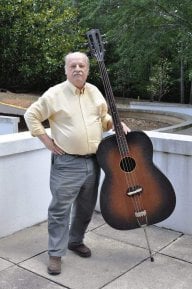
I’m looking into building an Oahu flattop bass. If you haven’t seen one I’ll include a video link.
I can’t find anything on the bracing pattern or even pics. Anyone have any info on these?
30’s flattop upright bass. Not as big as a traditional more of a 1-3 size I feel like.
I’ve been thinking about building with latter bracing like I’m assuming they had. Instead of the x bracing my brain keeps insisting on. This will be for me for ***** and giggles so to speak. But I can’t find any real info on size or bracing. Any input would be appreciated. I’m new here and open minded. So shoot me your good natured thoughts or insights.
 
Building for porch jams we have regularly. Always missing the low end and there just aren’t any ABG’s that will keep up with the other acoustic instruments. I was gonna build a banjo bass out of an old bass drum. But this seems way cooler, more vibe and easier to move around with.
 
Wow! This popped up suddenly. Thanks to @Matt Liebenau for cluing me in. I have two of these. Up until about six weeks ago I had three, but I gifted one to my best buddy.

Oahu is not the maker of these instruments. They are the Regal Bassoguitar, manufactured by Regal. Oahu was a firm that was heavily involved in the Hawaiian music scene just prior to World War II, and they had some Regals branded as Oahu and listed them as such in their catalog.

If you wanted a gig bag for one of these, a half-size DB bag probably would give the best fit. You are correct about the bracing; it is ladder -- four top and four back -- with a circular reinforcing "wafer" beneath the soundhole. If you want a truly authentic instrument, you will have to craft an endpin that is too short and a bridge that is too tall. You will be building to a 42" scale length.

Someplace I have got measurements jotted down which I will provide you once I find them, and I may be able to answer additional questions. But give me a few days? Sunday afternoon my community band has it Christmas concert, and I need the time to woodshed for that.

If you want to porch pick while you are still building your bass, I suggest you get a 1/4 size DB. They are smaller (though heavier, thanks to the tuning machines), and louder than a Bassoguitar. Both the DB and the Basso can be played quite comfortably sitting on the thigh; the reach to nut is not daunting.

Somewhere in the DB forum I've got a thread (with pics) of my quarter-size "acoustic bass guitar."
 
I don’t know if the Bassoguitars (thanks for that Gretschwretch) are susceptible to the same issues as a ladder braced acoustic guitars but there are some steps that can be taken with bracing to mitigate them.

I don't know why they would not be susceptible. I have a circa 1930s Regal slot-head parlor guitar, and aside from size and number of strings, the instruments are virtually identical. The ladder bracing slopes down as it approaches the sides.

The vulnerable spots on these are the neck join, which is dovetail, and the top. The top is two halves with a center seam, and glue deterioration can lead to separation at the center line.

But the fun part is that, being flat-top, these can be set to multiple mensures, depending on player preference. Sometimes, just for the goof of it, I have cheated the bridge forward for a 36" scale.
 
I don't know why they would not be susceptible. I have a circa 1930s Regal slot-head parlor guitar, and aside from size and number of strings, the instruments are virtually identical. The ladder bracing slopes down as it approaches the sides.

The vulnerable spots on these are the neck join, which is dovetail, and the top. The top is two halves with a center seam, and glue deterioration can lead to separation at the center line.

But the fun part is that, being flat-top, these can be set to multiple mensures, depending on player preference. Sometimes, just for the goof of it, I have cheated the bridge forward for a 36" scale.


I was thinking more along the lines of the top slowly starting to fold up as there’s less braces running neck to bridge. There can be a big hump by the bridge and a dip by the sound hole. As I’m writing this I’m realizing that the Bassoguitar has a tailpiece and the strings push the bridge down so to speak and what I’m thinking of involves the bridge being glued to the body and the strings attempting to pull the bridge and thus the top up. So, apparently for the second time today, I’m quite publicly wrong. :rollno: :facepalm: Ah well, it’s not the first time. Carry on and to @MrNor78 i hope you embark on this build. It seems very interesting and cool.

 
I was thinking more along the lines of the top slowly starting to fold up as there’s less braces running neck to bridge. There can be a big hump by the bridge and a dip by the sound hole. As I’m writing this I’m realizing that the Bassoguitar has a tailpiece and the strings push the bridge down so to speak and what I’m thinking of involves the bridge being glued to the body and the strings attempting to pull the bridge and thus the top up. So, apparently for the second time today, I’m quite publicly wrong. :rollno: :facepalm: Ah well, it’s not the first time. Carry on and to @MrNor78 i hope you embark on this build. It seems very interesting and cool.

Top sinking due to downward pressure can happen with these basses due to that glued center seam. There are many ways to approach re-enforcing the top. One could modify the bracing, one could go double soundpost beneath the bridge; or, one could take the approach I would (and I am by no means a luthier): I would install a rectangular "wafer" on the underside of the top to help resist down pressure. Valco did this in the very late sixties with their National N50 and Custom Kraft Bone-Buzzer basses, although these both were f-hole archtops.

And if he wanted to OP could experiment with an f-hole arched top. F-holes would disperse the sound more widely, and he need not carve an arched top. There is one simple way I know of (because one of my busker basses has it) that brings into play the blocks and part of the ribs. The Bassoguitar neck has a slight overstand which would enable it to accommodate a higher top.
 
I buy t-shirts from Crazy Shirts in Hawaii for 10+ years now. Does that count? ( and I knew a guy that played bass at Blackies in Maui, but that was decades ago ).

Sorry, that was decades ago, and I still pine over it...
 
  • Like
Reactions: MrNor78
I buy t-shirts from Crazy Shirts in Hawaii for 10+ years now. Does that count? ( and I knew a guy that played bass at Blackies in Maui, but that was decades ago ). Sorry, that was decades ago, and I still pine over it...

I doubt anything can stop your pining over the bass player, but those shirts should spruce up your wardrobe.
 
Wow! This popped up suddenly. Thanks to @Matt Liebenau for cluing me in. I have two of these. Up until about six weeks ago I had three, but I gifted one to my best buddy.

Oahu is not the maker of these instruments. They are the Regal Bassoguitar, manufactured by Regal. Oahu was a firm that was heavily involved in the Hawaiian music scene just prior to World War II, and they had some Regals branded as Oahu and listed them as such in their catalog.

If you wanted a gig bag for one of these, a half-size DB bag probably would give the best fit. You are correct about the bracing; it is ladder -- four top and four back -- with a circular reinforcing "wafer" beneath the soundhole. If you want a truly authentic instrument, you will have to craft an endpin that is too short and a bridge that is too tall. You will be building to a 42" scale length.

Someplace I have got measurements jotted down which I will provide you once I find them, and I may be able to answer additional questions. But give me a few days? Sunday afternoon my community band has it Christmas concert, and I need the time to woodshed for that.

If you want to porch pick while you are still building your bass, I suggest you get a 1/4 size DB. They are smaller (though heavier, thanks to the tuning machines), and louder than a Bassoguitar. Both the DB and the Basso can be played quite comfortably sitting on the thigh; the reach to nut is not daunting.

Somewhere in the DB forum I've got a thread (with pics) of my quarter-size "acoustic bass guitar."

awesome. Thanks for the info man. Appreciate you. That would be awesome thanks
 
I don’t know if the Bassoguitars (thanks for that Gretschwretch) are susceptible to the same issues as a ladder braced acoustic guitars but there are some steps that can be taken with bracing to mitigate them.
Yea and I figure none of my kids took up music so if it only lasts as long as I do then ok. I’m also gonna make the neck removable (bolt on) so if I needs to “fix” anything down the line it will be easier
 
Wow! This popped up suddenly. Thanks to @Matt Liebenau for cluing me in. I have two of these. Up until about six weeks ago I had three, but I gifted one to my best buddy.

Oahu is not the maker of these instruments. They are the Regal Bassoguitar, manufactured by Regal. Oahu was a firm that was heavily involved in the Hawaiian music scene just prior to World War II, and they had some Regals branded as Oahu and listed them as such in their catalog.

If you wanted a gig bag for one of these, a half-size DB bag probably would give the best fit. You are correct about the bracing; it is ladder -- four top and four back -- with a circular reinforcing "wafer" beneath the soundhole. If you want a truly authentic instrument, you will have to craft an endpin that is too short and a bridge that is too tall. You will be building to a 42" scale length.

Someplace I have got measurements jotted down which I will provide you once I find them, and I may be able to answer additional questions. But give me a few days? Sunday afternoon my community band has it Christmas concert, and I need the time to woodshed for that.

If you want to porch pick while you are still building your bass, I suggest you get a 1/4 size DB. They are smaller (though heavier, thanks to the tuning machines), and louder than a Bassoguitar. Both the DB and the Basso can be played quite comfortably sitting on the thigh; the reach to nut is not daunting.

Somewhere in the DB forum I've got a thread (with pics) of my quarter-size "acoustic bass guitar."
Ok I’ll look it up.. interesting..
 
I was thinking more along the lines of the top slowly starting to fold up as there’s less braces running neck to bridge. There can be a big hump by the bridge and a dip by the sound hole. As I’m writing this I’m realizing that the Bassoguitar has a tailpiece and the strings push the bridge down so to speak and what I’m thinking of involves the bridge being glued to the body and the strings attempting to pull the bridge and thus the top up. So, apparently for the second time today, I’m quite publicly wrong. :rollno: :facepalm: Ah well, it’s not the first time. Carry on and to @MrNor78 i hope you embark on this build. It seems very interesting and cool.
Oh I intend to. Sourcing materials already. Plan to start in January once I have caught up with repair work. Take a week or 2 off and build some toys for me
 
  • Like
Reactions: Matt Liebenau
Top sinking due to downward pressure can happen with these basses due to that glued center seam. There are many ways to approach re-enforcing the top. One could modify the bracing, one could go double soundpost beneath the bridge; or, one could take the approach I would (and I am by no means a luthier): I would install a rectangular "wafer" on the underside of the top to help resist down pressure. Valco did this in the very late sixties with their National N50 and Custom Kraft Bone-Buzzer basses, although these both were f-hole archtops.

And if he wanted to OP could experiment with an f-hole arched top. F-holes would disperse the sound more widely, and he need not carve an arched top. There is one simple way I know of (because one of my busker basses has it) that brings into play the blocks and part of the ribs. The Bassoguitar neck has a slight overstand which would enable it to accommodate a higher top.

im debating some kind of modified x bracing since its not a full sized upright bass. Less area so im gonna experiment.. but would like to know the original bracing pattern to go off of.