I think the guy put Rotosound 66's on it which I don't really like...Once I can afford a new set of strings I will restring it using at least 3 wraps around the tuning peg & see how that goes.

TalkBass has been independent since 1998. Add your voice.
Create a free account to reply to discussions, view embedded media, and browse with fewer display ads.
Join free Log in
Want zero display ads or expanded classifieds tools? Compare plans.
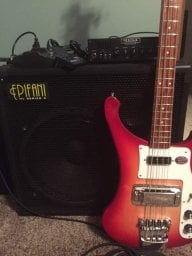
I know the guy I bought it from set it up my measuring things like string height & neck bow but...I'm not sure how he did the intonation though.Did you "intonate" using the method that Fender suggests (measuring stuff) or are intonating checking that the tone is in tune at the 12th fret as well as the open string? I don't think the measuring method is really very accurate, just kind of close.
Your saddles look like maybe you used the measuring method (that I just learned about yesterday in another intonation thread). I never tried using the measuring method and it's hard to imagine that it can be as accurate as checking against the octave.

YOu should learn to do your own setups. It's not rocket science and will save you a ton of money. Assuming the rest of the nck is set properly (needs to be done before you intonate), intonating is quite simple.I know the guy I bought it from set it up my measuring things like string height & neck bow but...I'm not sure how he did the intonation though.
Witness points on a stringed instrument are places where the string transits over a stationary point, the saddle, the nut, the tuner post, the tail piece, or the body. The string angle changes at those points and that needs to be a well defined break angle. If you allow the string to have an arc there, over time that angle will still define itself, but in the meantime your instrument will not hold tune. You can accelerate that settling of the string by forcing the bends. Forcing those bends is called setting the witness points.

I thinj they pretty much set rheir own witness points, and the strings aren't going to stretch so much where there will be a kink past the bridge. Never had that happen ever.I never understood this myself....
New strings. Set wtness point.
And like all new strings, they will stretch, leaving a kink above the new witness point...no?
I for one have never done this, and have never had an issue.
Not arguing, just dont understand the process.

Setting the witness points accelerates the process. New strings that haven't had the witness points set don't actually stretch, the witness points settle in over time and makes it appear that the strings stretch. By forcing the set of the witness points you eliminate that apparent stretching.I never understood this myself....
New strings. Set wtness point.
And like all new strings, they will stretch, leaving a kink above the new witness point...no?
I for one have never done this, and have never had an issue.
Not arguing, just dont understand the process.
I know what you're saying and don't understand why, but it really does help to set the winess point.I never understood this myself....
New strings. Set wtness point.
And like all new strings, they will stretch, leaving a kink above the new witness point...no?
I for one have never done this, and have never had an issue.
Not arguing, just dont understand the process.

I have, and I wouldn't be too quick to blame it on your ears.Hey y'all I'm new here & I have a very strange question & I'll try to word it correctly...
When I play, say, a low G & then play the octave G, (5th fret of D-string)
the octave sounds flat to me.
I've checked the tuning & intonation using several different tuners & everything checks out fine. Has anybody run into this before? Are my ears messed up?

WOW! Thank you for the reply. That's a lot to chew on but I"m sure will be useful. I'll see how she does at practice tonight.I have, and I wouldn't be too quick to blame it on your ears.
I've seen it mostly with specific string types, or with hardware issues- for instance, loose wires in a trapeze-style tailpiece can cause odd overtones on hollow-body guitars and basses. Pickups that are too close to the strings can cause odd pitch artifacts as well.
For example, I have a little acoustic bass that uses nylon-core strings. The scale length would normally be considered more appropriate to a guitar, at 25". It sounds great with the stock strings, or with other strings that share similar construction.
However, I strung it up with a custom set of regular steel-core nickel strings, and the tension was so low that the upper harmonics were messed up. The overall effect was that a.) the initial attack started at one pitch, but it shifted as the note decayed, and b.) the harmonics were out of tune with the fundamental. Sounded gross!
I've also noticed false harmonics with Fender and Squier Bass 6's. I haven't worked on them enough to know whether it's caused by the short scale and skinny string gauges, or the sub-par bridge and tremolo hardware.
Do you hit the strings unusually hard? When you really wail on the strings, it pushes the initial attack sharp, compared to the sustained pitch. The lighter the string gauge, the easier it is to push the instrument out of pitch through overplaying.
Here's another reason to check your gear before blaming the issue on your ears- some tuners are better than others. For instance, I used to have a first-generation Planet Waves pedal tuner. The tuner engine had pretty decent accuracy, something like a quarter of a cent. However, they didn't publish any data on tuner lock. Sure enough, the LED would show pitch lock over a much wider window.
I don't claim to have perfect pitch, but the lock was loose enough that it would go green when I could hear quite clearly that it wasn't in tune. While it was more or less useable for rough stage tuning, it was far from good enough for setting intonation.
Here's what I would do if I were in the OP's shoes:
At this point, there's a good chance that the bass will play and sound better than it ever has.
- Check for loose screws or parts on the headstock, bridge and tailpiece. That includes tuner ferrules, string trees, bridge mounting screws and saddle adjustments, clamps, etc. Tighten up anything that moves or rattles.
- Check that the nut isn't binding. Use vaseline or graphite to lubricate the slots as needed.
- Bang gently on the back of the neck, just below the headstock. Listen for any buzzes or rattles. If you hear anything, see if you can stop the noise by tightening the truss rod just a hair- if turning the nut one flat isn't enough to stop the buzz, then the problem is above your pay grade: take it to a luthier.
- Buy a good set of replacement strings. Stick with a reliable, popular brand like D'Addario or DR, and a normal construction, i.e.; non-coated, stainless or nickel roundwounds. Go for a standard tension, i.e.; 45-105 or thereabouts on a 34" scale.
- Buy or borrow an intonation-worthy tuner. The cheapest would be the Peterson phone app. Hardware-wise, the only ones I trust for this job are the Peterson floor pedal, or my personal favourite, the Turbo Tuner 200.
- Use the tuner to bring the instrument up to pitch, and do an initial intonation.
- With it properly up to concert pitch, check the string height and neck relief. Also check the pickup heights, using the Fender Bass instruction sheet for your initial measurement targets.
- Correct it if necessary, using feeler gauges for accuracy.
- Now that it's at concert pitch and correctly set up, be sure to push down on each string where it crosses over the bridge saddles. The idea is to get a good, sharp bend instead of a lazy curve. This will likely lower the pitch.
- Do the same at the headstock if there's a steep break angle over the nut.
- Now re-set the tuning, and check to see if the intonation requires further tweaking.
If you still hear pitch issues, you either have unusually sensitive hearing, or the instrument needs to be looked over by a good luthier.
right 'bout now.

Hey y'all I'm new here & I have a very strange question & I'll try to word it correctly...
When I play, say, a low G & then play the octave G, (5th fret of D-string)
the octave sounds flat to me.
I've checked the tuning & intonation using several different tuners & everything checks out fine. Has anybody run into this before? Are my ears messed up?


Well, there’s nothing wrong about looking at your bass when you’re playing. Look, classical players don’t look, but use paper.In my case I'm pretty sure my ears are messed up. I used to have impeccable hearing/tuning, with a background as an oboist and orchestral percussionist. Now, at age 66, on every bass I own, I have that "flat octave" problem that extends to many intervals, not just octaves. As I rock drummer I had some sonic traumas and way too much crash cymbals and it has taken a toll. Really takes the fun out of playing around on a bass when I can't hear the true note I'm playing; relying on music theory and watching the fretboard to know I'm playing the right note is not what any of us strive for on this instrument. I'm about to give it up. At the other end of the spectrum, as a percussion grad student I could not distinguish pitches at the upper registers of orchestra bells; again, had to rely of watching the bars and mallets to know I'd hit the right one. Take care of your ears, kids!