I'm starting the plan stages of an experimental bass build and I hope to benefit from the accumulated knowledge and experience of some of the advanced luthiers on this board. What I am contemplating is a build with continuous neck/fingerboard that runs to the bridge and the saddles.
Think of similar features on Pagelli and some Ritter models.
Pagelli:
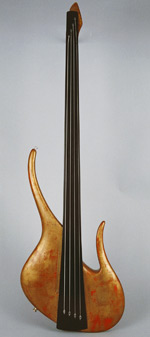
Ritter:

I have an Indonesian ebony 4/4 size fingerboard blank - cut for an upright bass - that I'd like to use for this. It's solid black, and I'd hate cutting into it. Done right, it's thick enough to make the whole neck and fretboard of a single piece, with shaping on the back and re-radiusing the front.
Here's my stupid question:
What are the drawbacks of using this as a fretted neck, without cutting and adding a truss rod?
Is it viable to build this way, and get a decent set-up?
I've seen what Basslab does for fretted, carbon-fiber necks and their trussless design. Pagelli is fretless, and has fewer such problems, I suppose.
I'm assuming that I'd use a zero-fret, and have good, individually adjustable saddles to manage string height/action. The ebony is not in danger of bowing - 'tho one could imaging minor humidity changes.
My alternative is to flatten the face of the ebony, for the length of the fretted area, channel a conventional truss, and face it with a matching black fingerboard. Less elegant an monumental - but not inconceivable.
Thanks for any and all points of view. I value a "pros and cons" response. Even from Wishbass modders.
Think of similar features on Pagelli and some Ritter models.
Pagelli:
Ritter:
I have an Indonesian ebony 4/4 size fingerboard blank - cut for an upright bass - that I'd like to use for this. It's solid black, and I'd hate cutting into it. Done right, it's thick enough to make the whole neck and fretboard of a single piece, with shaping on the back and re-radiusing the front.
Here's my stupid question:
What are the drawbacks of using this as a fretted neck, without cutting and adding a truss rod?
Is it viable to build this way, and get a decent set-up?
I've seen what Basslab does for fretted, carbon-fiber necks and their trussless design. Pagelli is fretless, and has fewer such problems, I suppose.
I'm assuming that I'd use a zero-fret, and have good, individually adjustable saddles to manage string height/action. The ebony is not in danger of bowing - 'tho one could imaging minor humidity changes.
My alternative is to flatten the face of the ebony, for the length of the fretted area, channel a conventional truss, and face it with a matching black fingerboard. Less elegant an monumental - but not inconceivable.
Thanks for any and all points of view. I value a "pros and cons" response. Even from Wishbass modders.