
No one in the audience is going to know or care. You guys are something.

TalkBass has been independent since 1998. Add your voice.
Create a free account to reply to discussions, view embedded media, and browse with fewer display ads.
Join free Log in
Want zero display ads or expanded classifieds tools? Compare plans.

You don't hear about it more because you'd be wasting your money.
In a bass tone circuit all capacitors of equal value sound the same.
The point of the double blind test is that neither the subject or the tester know.
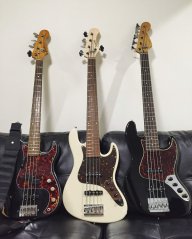
0.47 is the wrong capacitance, in any unit of measure. You want 0.047uF/47nF. The decimal point is very important.What does it mean after 0.47. Some say 100v I have seen 50v even 500v what should I get ?
I know p bass is 0.47
Would a jazz deluxe 5 string be the same
Thanks for your help

ank0.47 is the wrong capacitance, in any unit of measure. You want 0.047uF/47nF. The decimal point is very important.
The voltage rating of a capacitor does not matter for a tone control. Your maximum voltage will be a couple of volts, and that's if you are really playing hard. Accordingly, any capacitor rated for more than a couple of volts will be able to handle the signal just fine.

What does it mean after 0.47. Some say 100v I have seen 50v even 500v what should I get ?
I know p bass is 0.47
Would a jazz deluxe 5 string be the same
Thanks for your help

You'd be surprised to find PIO caps in some let's-call-them "modern" devices.Think of high-end audio systems with tubes where PIO have two major applications : one is as a signal cap (right in the audio path betwen two stages or as a cathode bypass) and the other is in HT source (as a standalone or bypassing something else).The other use I saw is in some microwave ovens (a high-voltage,small capacity PIO).In the not-so-far past I ran some caps'measurements using an industrial (branded "Marconi" if I recall corectly) capacimeter wich had a strange measurement function called "Q" (quality of...something).The PIOs I measured (one with copper foil,the other w/silver foil) developed the best figure,far better than any "modern" cap (read:made with hitec materials) in the same value range.The same surprise with mica-silver caps.True,they're (both types) rather big and unfriendly to work with in tight spaces BUT AFAIK there's no PIO that's gonna let you down (assuming that you're not doing something really insane with them).Has anyone here seen a paper or oil cap in any other modern electronic device? There's a reason for that.
You'd be surprised to find PIO caps in some let's-call-them "modern" devices.Think of high-end audio systems with tubes where PIO have two major applications : one is as a signal cap (right in the audio path betwen two stages or as a cathode bypass) and the other is in HT source (as a standalone or bypassing something else).The other use I saw is in some microwave ovens (a high-voltage,small capacity PIO).In the not-so-far past I ran some caps'measurements using an industrial (branded "Marconi" if I recall corectly) capacimeter wich had a strange measurement function called "Q" (quality of...something).The PIOs I measured (one with copper foil,the other w/silver foil) developed the best figure,far better than any "modern" cap (read:made with hitec materials) in the same value range.The same surprise with mica-silver caps.True,they're (both types) rather big and unfriendly to work with in tight spaces BUT AFAIK there's no PIO that's gonna let you down (assuming that you're not doing something really insane with them).
Related to passive tone in a bass,it's fully understandable why an installed PIO looks like snake oil.The cap itself has little to do with those areas where really shines.I'd say,the tone cap's value (together with the pot's value and the PU's characteristics) plays a more important role,being a humble ceramic up to...whatever suits your wallet and eye's pleasure.
 DR: If you need a good .047 uf at 20 kv, oil's your choice.
 Look up at some power poles; oil caps are used for phase compensation/motor start/run, etc. in AC power systems, as well as filter caps in HV (> 1kv) power supplies. As far as consumer electronics goes, the ones in your microwave or (possibly, if big enough) electric motors are pretty lonely among the hundreds or thousands of caps in a typical residence.
I really don't intend opening THE can of worms here but I have to dissapoint you:yes,I hear such differences.You'd hear them too if you'd listen the audio systems I'm listening and rely on (minimalist tube amps w/horns).On the other hand,true,in other "consumer-grade" SS devices,the difference is none.Can you hear the difference between a coupling cap with a Q of 200, and an oil coupling cap with a Q of 2000? No.
The placebo and snake-oil effects are the main reason I left a long time ago the "audiophile world" and every BS related to it.Still,a trained ear can discern between a Harman Kardon receiver and a AN Kondo's work of art and concepts.I think that's the other popular audiophile argument for using them.
I really don't intend opening THE can of worms here but I have to dissapoint you:yes,I hear such differences.You'd hear them too if you'd listen the audio systems I'm listening and rely on (minimalist tube amps w/horns).On the other hand,true,in other "consumer-grade" SS devices,the difference is none.
The placebo and snake-oil effects are the main reason I left a long time ago the "audiophile world" and every BS related to it.Still,a trained ear can discern between a Harman Kardon receiver and a AN Kondo's work of art and concepts.

Cool.Statistically,someone DOES hear the difference.Marketing psychology has NOTHING to do with what and how I hear...at least because I have a completely different background wich isn't tributary at all to market trends.
To respond to your second (also rethorical?) question,because different systems are,well,different by concept and construction.What (read:a component,any component) it's non-relevant in one,may work in spades in the other.Learned this during thousands of hours of trial-and-error tests.
No AUX.Your AyPheun should do it.Cool.
Do you have an AUX in? I want to play my 128kbps Spotify stream.


