• TalkBass has been independent since 1998. Add your voice.
    Create a free account to reply to discussions, view embedded media, and browse with fewer display ads.
    Join freeLog in
    Want zero display ads or expanded classifieds tools? Compare plans.

Old tools

I've posted this before, but here's my Grandfather's Craftsman benchtop drill press, circa 1948 or so. I remember seeing this in his basement as a kid, and I eventually inherited it from my father. The motor was replaced at some point, but it's otherwise all original. The bearings are pretty much shot on it, and it's got a lot of "wobble" (probably not the right technical term) in the quill. The other problem is the quill-return spring, which is a coil spring with "tails" at each end that gets twisted into tension as you lower the chuck. One of the "tails" snapped off. I ineptly tried heating one end and bending a new tail, which broke off too after about a week of use. I'm sure I ruined the temper on the spring. Parts for these old machines are available for $$$, but that spring seems to be unobtanium. I always assumed there must be a top pulley cover that got lost or broken at some point, but apparently that's how they were made: DON'T stick you hand in the pulleys.
AbTWAQY.jpg

mwVKXSX.jpg


I recently came into possession of an early 80's Delta floor model drillpress, which is better in most respects than the Craftsman, but lacks the simple stop-collar that makes setting depth of travel easy. It has none of the retro-futuristic charm of the old Craftsman, of course. The "machine turned" name badge is particularly cool.
I love that engine turned trim piece. :cool:
 
  • Like
Reactions: Gilmourisgod
Lots of good examples here, I love all of those vintage levels featured earlier.

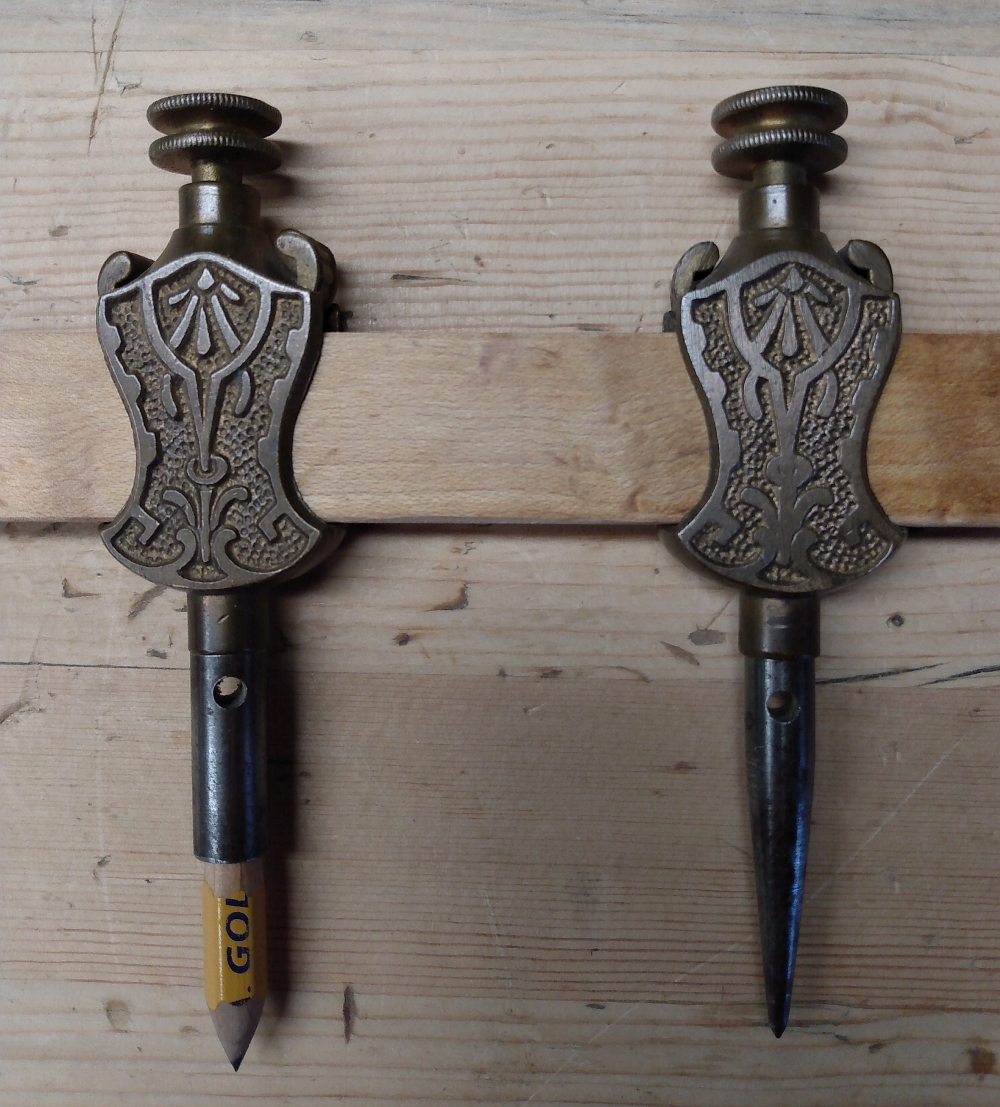
I'd be remiss not to include my Trammel / Beam Compass points. (I have the other screw in point, too.) It's still on the 1/4" by 1" by 48" wood beam that they were attached to.

There's something about tools from a bygone era that are not only functional, but beautiful as well. My parents were antique dealers for something like 40 years and I sometimes absconded with something from their various boxes of random stuff they brought in, these instantly appealed to me.

They also had one of those huge miter shavers as posted above and I think they sold it for something like $5 because nobody knew what it was! "Cigar cutter" was a popular guess.

PjAHtiN.jpg

That's a beautiful old set of Trammel Points. I'm envious. I've got several sets in my collection, but more modern designs. Not as elegant as those. They look to be 1920's or 1930's era. The glory days of cast iron.

Trammel Points are very useful tools for a Luthier. I have one modern set right in my main layout tools drawer, and they get a lot of use.
 
I've posted this before, but here's my Grandfather's Craftsman benchtop drill press, circa 1948 or so. I remember seeing this in his basement as a kid, and I eventually inherited it from my father. The motor was replaced at some point, but it's otherwise all original. The bearings are pretty much shot on it, and it's got a lot of "wobble" (probably not the right technical term) in the quill. The other problem is the quill-return spring, which is a coil spring with "tails" at each end that gets twisted into tension as you lower the chuck. One of the "tails" snapped off. I ineptly tried heating one end and bending a new tail, which broke off too after about a week of use. I'm sure I ruined the temper on the spring. Parts for these old machines are available for $$$, but that spring seems to be unobtanium. I always assumed there must be a top pulley cover that got lost or broken at some point, but apparently that's how they were made: DON'T stick you hand in the pulleys.
AbTWAQY.jpg

mwVKXSX.jpg


I recently came into possession of an early 80's Delta floor model drillpress, which is better in most respects than the Craftsman, but lacks the simple stop-collar that makes setting depth of travel easy. It has none of the retro-futuristic charm of the old Craftsman, of course. The "machine turned" name badge is particularly cool.

Oh yeah, those King-Seeley drill presses are nice old machines. They were made by King-Seeley for Sears, and sold under the Craftsman and Dunlap brand names. Most of them are from the 1960's. I've got two of them in my row of working drill presses.

Here in the Los Angeles area, there are always a few of them for sale on Craigslist, usually in the price range of $100-$300. Nice drill presses for a Luthier's shop.
 
That's a beautiful old set of Trammel Points. I'm envious. I've got several sets in my collection, but more modern designs. Not as elegant as those. They look to be 1920's or 1930's era. The glory days of cast iron.

Trammel Points are very useful tools for a Luthier. I have one modern set right in my main layout tools drawer, and they get a lot of use.
Thanks, Bruce.
I mostly use mine as a large radius compass. The bottom barrels are steel but all the rest is solid brass. They have a patina that you just can't duplicate with anything other than time.
 
Retrieving more of my father's tools. This is a Craftsman rotary grinder. Basically a macho Dremel with 1/4" shaft.


I don't like the idea of using this freehand but I've started contemplating whether it's feasible to mount it to something… assuming it works.

(edit: pic upload ain’t working from this device, I’ll try again later this week.)
 
Last edited:
Retrieving more of my father's tools. This is a Craftsman rotary grinder. Basically a macho Dremel with 1/4" shaft.


I don't like the idea of using this freehand but I've started contemplating whether it's feasible to mount it to something… assuming it works.

I can't see your pictures, but if that's the tool I think it is, yes, it's a very useful tool for woodworking. I have a large Makita rotary grinder, and it gets regular use shaping the tight contours in necks.
 
Several years back I picked up a nice old workbench locally on craigslist. It has a solid maple top and an all wood vise. It's great for guitar building since there aren't any metal parts to dent things up. The top is beat up, which is fine by me. I don't have to worry about keeping it nice. The vise is marked "J Niederer Co Los Angeles". There's also mounting brackets for a wooden vise on the right side of the workbench. That would be a nice addition, because the top has square holes for bench dogs.
WoodVise.jpg

ViseCloseup.jpg
 
Retrieving more of my father's tools. This is a Craftsman rotary grinder. Basically a macho Dremel with 1/4" shaft.


I don't like the idea of using this freehand but I've started contemplating whether it's feasible to mount it to something… assuming it works.

(edit: pic upload ain’t working from this device, I’ll try again later this week.)
I can't see your pictures, but if that's the tool I think it is, yes, it's a very useful tool for woodworking. I have a large Makita rotary grinder, and it gets regular use shaping the tight contours in necks.
Trying again...
IMG_4951.jpeg
IMG_4953.jpeg

I'm idly wondering if this can be mounted to a drill press type rig. ("idly" because even if it works I won't be doing anything with it for a while, other things to do first.)
 
  • Like
Reactions: Matt Liebenau
Trying again...
View attachment 5424273 View attachment 5424272
I'm idly wondering if this can be mounted to a drill press type rig. ("idly" because even if it works I won't be doing anything with it for a while, other things to do first.)

Yes, that's the tool I'm talking about. These days, they are usually called an Electric Die Grinder. It's made for grinding and shaping small areas of metal parts. They (used to be) commonly used for cleaning up welds and fitting corners of steel parts together. Back in my Race Car days, we used them to enlarge and polish out the ports in cylinder heads.

If you fit it with a small diameter (1/2" or less) toothed cutter, it's a great tool for quickly shaping wood. Such as the transition contours around the headstock of a bass neck. I have a more modern Makita Die Grinder, like below, and I use it a lot for shaping the headstocks of my Scroll Basses.

https://www.amazon.com/Makita-GD060...400&sprefix=Makita+die+grinder,aps,211&sr=8-3

This is the type of cutter you want to fit to it, for shaping wood. It's called a carbide rotary rasp:

https://www.amazon.com/EZARC-Tungst...=d2lkZ2V0TmFtZT1zcF9zZWFyY2hfdGhlbWF0aWM&th=1

Don't even think about trying to mount that in a drill press! It spins at 24,000 rpm and has a little bit of horsepower. You have to hold it with two hands when using it.
 
As an Amazon Associate, TalkBass may receive commissions from qualifying purchases made via links on this site.
  • Like
Reactions: ardgedee
Yes, that's the tool I'm talking about. These days, they are usually called an Electric Die Grinder. It's made for grinding and shaping small areas of metal parts. They (used to be) commonly used for cleaning up welds and fitting corners of steel parts together. Back in my Race Car days, we used them to enlarge and polish out the ports in cylinder heads.

If you fit it with a small diameter (1/2" or less) toothed cutter, it's a great tool for quickly shaping wood. Such as the transition contours around the headstock of a bass neck. I have a more modern Makita Die Grinder, like below, and I use it a lot for shaping the headstocks of my Scroll Basses.

https://www.amazon.com/Makita-GD0601-4-Inch-Die-Grinder/dp/B001ASC73E/ref=sr_1_3?crid=2G4NAXBAWBYZQ&dib=eyJ2IjoiMSJ9.WdWUxyO_a2GCzuW5DHuEbqj8S85juRFULOAHLFYKZ5bV0SvNNmTVeUICmqvyKa1KTBtmef0lFV_DkjEK8LUfkCl9xmC8dRkXK_C9VnXgUyiAxlrqr7TDjWDWPvRawJ0j56cjFLpO83Cy-i1awbx8bBEMVZ8ioh7woyyz_yswxlsYP5Mu-wkBs0QNfOkkvdgUq27eMZEr83Dcb47NKabsbCmSNwiu4Z0Hlaa5XYM8OhE1-A7Vhh2d_oiphcuDB40Yg9nvBw4_A3vJhpwKdEy8fiDqe4W2cdmuwcazkuIMT-I.OWh57sxUuHVvW1Ew4gyK0VOxXXSOhxqLfd4nhUQkJug&dib_tag=se&keywords=makita+die+grinder&qid=1713631400&sprefix=Makita+die+grinder,aps,211&sr=8-3

This is the type of cutter you want to fit to it, for shaping wood. It's called a carbide rotary rasp:

https://www.amazon.com/EZARC-Tungsten-Carbide-Grinder-Cutting/dp/B0BX56JT4C/ref=sxin_15_pa_sp_search_thematic_sspa?content-id=amzn1.sym.15bb851a-7b12-4426-b7a1-b84d50f201d9:amzn1.sym.15bb851a-7b12-4426-b7a1-b84d50f201d9&crid=UE132Z27Q8WD&cv_ct_cx=makita+die+grinder+bits&dib=eyJ2IjoiMSJ9.d8jqHLhqYaIiCSG2aMUk3HVto809-Dq-gAlALp51B2an8kzEctkIhZe2J5RzE2SfOeEBrpYE5fvT-FQHllDgLQ.AqNr4d35xWU-zgetpEPf702STZs5ufmzS4TeU0ebQjE&dib_tag=se&keywords=makita+die+grinder+bits&pd_rd_i=B0BX56JT4C&pd_rd_r=3633c559-e213-4bab-811f-5ab67be37137&pd_rd_w=BQArb&pd_rd_wg=p92d6&pf_rd_p=15bb851a-7b12-4426-b7a1-b84d50f201d9&pf_rd_r=28FB72118Z4CSV3B1GDR&qid=1713631589&sbo=RZvfv//HxDF+O5021pAnSA==&sprefix=makita+die+grinder,aps,405&sr=1-5-b0e9b49d-e3b6-4957-8780-cb03c5a6f67a-spons&sp_csd=d2lkZ2V0TmFtZT1zcF9zZWFyY2hfdGhlbWF0aWM&th=1

Don't even think about trying to mount that in a drill press! It spins at 24,000 rpm and has a little bit of horsepower. You have to hold it with two hands when using it.
Good to know. I got a variety of rotary rasps with it, including one or two of that shape. They'll need cleaning up before use. Noted for future me's sake.
 
As an Amazon Associate, TalkBass may receive commissions from qualifying purchases made via links on this site.
Spend little time working with it on scrap wood. With a little practice, you can carve wood very accurately, intricate shapes. Like you would do with small gouges and chisels. But much faster!

The important thing is the size and weight of it. Holding it in two hands, you can control it very accurately. As compared to a smaller Dremel-size tool, which twitches around in your hands.

One warning: Don't use cutters larger than 1/2" diameter in it. At a larger radius, it develops a fierce torque, and will start kicking badly. And be sure that the cutter you use is rated to go to 24,000 rpm. Don't put a 1 1/2" diameter 1/4" shank router bit in it. They'll be removing pieces of it from you in the hospital.

Also, for your own safety, don't fire it up with that stone that's in it now. As old as it is, it could easily have a crack in it. It could explode like a grenade and seriously injure you. Don't risk it. Take that wheel off of there and throw it away.
 
Last edited:
Spend little time working with it on scrap wood. With a little practice, you can carve wood very accurately, intricate shapes. Like you would do with small gouges and chisels. But much faster!

The important thing is the size and weight of it. Holding it in two hands, you can control it very accurately. As compared to a smaller Dremel-size tool, which twitches around in your hands.

One warning: Don't use cutters larger than 1/2" diameter in it. At a larger radius, it develops a fierce torque, and will start kicking badly. And be sure that the cutter you use is rated to go to 24,000 rpm. Don't put a 1 1/2" diameter 1/4" shank router bit in it. They'll be removing pieces of it from you in the hospital.

Also, for your own safety, don't fire it up with that stone that's in it now. As old as it is, it could easily have a crack in it. It could explode like a grenade and seriously injure you. Don't risk it. Take that wheel off of there and throw it away.
Sage advice, thanks. The 1.5" max diameter recommendation on the housing sounds kind of ridiculous for something rated to spin at 24000 rpm.

The tips I have are some stones like you see, some rasps in tapered and cylinder shapes, and some sanding barrels. I don't see a use for the stones, and I'm not sure how to use the sanding bits safely so I'd probably stick to the rasps, assuming everything's in usable or restorable condition.
 
Sage advice, thanks. The 1.5" max diameter recommendation on the housing sounds kind of ridiculous for something rated to spin at 24000 rpm.

The tips I have are some stones like you see, some rasps in tapered and cylinder shapes, and some sanding barrels. I don't see a use for the stones, and I'm not sure how to use the sanding bits safely so I'd probably stick to the rasps, assuming everything's in usable or restorable condition.

A sanding drum is kind of useless on that thing. It'll clog up and burn so fast on wood. But the tungsten rasp bits last a long time. I've been using the same bit in my Makita for maybe 20 years. It doesn't really get dull, it just gets gunked up with cooked-on varnish. Like a router bit. I clean it with automotive carb cleaner and a brass wire brush. And it keeps going, cutting very well.

With practice, you learn to take gentle sliding cuts with it. Don't dig in too deep and burn the wood. Light passes, and the sawdust comes off like using a file.
 
  • Like
Reactions: ardgedee
A sanding drum is kind of useless on that thing. It'll clog up and burn so fast on wood. But the tungsten rasp bits last a long time. I've been using the same bit in my Makita for maybe 20 years. It doesn't really get dull, it just gets gunked up with cooked-on varnish. Like a router bit. I clean it with automotive carb cleaner and a brass wire brush. And it keeps going, cutting very well.

With practice, you learn to take gentle sliding cuts with it. Don't dig in too deep and burn the wood. Light passes, and the sawdust comes off like using a file.
I assume using anything firmer than a light pass will make it want to take off like a dragster anyway.
 
Pipe clamps! Not for clamping pipes, but for using pipes to clamp with! They're each about 5 1/2 feet (168cm) long.
IMG_5009 (1).jpeg

IMG_5014 (1).jpeg

IMG_5013 (1).jpeg


I don't know much about these. I think they were just sold as clamp ends, you provided the pipe yourself. Dad repurposed the legs of an old swingset - you can see the boltholes. The adjustable side of the clamp threads onto the end of the pipe, the other clamp side moves freely when the trigger is pulled.

Not sure if Dad tapped the ends of the pipe himself, had somebody else do it, or they were already conveniently threaded exactly as needed.

It's more flexy than I'd expect an equivalent length of metal plumbing to be, but it seems to be capable of enough clamping pressure for woodworking purposes since Dad kept these around for so long. Makes sense - the legs had to be strong enough to endure a bunch of kids trying their darndest to launch into space.

Not sure how to clean this up. The clamp ends look well-weathered but all parts still move smoothly. As nasty as the pipe looks the rust doesn't seem to have gone deep. New paint is just gonna get scraped off, and I don't have the means to give it another coat of enamel.
 
Last edited:
Pipe clamps! Not for clamping pipes, but for using pipes to clamp with! They're each about 5 1/2 feet (168cm) long.
View attachment 5460494
View attachment 5460492
View attachment 5460493

I don't know much about these. I think they were just sold as clamp ends, you provided the pipe yourself. Dad repurposed the legs of an old swingset - you can see the boltholes. The adjustable side of the clamp threads onto the end of the pipe, the other clamp side moves freely when the trigger is pulled.

Not sure if Dad tapped the ends of the pipe himself, had somebody else do it, or they were already conveniently threaded exactly as needed.

It's more flexy than I'd expect an equivalent length of metal plumbing to be, but it seems to be capable of enough clamping pressure for woodworking purposes since Dad kept these around for so long. Makes sense - the legs had to be strong enough to endure a bunch of kids trying their darndest to launch into space.

Not sure how to clean this up. The clamp ends look well-weathered but all parts still move smoothly. As nasty as the pipe looks the rust doesn't seem to have gone deep. New paint is just gonna get scraped off, and I don't have the means to give it another coat of enamel.
I have three sets of those clamps that were my dad’s. I believe they are meant to be used with cast iron pipe, which Dad used, and are much less susceptible to flexing. Should be easily found at most hardware stores, if you want to go that route.

As for rust, I’ve had good luck with soaking things like that in Evaporust, brushing the heaviest rust off first.
 
  • Like
Reactions: Beej and ardgedee
I have three sets of those clamps that were my dad’s. I believe they are meant to be used with cast iron pipe, which Dad used, and are much less susceptible to flexing. Should be easily found at most hardware stores, if you want to go that route.

As for rust, I’ve had good luck with soaking things like that in Evaporust, brushing the heaviest rust off first.
Yeah, pipe in all kinds of configuration is available pretty regularly at reuse stores here, way cheaper than hardware stores. Getting a shorter length is not the worst idea anyway - I can't think of anything I'd be making that needs something this long, since I won't be building table tops. On the other hand, as nasty as these look, they work. So maybe I'll just clean up the clamp pieces and keep the pipe as-is.
 
  • Like
Reactions: farace
Not sure how to clean this up. The clamp ends look well-weathered but all parts still move smoothly. As nasty as the pipe looks the rust doesn't seem to have gone deep. New paint is just gonna get scraped off, and I don't have the means to give it another coat of enamel.


Wirebrush or sand the rust, and oil or wax it. Soak in citric acid till the rust is gone, and oil or wax it. Drop in your electrolysis tank to get the rust off, and oil or wax it.

Preferred oiling approach for iron is to get it fairly hot and apply a bit of linseed oil. "Blacksmith finish" for black iron. The heat speeds the cure.

But wax is not a bad idea ANYWAY for things that will get glue dripped on them. Merely good and warm should do for that - just a thin coating to keep the rust off and the glue from sticking to the clamp, not a heavy or thick layer. Paste wax works if you don't want to fuss with heat at all, though heat also helps to dry the steel out before you seal it.


And yes, these were and are normally sold without the pipe.
 
Last edited:
  • Like
Reactions: boxerrider

Latest posts