Could you measure out and mark the center and punch or hand drill a tiny starter divet?
Then do it on the drill press?
Then do it on the drill press?

TalkBass has been independent since 1998. Add your voice.
Create a free account to reply to discussions, view embedded media, and browse with fewer display ads.
Join free Log in
Want zero display ads or expanded classifieds tools? Compare plans.
Could you measure out and mark the center and punch or hand drill a tiny starter divet?
Then do it on the drill press?
What are the chances the knobs will fit in a socket? Could put a touch of hot glue to secure them. Chuck a socket extension arm in the drill press?
That sounds promisingA variant that should be more precise is to make a jig by securely clamping a block to the table, drilling a 19 mm hole in it, then insert the knob upside down in the hole, then chuck a 6 mm bit and drill the hole in the bottom.
Would I be a jerk for asking why the hole in the knob wasn't part of the CNC process?
Could you pre-drill them, then have the CNC cut the knob around the hole?
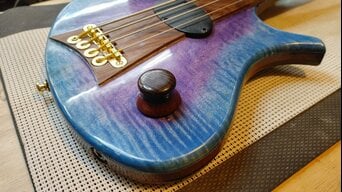
Have the CNC drill the hole as a step, then remove said knob blank and replace with another scrap piece, have the CNC cut a post the same size as your pot shaft/hole to be used as an alignment dowel as the next step, place the knob blank on the alignment dowel and then have the CNC cut the knob as the final step. The CNC would know where center is because it used that center to carve the alignment dowel....Yes, you could, but then there is a problem of alignment. With the hole on the bottom of the blank, how do you know precisely where the center of that hole is so you can make the outside of the knob concentric around it?...


I am curious why you want to be that precise. I could see the argument if you were going to set the knobs into counterbores in the body with very little clearance. (Somebody posted a picture like that recently in another thread, can't remember which one.) You probably could see an eccentricity of a few tenths in a radial gap of a mm.I also realize I probably didn't explain my problem that well initially: I want the center of the pot shaft to be aligned with the center of the knob to less than tenths of a mm (a few thousandths of an inch). More precise than I could be with measuring and marking by hand. Perhaps my true problem is I am trying to be more precise than I need to be!
Have the CNC drill the hole as a step, then remove said knob blank and replace with another scrap piece, have the CNC cut a post the same size as your pot shaft/hole to be used as an alignment dowel as the next step, place the knob blank on the alignment dowel and then have the CNC cut the knob as the final step. The CNC would know where center is because it used that center to carve the alignment dowel.
Make a jig to hold the workpiece upside down while you cut the hole, then flip it onto another part of the jig with a dowel pin that keys into the hole? Then you could program a pause to allow you to flip the workpiece and you'd know the exact positioning for each step.


I am curious why you want to be that precise. I could see the argument if you were going to set the knobs into counterbores in the body with very little clearance. (Somebody posted a picture like that recently in another thread, can't remember which one.) You probably could see an eccentricity of a few tenths in a radial gap of a mm.
Deviations caused by sanding and finishing could also be on the order of tenths of a mm, possibly making machining accuracy somewhat moot. You might have to settle for making more knobs than you need and choosing the best ones at the end.
We have a saying at work, "perfect is the enemy of good enough." The perfect solution that never comes is worse than the solution that is good enough and ready to go.Even if it's not perfect it may be good enough.
I want the center of the pot shaft to be aligned with the center of the knob to less than tenths of a mm

That might actually be the best solution. Or three, because with two you can only centre it in one plane.Then a slight oversized hole with 2 grub screws to center the knob with
I figure with a D shaft or a split shaft 2 would work (provided your grub screws were precisely centered on the knobThat might actually be the best solution. Or three, because with two you can only centre it in one plane.
 ). For a solid round shaft you'd need 3.
Hey, stop it. I wouldn't say that. Maybe a little nuts, but there's nothing wrong with that.because I have no life.
off-centre
That's OK, all the extra U's are worth a point each, so I'll still come out ahead in the long run.However, I did have to deduct a point for spelling.