• TalkBass has been independent since 1998. Add your voice.
    Create a free account to reply to discussions, view embedded media, and browse with fewer display ads.
    Join freeLog in
    Want zero display ads or expanded classifieds tools? Compare plans.

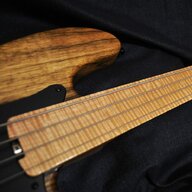
One piece black walnut crotch headless 6 string

One slight variation on your approaches that IS CNC-able:
-- form the body of your knob on the CNC, from the top
-- drill the 1/4" hole from the top
-- after all the remaining processes, add a cap to the knob.
For a wenge knob body a cap could be ebony, maple, holly or more wenge. The only knobs I made actually were wenge, and the cap I used was teak to match the top. Never saw any eccentricity when turning the knobs.
 
  • Like
Reactions: Jeff Siddall
Found the 6-years old pics. Really only the last 4 or so would apply to capping CNC-created knobs, so some of this may be a waste of space.
Knobs1-block.jpg

Knob prep, seen from the bottom, but the point is that they're drilled through.

Knobs2-separating.jpg

Knobs now separate.

Knobs3-turning.jpg

Turning all 4 on the drill press. At the top there's a large T-nut. At bottom there's a ball bearing with a bolt sticking up. Top of bolt is turned to a cone-shaped point. The head of the long 1/4" bolt that is the mandrel for the 4 knobs is recessed. Seems crude, works great since only the bearing spins.

Knobs4-tapping.jpg

Pilot hole for tapping the knobs for the grub screws. The Vee block and dowel make the holes just about perfectly centered.

Knobs5-grubs.jpg

Grub screws in. Tap, add CA, tap again as suggested above.

Next post you'll see the part that applies to from-the-top capping the knobs.
 
Since I have a bunch of slabs of suitably thick maple on hand, I got to thinking that it might be a good idea to do a test run of the one piece build process using hard maple to build a 4 string version first:
View attachment 4488654

That paper template is strategically placed on the board to avoid all the existing checking, though I fear that over the next year the checking might get worse to the point of making the board entirely unusable. Only time will tell, which of course will only further delay the walnut bass.

Still, increasing the chances of success with the crotch walnut seems like a worthwhile path. If/when I start the maple build I will post the pics in this thread.

Maybe this will be a 2 for 1 thread :thumbsup:

Or maybe 0 for 2 :bawl:

Really hoping for the former!

Update on the pre-one-piece-walnut-6-string one-piece-maple-4-string build: Back in late 2021 I cut down the maple slab to about 8" longer than the bass will be, sealed it, and left it to dry for the past year and a half. I have been checking the weight of the ~1' long offcuts since then and they have been at equilibrium for almost a year now. I think it is safe to start trimming the one piece down to be a more BSO this spring.

Unfortunately, all the waiting for the wood to dry left me too much time to think about how much work this "test run" bass was going to be, and how much I would like to make it look better than just a plain maple bass. That thinking eventually lead me to buy some more exotic woods for the fretboard and top, so it has effectively become a 3 piece bass. Also in that time, I wrote a script for cutting twisted necks so I might as well add that to the mix too!

All that to say that, since that project has taken on a life of its own it deserved it's own build thread:

Three piece maple/amboyna/ziricote twisted headless bass
 
I had the day off on Friday so did some work on the bridge for this build. I decided I should try to improve the design of the original one (back in post #20) to give finer tuning control. The original design used standard M5 thumb screw for tuning, but that is only 0.8 mm per turn (about 32 TPI) which is less than idea.

Since off-the-shelf parts for finer threads using the original design aren't available, I instead designed a brass pull block using FreeCAD that I put my own threads into:
bridge_pull_block_cad.jpg


This design uses M3 fine threads with 0.35 mm per turn (equivalent to 73 TPI). Much better, though much more work too. Theoretically, the threads should have been strong enough for even the highest tension typical strings. More on that later. Anyway, a few hours later, here is the finished block:
bridge_block_finished.jpg


I detailed the procedure over on Bruce's "Making Custom Metal Hardware" thread if anyone is interested.

Then onto the test board to see how it performed. Good news, I could tune a 0.065" D string to pitch with no issues. This is the highest tension string of the set I plan to use on this bass, at just under 50 lbf:
bridge_block_test.jpg


Due to the fine threads, the screw was easy to turn with only a cm or two of leverage on the hex key. Of course, I would also need to attach the cap screw to some kind of knob if I were to make it finger adjustable.

Unfortunately, when testing, I started with only a couple of turns of thread in the block before beginning tensioning. That meant only about 6 mm of thread was engaged for full tension. After a couple of tension/release cycles the threads pulled out:
bridge_thread_failure.jpg


Ugh :crying:

I may end up having to go to a bigger screw with correspondingly coarser threads (ex: M5 x 0.5) but I haven't given up all hope on fine threads yet. I have room for about 11 mm of thread in the block, so if I started with about 5 mm engaged (about 15 turns) the threads may be strong enough. I might also try using a smaller pilot hole. I used 2.6 mm this time, which is recommended for M3 taps, but I could go a smaller since I have a 2.4 mm (3/32") bit on hand. This might make the threads deeper and stronger, though potentially at the cost of binding when adjusting.

More testing required.
 
Last edited:
Might well be fiscally impractical, (and evidently I already mentioned them back in post 21... :facepalm:) but:

I see taps at McMaster for 3/16-100 and 1/4-80 (it's McMaster. No, they are not cheap. Might be cheaper somewhere else.)

And I see matching thumbscrews if you don't want to turn your own. Not shockingly, no handy inexpensive cap screws for that threading...

Though I do see "raw" adjuster screws from other sources (apply your own head/handle) which appear to be slightly less expensive, without bothering to check shipping cost and other "gotchas" (though one supplier of screws had the "gotcha" of use their pre-threaded bushings or no guarantee the thread would interchange with others, so possibly wonky in tolerances or thread form)

So 4.76 and 6.25 mm at finer threading that what you had on 3mm. They are UNS thread size (special)

When shrinking the pilot hole, tap breakage is the real reason not to overdo that. Broken taps are expensive and a PITA to get out of the hole (or you have to scrap the part with the broken tap stuck in it.) 75% thread depth tap drill is 2.66mm/0.105", minor diameter (100% thread depth) is 2.62mm/0.1032" per this reference for that M3 fine pitch size https://www.machiningdoctor.com/threadinfo/?tid=2009 so you are already at 100% thread depth (coarse pitch has a smaller shaft and thus a smaller hole in the female thread than fine pitch does. A chart for M3-0.5 will lead you astray.)

Then again, perhaps what you need is to put a steel M3-0.35 nut in the back of your brass tuner block, rather than tapping the brass, to have stronger female threads.
 
Last edited:
Might well be fiscally impractical, (and evidently I already mentioned them back in post 21... :facepalm:) but:

I see taps at McMaster for 3/16-100 and 1/4-80 (it's McMaster. No, they are not cheap. Might be cheaper somewhere else.)

And I see matching thumbscrews if you don't want to turn your own. Not shockingly, no handy inexpensive cap screws for that threading...

Though I do see "raw" adjuster screws from other sources (apply your own head/handle) which appear to be slightly less expensive, without bothering to check shipping cost and other "gotchas" (though one supplier of screws had the "gotcha" of use their pre-threaded bushings or no guarantee the thread would interchange with others, so possibly wonky in tolerances or thread form)

So 4.76 and 6.25 mm at finer threading that what you had on 3mm. They are UNS thread size (special)

When shrinking the pilot hole, tap breakage is the real reason not to overdo that. Broken taps are expensive and a PITA to get out of the hole (or you have to scrap the part with the broken tap stuck in it.) 75% thread depth tap drill is 2.66mm/0.105", minor diameter (100% thread depth) is 2.62mm/0.1032" per this reference for that M3 fine pitch size https://www.machiningdoctor.com/threadinfo/?tid=2009 so you are already at 100% thread depth (coarse pitch has a smaller shaft and thus a smaller hole in the female thread than fine pitch does. A chart for M3-0.5 will lead you astray.)

Then again, perhaps what you need is to put a steel M3-0.35 nut in the back of your brass tuner block, rather than tapping the brass, to have stronger female threads.

Yes, I had looked into those 100 TPI options, but the "fiscally impractical" part drove me to find other solutions. Basically, I would be in for about $200 shipped for just the adjusters and a tap for this build, at which point I am in the realm of buying commercial tuners. Also, I had some FUD about compatibility of the threads.

There is also the very real concern of thread strength. Finer threads are also shallower threads and the ultra fine threads I found specs for were rated pretty low, for example: "Max Load: 6.8 kg (15 lbs)". That's only about 1/3 of typical string tension.

Having now tried, and failed, with the M3x0.35 parts, I have some doubts about how well M3 things will hold up over time, even if I can ensure longer thread depth. Apparently Steinberger used M3.5x0.6, which is a coarse thread (42 TPI), for their bridges. Is going finer than that sure to be better?

A viable, and relatively inexpensive, alternative may be to use an M5x0.5 thread. This is 20% finer than Steinberger used, but the bigger diameter should make up for the lost thread strength of the finer threads. I think I will try that next.

I would still like to try an ultra fine thread option. I see there are M6x0.25 taps and adjuster available (102 TPI), but that is an expensive test if the threads can't take the 50 lbf. required. The tap is about the same as 5 of the adjuster screws, but is a one time cost. I already have plans for two headless builds, so the cost would be amortized a bit. Hmmm...
 
I started reading and was instantly concerned about the tension on those fine threads. :( :thumbsdown:

You and me both!

I have ordered a M5x0.5 tap, 4.5 mm drill, and a set of cap screws. Those threads are both coarser and larger so should entirely resolve the thread pulling out. Less fine control (51 TPI) but still better than commercial tuners (42 TPI) so hopefully good enough.
 
Last edited: