• TalkBass has been independent since 1998. Add your voice.
    Create a free account to reply to discussions, view embedded media, and browse with fewer display ads.
    Join freeLog in
    Want zero display ads or expanded classifieds tools? Compare plans.

Orange Isobaric Cabs, SP212, SP410 questions

Link to JLAudio Isobaric Overview

There is a -3dB loss of sensitivity in the isobaric model.
This is offset by the +3dB gain in output from the power draw of two drivers in parallel.
The net result is a zero sum change in loudness at a given knob setting with a SS power amp.

The isobaric downsides:
  • Higher cost of two drivers
  • Weight of two drivers
  • Build complexity for two drivers
  • Halved impedance and 2x power draw with SS amps
The isobaric benefits:
  • Identical bass response from smaller box
The intended upside of the isobaric is reduction in cabinet volume.
When Harry Olson invented these, loudspeakers required very large boxes for bass response.

Assume somebody wants to run an Eminence Delta 15LFa (95 SPL) in the Flat (F3 = 24 Hz) alignment.
This requires 21.8 cubic feet, which is reduced to 10.9 cubic feet with an isobaric design.
The 2nd driver weighs 12.8 pounds, and I suspect the amount of wood saved with the smaller box might balance this.

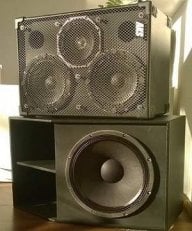
I think you guys have covered it pretty well, but I look at it a little differently.

When two woofers are coupled in this way, they, in every sense, become a single woofer with different characteristics.

To wit: The fs is unchanged (almost), the compliance is halved, the Qts stays the same. The sensitivity is halved.

Now you have a woofer which weighs twice as much, costs twice as much, and is half as efficient as a single woofer designed to have the same characteristics, which works well in a smaller enclosure.

Why not just make a single woofer with these characteristics, or in fact, with the same parameters, but twice as efficient.

Duh.

The Isobarik concept is utterly impractical, and has failed to stand up to the test of time. For good reason.

Thanks,
Andy
 
I think you guys have covered it pretty well, but I look at it a little differently.

When two woofers are coupled in this way, they, in every sense, become a single woofer with different characteristics.

To wit: The fs is unchanged (almost), the compliance is halved, the Qts stays the same. The sensitivity is halved.

Now you have a woofer which weighs twice as much, costs twice as much, and is half as efficient as a single woofer designed to have the same characteristics, which works well in a smaller enclosure.

Why not just make a single woofer with these characteristics, or in fact, with the same parameters, but twice as efficient.

Duh.

The Isobarik concept is utterly impractical, and has failed to stand up to the test of time. For good reason.

Thanks,
Andy

Hey Andy!

Yeah, that is the 'efficiency' thing I was talking about (efficiency in the sense of complexity, weight and resources, etc.).

I guess (and it is a guess) that the one advantage might be tonality IF the dual isobaric drivers sound pretty much like the single 'non heavy duty driver' in breakup characteristics and general tonality. If this is the case (i.e., getting the midrange punch and 'top of the driver' tone of a more midrange oriented driver with the 'ooomph' of a driver with better mechanical properties).

That is 'kind of' what I heard with the Orange 1212 cab I played, but hard to isolate 'what is responsible for what'.

+1 to all the comments though that it seems the isobaric design will be a 'one off anachronism' that might find a limited place in today's market among a niche of players. Who knows!
 
The part I dislike the most is that although they don't state it specifically, Orange is essentially marketing these as something new and not making the buyer aware that the 212 won't perform as loudly or efficiently as a "real" 212. IMO they are capitalizing on the simple fact that there's no direct comparison....because other manufacturers have abandoned the concept, not because it's new or improved.
 
Why not just make a single woofer with these characteristics, or in fact, with the same parameters, but twice as efficient.

Duh.
My Dad used to say that farming was easy work when you plowed with a pencil.

If it were possible to design a woofer "with the same parameters", i.e. half-sized box, full bass extension and 2x efficiency, do you not think that would be done by now?

That product would be a runaway best seller.
 
My Dad used to say that farming was easy work when you plowed with a pencil.

If it were possible to design a woofer "with the same parameters", i.e. half-sized box, full bass extension and 2x efficiency, do you not think that would be done by now?

That product would be a runaway best seller.

Has been. But you can't pretend its a 2x12 in a 1x12 sized because, because its a 1x12.
 
I do have a hearty laugh at the endless TB debates over nits.
It's a 1x12, no it's a 2x12. Who cares?
Everybody has forgotten the OP's original question:

In my quest for the perfect downsized cab to take on tour, I just stumbled across these Orange cabs, which have definitely piqued my interest. The fact that they seem to generally favor an old-school tone (what with no tweeters), the overall design aesthetic (gotta love Orange), and the diminutive size seem to put them in a category all their own.

I'm curious how they stack up to normal cabs in the tone and volume department.

Back to nit-picking: Please illuminate me as to any driver that runs in half the volume, with the same bass extension, and 2x sensitivity, than a full-sized competitor.
Use the Delta 15LFa, Kappalite 3015LF, BP102, or any other driver of your choice.

I would love to find an equivalent for a BP102 3.98/2 cubic feet, or a 3015LF in 8.2/2 cubic feet, both of course having +3dB more sensitivity, and the same bass response.
 
My Dad used to say that farming was easy work when you plowed with a pencil.

If it were possible to design a woofer "with the same parameters", i.e. half-sized box, full bass extension and 2x efficiency, do you not think that would be done by now?

That product would be a runaway best seller.

"If it were possible?" Seriously? Why would it not be possible? It's possible to construct a woofer with pretty much whatever parameters you want.

The answer to your question is yes, it has "been done" by now. And it's "2x efficiency," compared to the isobarik albatross, not a conventional speaker. It's all relative, no?

Actually, a lot of automotive woofers have characteristics sort of like that- higher stiffness, greater mass.

Andy
 
I do have a hearty laugh at the endless TB debates over nits.
It's a 1x12, no it's a 2x12. Who cares?
Everybody has forgotten the OP's original question:

Back to nit-picking: Please illuminate me as to any driver that runs in half the volume, with the same bass extension, and 2x sensitivity, than a full-sized competitor.

Obviously not nit-picking at all! That's the central question.

Does someone here have the idea that an isobarik system is more sensitive, and not less than each of the woofers when used individually? If so, that misconception could be the source of the confusion.

Because as you know, bgavin, it's a simple matter to decrease the efficiency in order to squeeze greater extension from a smaller enclosure. That's what I do.

And isobarik system does a similar thing, but at greater cost, and more weight.

Thanks,
Andy
 
Why not just make a single woofer with these characteristics, or in fact, with the same parameters, but twice as efficient.

Duh.
Duh is insulting, and contributes nothing. I expected more.

I ask you again, please name the magical driver that offers the same bass extension, 2x efficiency, in half the box volume.
If Acme Bass could make a box using Magic Drivers offering these traits, it would have a runaway best seller.

Q: Why buy a D410-XLT when you could have a box that is 2x more sensitive, same bass extension, and half the volume?
A: You can't, because Magic Drivers don't exist.
 
Duh is insulting, and contributes nothing. I expected more.

I ask you again, please name the magical driver that offers the same bass extension, 2x efficiency, in half the box volume.
If Acme Bass could make a box using Magic Drivers offering these traits, it would have a runaway best seller.

Q: Why buy a D410-XLT when you could have a box that is 2x more sensitive, same bass extension, and half the volume?
A: You can't, because Magic Drivers don't exist.

I thought we were in agreement, which is why I quoted you in the first place. You totally lost me. I said "duh" because I thought it was obvious that we were on the same page.

Again, we are on the same page. There is no magical driver such as the one you want. Sorry to break it to you. I never suggested that such magical drivers exist. If you thought I did, you didn't understand what I said.

If we disagree about anything, please tell me what it is. I don't have time to argue about nothing, for the sake of arguing.

Thanks,
Andy
 
The part I dislike the most is that although they don't state it specifically, Orange is essentially marketing these as something new and not making the buyer aware that the 212 won't perform as loudly or efficiently as a "real" 212. IMO they are capitalizing on the simple fact that there's no direct comparison....because other manufacturers have abandoned the concept, not because it's new or improved.

+1

We need 100% full disclosure from all manufacturers using abandoned concepts. I did see a "push-pull" design mentioned in this thread that claimed lower distortion, more output, ... :hiding:


Science is right more often that wrong, and the science of cabinet design is solid. Yet, Give it a few years, and you'll see more of what has been abandoned as something "new". Only because you can't Radically improve the science.
 
Duh is insulting, and contributes nothing. I expected more.

I ask you again, please name the magical driver that offers the same bass extension, 2x efficiency, in half the box volume.
If Acme Bass could make a box using Magic Drivers offering these traits, it would have a runaway best seller.

Q: Why buy a D410-XLT when you could have a box that is 2x more sensitive, same bass extension, and half the volume?
A: You can't, because Magic Drivers don't exist.

I think I figured out what stuck in your craw.

You seem to think that an isobarik coupling results in "2x efficiency."

You then projected that misconception onto me, and inferred, wrongly, that I was suggesting that you could make a magic driver which is, as you say, "2x more sensitive, same bass extension, and half the volume."

Of course, I said no such thing, and as you say, there is no magic driver, and no, isobarik systems are NOT "2x" as efficient. Quite the opposite.

Thanks,
Andy