
Enjoy the benefits of a premium membership!
Upgrade Account
-
TalkBass has been independent since 1998. Add your voice.
Create a free account to reply to discussions, view embedded media, and browse with fewer display ads.
Join free Log in
Want zero display ads or expanded classifieds tools? Compare plans.
You are using an out of date browser. It may not display this or other websites correctly.
You should upgrade or use an alternative browser.
You should upgrade or use an alternative browser.
Double Bass Orchestral Music Help -- Low C's..
- Thread starter julzifer
- Start date
More options
Who Replied?
I recall there is a Verdi opera that calls for a low-C, C# and D to be played pp at the same time to give an eerie effect. (or was that low- B, C, C#?). Haven't played it though.
The third mov't of Beethoven 9 just isn't the same with out the low-Db at the climax.
The third mov't of Beethoven 9 just isn't the same with out the low-Db at the climax.
If it's Verdi pre-Otello, it was meant to be played an octave higher. He didn't write anything lower than an F or F# before 1887 that is supposed to be played as written. Everything below G (even some F's and F#'s) are supposed to be played up an octave.
There is an optional low B at the beginning of the 4th movement of Respighi's Pines of Rome but more importantly, the opening of the second movement is a 3 part divisi in the bass. The bottom part part goes down to C and really couldnt work in context if it were played up the octave. One of the most beautiful bass/cello moments in orchestral lit.
Hey, Bringing this thread back up. Anyone know any other pieces (apart from Pines of Rome) that requires the low B?
Also Sprach Zarathustra - partway through the slow section that kicks off with the 4 bass fugue. There's an entry of the fugue subject divisi in octaves with the first note being a low B, fortissimo! Playing this in February, just bought a massive old German 5er and it's gonna be sweeeet...
Slightly less authentic but definitely arguable is the last movement of Sibelius 1 - just before figure U. There's a scale descending underneath an F# chord, starting right up on the top string. The last three notes are put up the octave for some reason and it's totally musically unsatisfying to play them as written - they should definitely go down in my opinion. Huge B major climax, why not?
Played some stuff by Helmut Lachenmann a few months ago ('Ausklang' and 'Schreiben') - the bass part quite often split into 8 divisi lines, all of which required the player to have a low B. All the music i've ever done by more contemporary composers esp. Birtwistle and George Benjamin was literally full of passages which were a total nightmare on my other bass (before I got the 5 stringer, a smaller hungarian thingy with a ski-slope extension) because they required so many low notes in loud legato passages, or due to speedy runs and not having time to set myself up for them. Also I was never happy with the intonation. 5 strings make these issues much more easy to deal with!
Composers and conductors will love you if you have a 5 stringer, i've found.... Apparently some students at the Guildhall were doing a Beethoven 9 with Sir Colin Davis and he asked them to put that quaver figure in the coda of the 1st movement down the octave, detuning the B string to a low A!
I found it annoying, though, that it took ages for me to find an instrument (in the UK and in my price range) that could deliver the goods - I've tried several 5ers and they were all pretty terrible in sound, response, feel, everything. Quite often they had hideously high price tags attached too, clearly they were nice instruments before (old english, italian etc.) but the conversion just didnt work for them. I had to take a gamble on a massive old German thing which I got Tim Batchelar to do an excellent conversion on. Thank God it turned out OK, frankly, but even now it's still a compromise as the instrument is huge, (44 1/4" stop) and difficult for solo playing, which makes those auditions all the more daunting. Sounds great at the bottom though. Sorry for the rant, I guess I just feel that more people would play 5 stringers if they encountered instruments that were actually serviceable....
Slightly less authentic but definitely arguable is the last movement of Sibelius 1 - just before figure U. There's a scale descending underneath an F# chord, starting right up on the top string. The last three notes are put up the octave for some reason and it's totally musically unsatisfying to play them as written - they should definitely go down in my opinion. Huge B major climax, why not?
Played some stuff by Helmut Lachenmann a few months ago ('Ausklang' and 'Schreiben') - the bass part quite often split into 8 divisi lines, all of which required the player to have a low B. All the music i've ever done by more contemporary composers esp. Birtwistle and George Benjamin was literally full of passages which were a total nightmare on my other bass (before I got the 5 stringer, a smaller hungarian thingy with a ski-slope extension) because they required so many low notes in loud legato passages, or due to speedy runs and not having time to set myself up for them. Also I was never happy with the intonation. 5 strings make these issues much more easy to deal with!
Composers and conductors will love you if you have a 5 stringer, i've found.... Apparently some students at the Guildhall were doing a Beethoven 9 with Sir Colin Davis and he asked them to put that quaver figure in the coda of the 1st movement down the octave, detuning the B string to a low A!
I found it annoying, though, that it took ages for me to find an instrument (in the UK and in my price range) that could deliver the goods - I've tried several 5ers and they were all pretty terrible in sound, response, feel, everything. Quite often they had hideously high price tags attached too, clearly they were nice instruments before (old english, italian etc.) but the conversion just didnt work for them. I had to take a gamble on a massive old German thing which I got Tim Batchelar to do an excellent conversion on. Thank God it turned out OK, frankly, but even now it's still a compromise as the instrument is huge, (44 1/4" stop) and difficult for solo playing, which makes those auditions all the more daunting. Sounds great at the bottom though. Sorry for the rant, I guess I just feel that more people would play 5 stringers if they encountered instruments that were actually serviceable....
Oh yeah, the orchestra basses in the Tubin concerto have a low B to play, in that part in the first movement with the little cello bass tune! 
Im playing the 2nd cello part on bass, and this piece especially is pretty annoying without the low C. I've actually never had one

I believe that one of our local bassists in the Vancouver Symphony wrote a paper or even a thesis on the notes below E in the orchestral repertoire. His name is Frederick Schipitzky, and he's also a well-known composer. You could probably contact him through the VSO admin office. . .
for the last few decades, i myself have been researching the bass extension and recently invented my own device i have christened the super extension. i travelled across germany searching for the elusive "grosse pollmann". having found and acquired it, i proceeded to convert it to a 6 string bass which is tuned, from the top down, High C, normal G, D, A, E, and a long low B (gotta keep it in 4ths), with a "B-extension" on this low B string, giving me a total range from low F-sharp to the upper violin range. i will debut the instrument at the next isb convention
for the last few decades, i myself have been researching the bass extension and recently invented my own device i have christened the super extension. i travelled across germany searching for the elusive "grosse pollmann". having found and acquired it, i proceeded to convert it to a 6 string bass which is tuned, from the top down, High C, normal G, D, A, E, and a long low B (gotta keep it in 4ths), with a "B-extension" on this low B string, giving me a total range from low F-sharp to the upper violin range. i will debut the instrument at the next isb convention
http://www.talkbass.com/forum/attachment.php?attachmentid=133331&d=1247623427
I bet that one's a b**** for bow clearance. You and OP should hang out....


Has anybody mentioned pines of rome? The first movement is all extension and the fourth has that famous lie b passage. Also contemporary music has a lot of this, composers want to take adantage of the full bass range whether that involves an extension or up in thumb position. I specifically remember playing three hallucinations in the last movement there is a big bass soli passage that has several e flats, the entire section had to tune down and re write the fingerings (only one c extension out of 8. Almost all bass parts have notes lower then e but some of them are trickier then others.
Yayyemen said:for the last few decades, i myself have been researching the bass extension and recently invented my own device i have christened the super extension. i travelled across germany searching for the elusive "grosse pollmann". having found and acquired it, i proceeded to convert it to a 6 string bass which is tuned, from the top down, High C, normal G, D, A, E, and a long low B (gotta keep it in 4ths), with a "B-extension" on this low B string, giving me a total range from low F-sharp to the upper violin range. i will debut the instrument at the next isb convention
Wow, that sounds amazing, are you going to give a recital on it? I'll have to write a note to check that out!
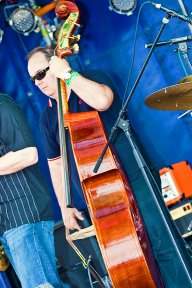
I have seen a few concerts of Shostakovich Symphonies in London with Russian Orchestras and I was surprised that they mostly had 5-string basses.


