• TalkBass has been independent since 1998. Add your voice.
    Create a free account to reply to discussions, view embedded media, and browse with fewer display ads.
    Join freeLog in
    Want zero display ads or expanded classifieds tools? Compare plans.

P bass owners - question about foam muting

Where do you live? How long did it take to arrive? Been eyeing that thing for a while, but I live across the pond.

I don't recall mine taking too long to arrive. I'm really surprised these aren't more common. Given the old school thump people are always describing, I'd think they'd be huge by now.

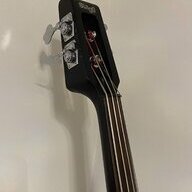
Obvious advantage is that it's on or off with the flick of a lever. A not so obvious advantage is that you can fine tune the amount of contact to the string, getting a very consistent string-to-string sound.

The obvious disadvantage is that it looks a little on the modern side, I guess.
 
I go with the car wash sponge as well. You can move it around between the pup and the bridge for different degrees of mute effect. Shoved all the way down by the bridge is a nice even mellow effect and closer to the pup is a tight decay, very muted effect with all varying levels in between.

It would make sense that above the strings works better for the lower notes simply because of string angle over the saddles. Playing a note higher on the neck shortens the string, which would cause a slightly sharper break angle and bring the strings away from a mute that is above them, and more into a mute that is below them.
 
This just works, doesn't mess with the intonation-tuning and it's cheap.

100_7515.jpg


100_7519.jpg


It's magic if you put it under the strings and non-magical if you put it on top of the strings.

With that goofy (^) declaration, I am only wondering how anyone can honestly believe that above or below makes any difference.

TINK is waiting for your cue
 
I personally don't understand how you could put a mute under the strings and not effect the tuning/intonation. I haven't tried weather stripping, foam, or a sponge, though I have tried various sizes of socks and whatever I try sharpens the pitch. By putting anything underneath the strings and having them touch this material you would shorten the string length, so in theory wouldn't it sharpen the pitch no matter what you use?

I guess the key is to have mute low enough where the bridge is still the main point of contact but the foam just stops the string when it vibrates, but I would still think that would effect the tuning.

Sorry if I seem like I'm putting up an argument, I'm truly not, I would just love to put in a mute without affecting the tuning, but I haven't been able to find a way to do it yet. And I know it can be done because some of you say you've done it, I just don't quite understand the science behind it. Though I guess should explore other materials before I give up. I do believe that the density of the mute's material would vary the amount of sharpening to the pitch.
 
mutes are not my thing but I have a roll of something like this in the garage. I use for pickup foam and once tried under the strings on a 2009 MIA jazz. worked fine. already sticky for when you get your bridge cover. I think they were cut in a wedge shape from the factory...like narrower towards the G string under the ashtray. but im not a bass historian.

Link Removed

all my basses are poly finish, im not sure if this stuff would react with nitro
 
On top or underneath, if it's having a muting effect it's also affecting intonation. How much depends on the setup and how firm the foam is and how much you are using.

IIRC Carole King recommends a felt strip over the strings on a p and felt or foam under the strings on a J. She just says she like the sound better this way.

I use an ashtray with weather stripping glues in on one of my flat wearing Ps, and I put foam underneath the strings on a J with flats very occasionally, specifically for some reggae. Because I prefer it, not because she does, heh, heh.

IMO opinion best results with foam mutes are on a bass with flats, and the muting to be fairly light. It not only decreases sustain lightly but it gives each note a bounce and radically changes the way each note sounds in a mix. It's a wonderful effect in the right music and it's really worth experimenting with.

Palm muting is also a great tool but sounds way different to me.