• TalkBass has been independent since 1998. Add your voice.
    Create a free account to reply to discussions, view embedded media, and browse with fewer display ads.
    Join freeLog in
    Want zero display ads or expanded classifieds tools? Compare plans.

P bass sounds terrible

A little late to the party here but I have some experience recording Precision basses and I will pass on what works for me. Of course, your sound is genre-dependent. What works in one style isn't ideal for another. If we are talking about a classic pbass sound here is what I have had great success with.

I record direct most of the time, sometimes I will re-mic either with a real amp or emulation but I want that direct signal to mix with. Most of the time my direct sound is pretty great and ofter I use it alone.

You need to hi-pass the bass at around 40Hz, (assuming this is a 4 string bass). You will be rolling off all of the frequencies below the open E string. There is where you get rumble and non-musical information out of your bass track.

Then roll off the low end. Set a shelf eq point at between 100 and 250 Hz and roll down to taste. Get a reference recording track you love and listen to how much low end is the recorded track. You may be surprised to find it's often way less than you would think. When you add kick drum and other instruments the overall track gets low end from other sources than just the bass and you need to leave room for that synergy. The less low end on the bass the tighter the track becomes. Of course, genre dictates what is too much low end.

Add some compression. Other than that, you don't need to do a whole lot. It's a Pbass, it will find a sweet place in the mix without too much wrestling.
 
Last edited:
I'm here looking for the "this is how I fixed it" post. @alex1fly can you drop a "this is what was wrong and how I fixed it" post when you do fix it?.

Sure, happy to. I hope to get some music time in this evening or this weekend at the very least.

Too many posts to respond to everyone, but I do thank you all that tried to provide some concrete direction. EQ and levels will be the first thing to try.
 
forgive the dummy-ness but, if I were to de-tune my E string to whatever I am playing at the time, (drop D, C standard, Drop C#, Drop C) would I find the frequency for each of my open low string and HPF that point?
or that just a rule of thumb / starting point is the 40Hz ?
Whatever your lowest note is D or C or B, find the frequency and filter everything below it. Said differently, High pass everything above it.
 
  • Like
Reactions: J-Mags and MrKpawz
My P-Bass is a lot hotter than I gave it credit for. I was setting the input level looking at the average digital VU meter - not the peaks. Turns out I was totally overloading. My sound got a lot better when I started setting my PEAKs at -18 dB. The bar levels look really low, but that is what got me a good signal. Adjusting the gain afterwards is easy, especially after compression.

Also, you might want to try some roundwounds. If not, make sure your strings are new.
 
  • Like
Reactions: One Way
To record I would always have the tone wide open and volume full. Distortion can be tempered by lowering gain. High frequencies can be backed off later. Give the recording everything the bass has to offer. There are so many ways to modify the track once it’s recorded. The one thing I know to be true is that my own ‘73 Precision records beautifully. They have a long standing reputation for recording well. If yours doesn’t, there is something amiss in the process that can be corrected. You just have to find it. There are also interface and DAW settings that may need adjustment.
 
Last edited:
I found listening to isolated bass tracks really improved my playing confidence and confirmed my inability to realize just how much different solo'd bass and bass in the mix sounds... I needed to modify my expectations to align with real world examples.

This is not to say a bass should sound bad or sloppy etc... just that I probably have too much of an idealized concept of how I want it to sound. We are our own worst critics. I will definitely be trying some of the tricks in this thread, as I know there is more I can learn/do to get the most out of my recordings.
 
  • Like
Reactions: One Way and MrKpawz
OP Here. Thanks again to everyone that offered advice. I did some experimenting and re-listening to my archive of recordings and found the following to be helpful:

-My bass input gain is too hot. It isn't clipping, but the strength of the signal dampens the liveliness of my playing. Temporarily solved it by the turning the bass volume down, but I may end up lowering the pickup as well so that I can max the volume control out for consistency.
-The Tone control being wide open helps a lot. These TI flats don't have a lot of high end anyways so it's still pretty dark sounding with the Tone knob at 10. But that still helped a bit to bring out some liveliness and natural feel.
-Mid cut removes some unnecessary beef. If no mid cut is there, need to bring the track volume down. But I like a deep bass sound from the P, so mid cut helps me get there.
-Compression helps even it out, but less compression and better technique is more effective.
-Disabling the amp/cab simulation on the Fractal and using my Sansamp (which is what I use live) helped a lot as well. The Sansamp is dialed for a mid-scooped Ampeg type sound.
-The Low E string is a little farty in general. Hopefully I can address this with pickup height adjustment. If not, it may be time for some new strings. I'm recording more and playing live less these days, and these strings have been in use for 2 years and have been on & off the bass probably 5 times. Their useful life (for the precision of recording vs the utility of live playing) may simply be over.
 
Last edited:
My PJ requires a lot of care when I record on the (GZR) P pickup alone. I have to make sure that the tone is on 10, make sure I'm not overdriving the interface, etc. and sometimes it still sounds bloaty, especially if I'm recording too long without checking on the sound. The main thing is to record at a level you think is far too low, and to keep all the treble in the signal. Just set the gain on your interface really, really low. I saw a YouTube recording video, which may have been erroneous, where a guy was saying that too low of a level is when you can't see it in your DAW, and too high of a level is when you're actually clipping. For a problem bass, err on the low side and you'll be happier.

If you mess up, you can usually rescue the sound with fairly aggressive EQ. Boost the upper mids, cut the lower mids (and occasionally the lows), and if you have to, high pass.

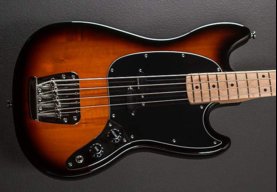
I have a Parts P and a Mustang that don't require such a level of attention, and the same bass is easy-peasy if I'm playing through both pickups. All my basses have flats.

I'll also second what @Dbassmon said, with the proviso that if necessary, you can use your ears to actually high pass above the resonant frequency of your lowest string. When you play an E through most speakers, most of what you're hearing is 80hz or higher. Most Ampeg cabs start to roll off well above 40hz as well. You don't want to overdo it, but it can really save your track in a pinch.
 
Last edited:
I forgot to mention something I nearly always do, and when I don't, I'll wish I had. I duplicate my bass track. Then I high pass it pretty radically. 250 HZ is about the lowest I'll go, 500 is about the highest. Then I'll add some saturation, or even a touch of reverb, and I might add a slight boost around 2-3k. Then I'll drop the slider all the way down, but dial in a little of the high passed track when I'm not cutting through, or if I need a bit more for a chorus.
 
  • Like
Reactions: Need Gigs