• TalkBass has been independent since 1998. Add your voice.
    Create a free account to reply to discussions, view embedded media, and browse with fewer display ads.
    Join freeLog in
    Want zero display ads or expanded classifieds tools? Compare plans.

Passive clipping success!

Jun 4, 2012
315
272
34
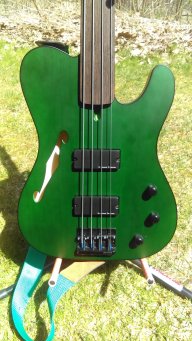
My main bass has had a spare space for a potentiometer or switch for as long as it has been in my possession. The previous owner had it both defretted and had the switchable dualcoil pup replaced with some unknown Emg. With the switch gone, the space was filled with some sort of ikea screw hole plug or something. Anyway I digress. I have installed an on-off-on switch, which selects between a single shottky diode, uneffected bass, and two opposing germanium diodes in parallel. I know that there is not a lot of love on TB for these circuits, but the results I have had are exactly what I was hoping for. The single diode adds a very subtle dirt with pleasing break up. The two germanium diodes are a much more fuzzy/overdriven sounding, but there is a slight volume drop. Not significant, but still present enough to mention. But I am VERY pleased with my results. Everything is passive, I'm just sending signal into a diode and then into ground. I have only within the last month pushed myself to learn about circuitry, and while I am only scratching the surface of an entire world of information, I am very excited about this.
I also built it in a knob-potentiometer style, where turning the knob "up" added more fuzz, but the taper of the pot wasn't great for that application, and it functioned more on/off than I would have liked, so I went with the switch build.

tl;dr passive fuzz works, sometimes well.
 
Last edited:
  • Like
Reactions: petrus61
The shottky is called , at least in this particular code, an NTE585, and the germanium is an NTE109. I do not know what any of that really means, I just used the types of diodes others on the web have used. Oddly, the ratings on the packaging for the diodes differ greatly, which makes me curious why one germanium one shottky finctioned so similarly to each other. I would love to understand that.
 
The shottky is called , at least in this particular code, an NTE585, and the germanium is an NTE109. I do not know what any of that really means, I just used the types of diodes others on the web have used. Oddly, the ratings on the packaging for the diodes differ greatly, which makes me curious why one germanium one shottky finctioned so similarly to each other. I would love to understand that.

NTE are replacement components. I'll have to look up what those parts are similar to when I get a chance. NTE has their own substitutions.

What specs are you noting a difference between? A lot of things are not important in applications like this, and hence you not hearing a difference.
 
  • Like
Reactions: fretless19
For instance, the germanium is rated Vf 1V @200mA, and the shottky at .Vf 6V @ 1 A. I think this is the forward voltage; and I guess the idea that if a milliamp is so much smaller than an ampere, but the volts are in the same range of each other, how does it accomplish nearly the same thing? the fuzz produced by just one of each diode was incredibly similar.
 
For instance, the germanium is rated Vf 1V @200mA, and the shottky at .Vf 6V @ 1 A. I think this is the forward voltage; and I guess the idea that if a milliamp is so much smaller than an ampere, but the volts are in the same range of each other, how does it accomplish nearly the same thing? the fuzz produced by just one of each diode was incredibly similar.


Those are maximum ratings and so are not very relavent:
1V @ 200mA
0.6V @ 1A

Those forward voltages would be quite a bit smaller at the currents involved and could be more comparable to each other.

For example germanium were used for passive circuit clipping because of their low forward voltage compared to silicon. This was typically about 0.25V for a 1N34A. Schottky diodes are also lower than silicon, at 0.4V vs 0.65V.

-
 
Hey folks, sorry for letting the post fall delinquent. Very useful information, thanks! The 585 Schottky is supposed to be equivalent to a 1n5819, and the Germanium 109 is I guess roughly equivalent to the 1n34a. Where do you get these voltages? Is there some way I can test them for that information with my multimeter?