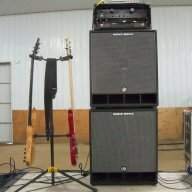
I have an 18" sub with a passive lo-pass filter rated at 125hz. I have a Mackie m1400i amp with a Subwoofer option and two settings: 63hz and 125hz. Interestingly, when the amp is set at 125hz, it cuts out noticably more of the upper end than the sub's built-in passive lo-pass filter does. For example, when I play an .MP3 file through the system, and set the amp output to be full-range, I can hear some faint vocals coming through. When I engage the amp's 125hz setting, those vocals are gone completely. This leads me to believe that the sub's lo-pass filter is "leaking" some higher frequencies, would you agree?
While I can simply run the amp in Subwoofer mode, and set the frequency selector to 125hz, I can't help but wonder if removing the sub's lo-pass filter will result in noticably better sound and/or power to the speaker. I spoke to Mackie yesterday and I was surprised to hear from the rep that I should leave the lo-pass filter in the sub, and don't worry about it, as I would likely not notice any difference, and that the sub's lo-pass filter is probably doing something else to help the sound in the speaker design. It sounds a bit hard to believe, so I am posting here to get opinions from people in the "real world".
It would be nice if Mackie was 100% correct in their answer, because it would offer more flexibility. For example, if in a pinch at a gig we needed to power a full range speaker (maybe a monitor amp dies, or whatever), having the lo-pass filter remain in the sub would enable us to set the amp in full-range mode and let the sub's lo-pass filter do the work, even if it is not an optimal lo-pass filter. ON the other hand, if removing it will yield better results in terms of sound and power to the speaker, I'm thinking I can always put the lo-pass filter in a project box, and run it inline if I ever need to, correct? Or, will it get too hot in a box? FWIW, I made a box with an L-pad that I run that way when I need to (albeit for a different purpose), but it does NOT get hot.
Given that I am currently running banana plugs from the amp to Speakon at the sub on 12 gauge wire, if I do put the lo-pass filter in a box, and end up having to run it that way, would running Speakon to 1/4" adapters in and out of the box degrade the signal?
Thoughts on ANY of this would be appreciated.
While I can simply run the amp in Subwoofer mode, and set the frequency selector to 125hz, I can't help but wonder if removing the sub's lo-pass filter will result in noticably better sound and/or power to the speaker. I spoke to Mackie yesterday and I was surprised to hear from the rep that I should leave the lo-pass filter in the sub, and don't worry about it, as I would likely not notice any difference, and that the sub's lo-pass filter is probably doing something else to help the sound in the speaker design. It sounds a bit hard to believe, so I am posting here to get opinions from people in the "real world".
It would be nice if Mackie was 100% correct in their answer, because it would offer more flexibility. For example, if in a pinch at a gig we needed to power a full range speaker (maybe a monitor amp dies, or whatever), having the lo-pass filter remain in the sub would enable us to set the amp in full-range mode and let the sub's lo-pass filter do the work, even if it is not an optimal lo-pass filter. ON the other hand, if removing it will yield better results in terms of sound and power to the speaker, I'm thinking I can always put the lo-pass filter in a project box, and run it inline if I ever need to, correct? Or, will it get too hot in a box? FWIW, I made a box with an L-pad that I run that way when I need to (albeit for a different purpose), but it does NOT get hot.
Given that I am currently running banana plugs from the amp to Speakon at the sub on 12 gauge wire, if I do put the lo-pass filter in a box, and end up having to run it that way, would running Speakon to 1/4" adapters in and out of the box degrade the signal?
Thoughts on ANY of this would be appreciated.