Thanks Line6man. I was hoping you would chime in here. I'd just like to add some follow up questions if I may.
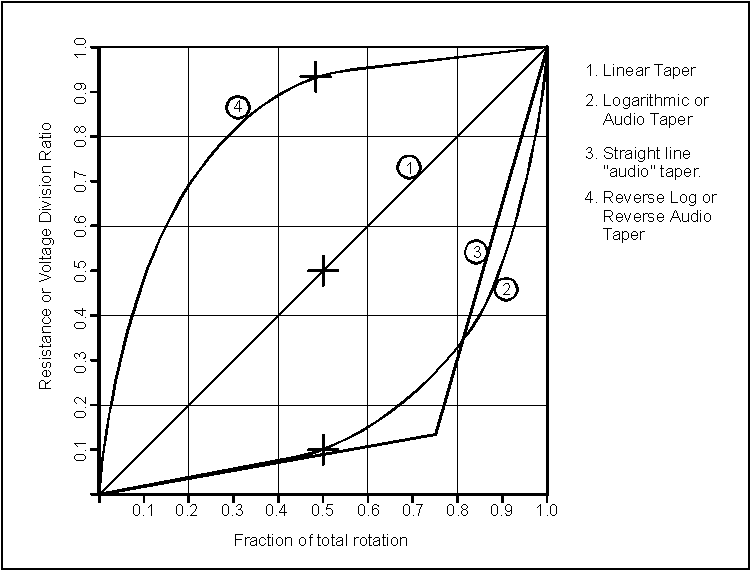
1) what is the difference between linear and audio taper pots?
Audio taper pots follow an approximate logarithmic taper. Linear taper pots follow a linear taper. This changes the way they behave when adjusted.
Makes sense, just to clarify. A linear taper volume pot at 100% open will allow 100% of the available volume through. If it was 63% open, it would only allow 63% of the volume through, and at 21% open, it would only allow 21% of its volume through?
Audio taper would not taper in this same way, they would act as per manufacturer's design?
Are there different kinds of audio taper pots, or do they generally all allow relatively the same amount of pass-through at relatively the same positions?
2) is the answer for number 1, the same for tone and volume pots?
Yes. (Though there are functional differences that make different tapers more or less suitable for different applications.)
Can you please elaborate?
If my understanding of linear taper is correct. I would think that would make adjustment more easily approximated by the end-user.
Can you please give different examples of when different tapers may be more suitable in one application, and when the same may be less suitable for different applications?
3) what's the difference in tone/volume between a 500k TONE pot from a 250k TONE pot?
500k pots allow you to retain a bypassed setting at the end of the rotation, for most passive pickups' impedances, because there is an additional 250k worth of resistance available to place between the signal and capacitor, when you want it.
4) what's the difference in tone/volume between a 500k VOLUME pot from a 250k VOLUME pot?
500k pots are brighter. 250k shifts the resonant frequency down a tad.
So basically, a 500k pot fully open (no taper), will nearly bypass this pot, but a 250k pot fully open (no taper), would still restrict the signal path a bit?
Using a 250k tone pot over a 500k tone pot, would give you a slightly less bright tone even with the pot fully open (no taper)?
Using a 250k volume pot over a 500k volume pot, would give you slightly less output even with the pot fully open (no taper)?
5) if I were to chose say 500k TONE pots, is it advisable to also go with 500k VOLUME pots?
That's personal preference. There is no technical reason to match or not match volume and tone values.
Gotcha. Thanks.
6) what is the difference in tone/volume between 0.47 mf capacitors and 1 mf capacitors?
Both of those values are far too high for standard high impedance, or even low impedance magnetic pickups. You want 0.047uF or 0.1uF, which are an order of magnitude less capacitive. In any case, higher capacitances cause a lower frequency cutoff point, while lower capacitances cause a higher frequency cutoff point.
Thanks for clarifying the values. I had a feeling I would get those wrong.
I don't think I fully understand your explanation here though. Please pretend like you're talking to a 5 year old (because in many ways, you are

).
If the tone pot is wide open (no taper) there will be no tonal difference between a 0.047uF and a 0.1uF capacitor?
Using a 0.047uF capacitor on a tone pot and closing/tapering the pot, would cause the higher frequencies (such as treble range) to be cut off?
Using a 0.1uF capacitor on a tone pot and closing/tapering the pot, would cause the lower frequencies (such as the bass range) to be cut off?
7) if I had the possibility to wire each split coil pickup with independent series/parallel switches, is there an added advantage to include an additional series/parrallel switch to switch the wiring configuration between the two pickups?
That's personal preference. Some people like versatility, while others do not find various options practical.
Understood, but let's say I had the neck and bridge pickup each in their respective series mode, but I switched them to be wired parallel with each other. Would the tone, volume, or output be any different then if I had just put them each in parallel to begin with?
8) is there a difference in signal quality between a Volume-Volume setup and a Volume-Blend setup?
There are functional differences and the practicality of each is subjective.
Okay, but is there a difference in signal loss/quality between the two. Putting personal preferences aside, would one ultimately put out a better quality signal no matter the position of the two respective pots?
I understand that answering these may be a daunting task, but I would really like to have a complete understanding of all of this stuff.
Thanks again.







 You're welcome.