• TalkBass has been independent since 1998. Add your voice.
    Create a free account to reply to discussions, view embedded media, and browse with fewer display ads.
    Join freeLog in
    Want zero display ads or expanded classifieds tools? Compare plans.

Passive wiring questions

I recently came into a 70's Ventura semi-hollowbody that has been gutted. I was given all the original parts as well as new parts to put it back together. I've never wired a bass before so I don't know where to begin.

I have brand new pots all labeled WD500 and a new 3 way selector. the bass has 2 old ass pickups, I'm guessing are humbuckers of some sort or another (how can you tell?). The body is pre-drilled for 4 pots plus the switch. If I wanted to wire this passively with a VVTT setup that uses the 3 way switch as a pickup selector, can I use 4 identical pots? The wiring diagram I've found doesn't include the switch, how would I incorporate that into the circuit?

attached is the diagram I've found and tentatively plan on working with.


Aside from the wiring confusion, how to hell does one get anything installed inside a semi-hollow instrument? There is zero room for activities in there!

This is the same model bass as I'm working on:
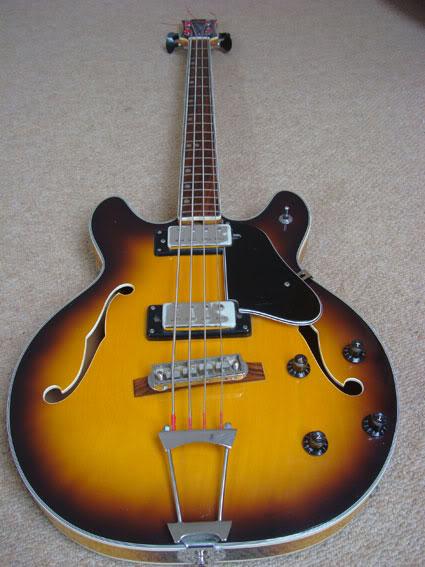
vent_2.jpg


Thanks for any and all help folks!
 

Attachments

You can use a wiring diagram for any two-pickup guitar with individual volume and tone controls, like a Les Paul or ES-335. Now, there's a thing you need to know about: wiring the volume pots. In the standard guitar style wiring, turning down one volume pot will mute (silence) the signal when the pickup switch is in the center (both pickups on) position. Or you can wire the volume pots like on a Fender Jazz Bass, so turning the volume of one pot all the way down WON'T mute the other pickup when they're both on. Seems like a no-brainer, right? Well, there's some other issues with this setup, but I don't know what they are nor do I care. But someone else here surely knows and will share.

As for how to get the electronics in and out, basically what's shown in this video:


I used soft plastic tubing that slipped over and gripped my pot shafts, but basically the same method. Oh, and I had to fish my controls out through the pickup hole, so I had to remove my pickups too. I didn't try to fish the controls out of the F-holes. Pre-assembling the pots and switch on a cardboard template is a great help too.
 
  • Like
Reactions: PatO
Seems like a no-brainer, right? Well, there's some other issues with this setup, but I don't know what they are nor do I care. But someone else here surely knows and will share.

The problem with independent volumes is that they don't function quite as nicely as when you wire the volume pots with their wiper terminals to the output. Jazz basses and other basses with multiple volume pots and no pickup selector, are only wired the way they are (backwards), because there is no alternative. Any time you have the option to wire the standard way, that is usually the best way to do it. Of course, as you noted, it comes at a price. Rolling one volume down too far will kill the output for both pickups. This is why different players have different preferences, depending on their needs.
 
  • Like
Reactions: PatO and Crater
[Invalid or Expired Link Removed]

What's the difference between wiring the capacitors between volume and tone as opposed to soldering it to the tone and grounding on the top?

There are many different ways to physically wire in the components, because neither the pot nor the capacitor have any polarity. Electrically, it makes no difference whatsoever, just as long as there is a capacitor in series with a pot, with the two components running parallel to the signal path.
 
  • Like
Reactions: PatO
thanks line6man. Last question before I attempt to actually do the wiring this weekend: any suggested cap's to reduce the treble and provide a nice warm, low, vintage tone for this semi-hollow body? I have a pair of 50v .02 caps but I've seen posts arguing for 0.22 caps.
 
thanks line6man. Last question before I attempt to actually do the wiring this weekend: any suggested cap's to reduce the treble and provide a nice warm, low, vintage tone for this semi-hollow body? I have a pair of 50v .02 caps but I've seen posts arguing for 0.22 caps.

If you are talking about numerical values in microFarads, 0.22uF is going to kill all of the treble, and possibly all of the bass, too. Completely inappropriate choice. If you are talking nanoFarads, then 0.22nF would be completely useless. Again, a wildly inappropriate choice.

0.02uF is a common choice for tone controls, but be aware that the frequency cutoff is quite high. A lot of people would say that it isn't capable of warming up easily. Consider a higher capacitance, such as the traditional 0.047uF used on 90% of basses.
 
  • Like
Reactions: PatO
If you are talking about numerical values in microFarads, 0.22uF is going to kill all of the treble, and possibly all of the bass, too. Completely inappropriate choice. If you are talking nanoFarads, then 0.22nF would be completely useless. Again, a wildly inappropriate choice.

0.02uF is a common choice for tone controls, but be aware that the frequency cutoff is quite high. A lot of people would say that it isn't capable of warming up easily. Consider a higher capacitance, such as the traditional 0.047uF used on 90% of basses.

The original pots that came with this project have little green caps labeled 50V.02 - I considered reusing them, but the wires are not long enough for my lack of skill to successfully remove and resolder onto new pots. I'm headed out tonight to attempt to find a pair of caps at a local shop/repair center. Is there a specific brand/model you'd reccommend with the 0.047uf rating?
 
The original pots that came with this project have little green caps labeled 50V.02 - I considered reusing them, but the wires are not long enough for my lack of skill to successfully remove and resolder onto new pots. I'm headed out tonight to attempt to find a pair of caps at a local shop/repair center. Is there a specific brand/model you'd reccommend with the 0.047uf rating?

It doesn't really matter in this application, just as long as you have a good tolerance. A good choice would be a film-based capacitor, as they tend to have good specs, and are not expensive.
 
  • Like
Reactions: PatO
As set forth above, how do you get into it? To quote Elmer Fudd, "vewy vewy cawfuwy." It is a pain. I've wired semi-hollow basses and guitars. Never again. As is probably in the video, using thread or thin string tied around the shafts of the various pots through their mounting holes is a good idea. The tailpiece grounding wire is a major issue if it comes loose, because you have to figure out not only how to thread it (usually from the outside in to the jack) but secure it to the tailpiece, usually by wrapping it around its mounting screw. Taking the pickup rings off to try to get any room at all is necessary.

It's not really worth any esoteric wiring diagram. As Line6Man said, just wire it for V-T-V-T similar to a Les Paul and be done with it.
 
The original pots that came with this project have little green caps labeled 50V.02 - I considered reusing them, but the wires are not long enough for my lack of skill to successfully remove and resolder onto new pots.

Whether re-using the original caps, or installing new ones-
use alligator clips as heat sinks between the cap and the solder joint to isolate some of the heat from the cap innards. Using heat sinks, you should be able to re-use the ones you have, and without trying them first, there's no way to really know if you want to use higher value caps or not. Might be a good idea to keep the soldered pots, cap and all hanging outside the sound hole and taped in place 'til you get it sounding as you want, then install it all.
 
This bass has a floating bridge, to ground everything to the tail piece, does it have to be soldered or simply pinched snug between the wood and metal brace?

Just pinch it snug. That's how it works on most basses, including solid bodies. On my hollow bass I ran a wire from pinched under the tailpiece to pinched under the jack plate, since the jack plate is ground. Wiring semi-hollow basses is a PITA. I found it useful to go in through the pickup opening, and have the jack plate off so you can reach through there also, and use a very long thin screwdriver to move stuff around that you can't reach.
 
that video is cool, but there's a few more tricks to wiring these instruments for sure. for instance a quarter inch aluminium rod filed with a groove like a phono plug to click into the output jack is handy to pull it back through of your jack is on the side. a simple blob of blutac on a pencil can be really helpful to lift and pull up wires or pots through holes. be sure to
use shakeproof washers on all your parts.

to earth a tail piece you should use a piece of copper shielding tape stuck to the body underneath. you can solder to this easily and it makes a good electrical contact.
 
Last edited:
  • Like
Reactions: PatO