

Enjoy the benefits of a premium membership!
Upgrade Account
-
TalkBass has been independent since 1998. Add your voice.
Create a free account to reply to discussions, view embedded media, and browse with fewer display ads.
Join free Log in
Want zero display ads or expanded classifieds tools? Compare plans.
You are using an out of date browser. It may not display this or other websites correctly.
You should upgrade or use an alternative browser.
You should upgrade or use an alternative browser.
PEAVEY 80'S AND 90'S AMPLIFICATION
- Thread starter Giffro
- Start date
More options
Who Replied?

Back about 80 I had a 300 head.
Pretty much like a combo 300 in head form.
Sounded clean and punchy through a pair of cabinets I built with Altec 421s.
Almost hifi before that was much of a thing.
300 watts at 4 ohms sounded promising, but since I was running 4 ohms I think it was 150 watts.
Pretty much like a combo 300 in head form.
Sounded clean and punchy through a pair of cabinets I built with Altec 421s.
Almost hifi before that was much of a thing.
300 watts at 4 ohms sounded promising, but since I was running 4 ohms I think it was 150 watts.
That's a very clean and well kept Combo 300!I paid $350 for a Mark IV and 2X15 cab in ‘91 and rocked it for a decade. It’s still my favorite bass head ever. These days I plug into the Combo 300 when I want to rattle the windows.
View attachment 4659886
Combo 300 was 210 Watts @ 4 Ohms, and 300 Watts @ 2 OhmsBack about 80 I had a 300 head.
Pretty much like a combo 300 in head form.
Sounded clean and punchy through a pair of cabinets I built with Altec 421s.
Almost hifi before that was much of a thing.
300 watts at 4 ohms sounded promising, but since I was running 4 ohms I think it was 150 watts.

Looks straight off the showroom floor lollThat's a very clean and well kept Combo 300!
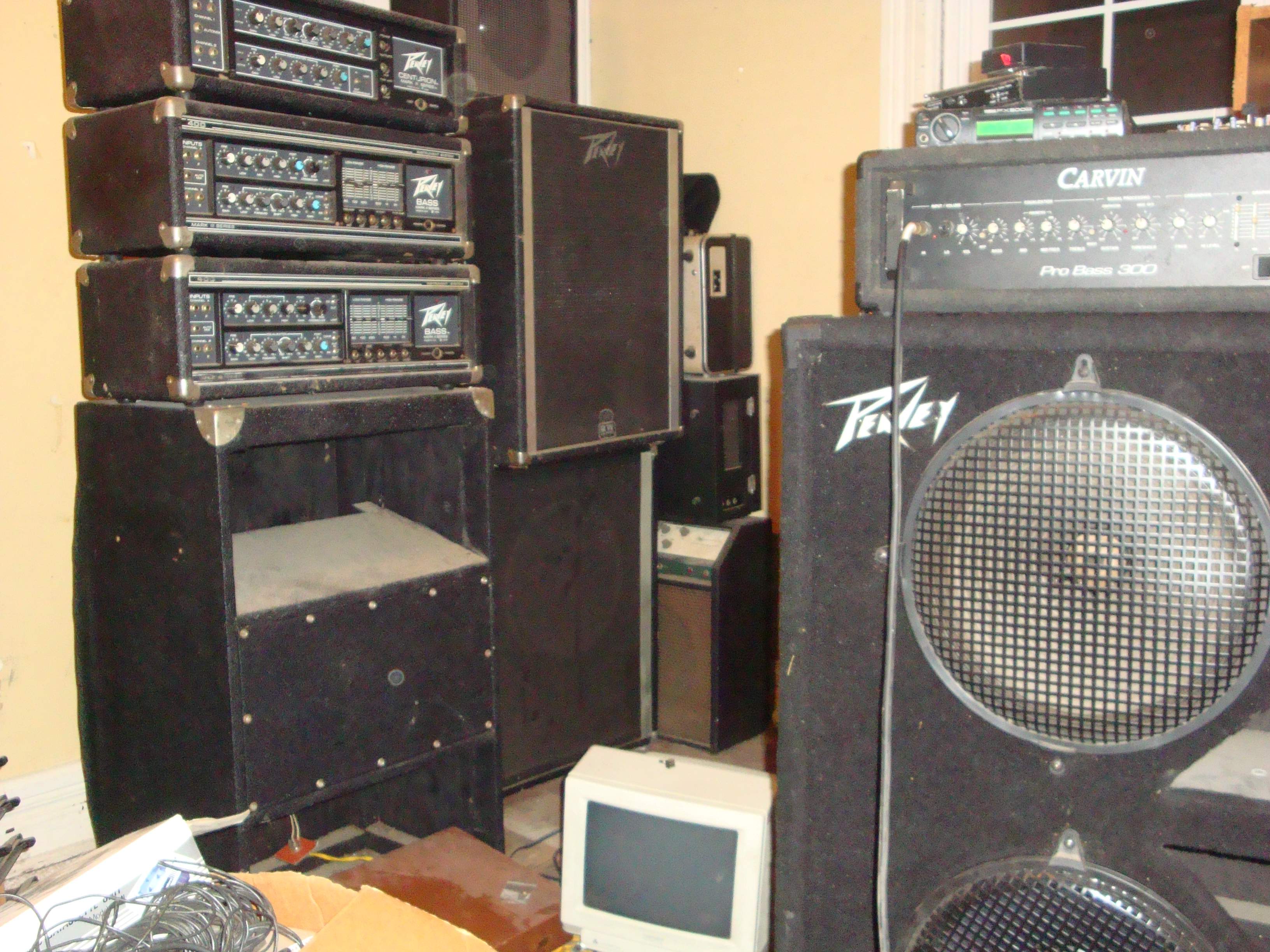
I still have all the Peavey amps and cabinets in the pic. They are also in my avatar. Recently the cabinets
have been dressed up but still in use.
I have switched to Carvin heads a while back do to my old butt not handling the weight of the Peavey heads.

have been dressed up but still in use.
I have switched to Carvin heads a while back do to my old butt not handling the weight of the Peavey heads.

Back in the 80s I thought Peavey were the only bass amps you could buy. The local musics shops must shifted tons of them. Pretty much every local band had a stage full of Peavey amps. It was crazy how popular they were. I had a TNT combo for years. That thing took so much abuse and never let me down. I graduated to a Megabass and matching cab in the early 90s. Both were great amps for their time. Affordable and durable. What ever happened to Peavey?


Nice walk down memory lane. Thanks for posting!
I still have my Basic 40!
I still have my Basic 40!

We're all remembering how heavy Peavy stuff was, I have Boris the Blade from the movie 'Snatch' in my head saying "Heavy is good, heavy is reliable. If it does not work, you can always hit him with it."
That's heavy lollWe're all remembering how heavy Peavy stuff was, I have Boris the Blade from the movie 'Snatch' in my head saying "Heavy is good, heavy is reliable. If it does not work, you can always hit him with it."
Here’s what I’m remembering about Peavey wholesale distribution in those days. Some of the MI industry old timers can correct me if I’m wrong.In the 70s and 80s living in small towns and rural areas meant it was usually hard to get access to Fender and Gibson gear, never mind more esoteric, cult gear from the smaller boutique companies that your guitar heroes were playing. You were going to have to plan a roadtrip to the nearest big city which might be several hours away. But every mom-and-pop music store in the country that sold pianos or band instruments also had Peavey amps.
One of the problems of transitioning to a direct sales system is that you're immediately undercutting your distribution and retail network. If you charge MSRP in order to protect your dealers, the web store might never get off the ground, but if your web store sells at street value prices, your resellers might just decide to drop you before your new platform is self-sustaining since they effectively become nonprofit showrooms on your behalf. Peavey might not have been in a position to be able to take that leap.
- Peavey wouldn’t wholesale to a store that already had Fender, and I think Gibson either. That meant you often saw them sold in Mom & Pop stores that couldn’t get the big players.
- Peavey’s wholesale pricing structure was different than just about everybody else’s; instead of MSRP being 2x wholesale price, it was more like 1.5x? This meant dealers couldn’t routinely knock 40% or so off of MSRP for retail customers like they could for most other brands.
- Feb 5, 2013
- 1,686
- 2,281
- Disclosures
- Endorsing Artist: Used Fender Lead Sleds and Hartke cabs with bent grills
I remember someone provided a backline for an outdoor show many years ago that included a 'red stripe' Combo 300 (PV Classic 50 combo for me, so I didn't have to bring mine from the van ). No PA for the bass, and it wasn't needed cuz it was literally loud and clear enough to carry without being mic'd (this was before the invention of DI  ). Then one of the bands playing after us put what looked like a matching PV 1x15 cab under it that he'd brought and it was deafening. I was standing maybe 5' from him wrapping cables when he fired it up at the same volume our bass player had just used and my ears and head vibrated like I was too close to an 81mm mortar launch. He's like "Umm ... my bad." From a mere 300 watts and a couple 15s.
I've always heard really decent bass tones from that old stuff, and later got usable tones from those amps myself when I started on bass. Especially on the ones with graphic EQ. You could always get something useful from them. And you never worried about it going down mid set.
I miss the old Peavey.
). No PA for the bass, and it wasn't needed cuz it was literally loud and clear enough to carry without being mic'd (this was before the invention of DI ). Then one of the bands playing after us put what looked like a matching PV 1x15 cab under it that he'd brought and it was deafening. I was standing maybe 5' from him wrapping cables when he fired it up at the same volume our bass player had just used and my ears and head vibrated like I was too close to an 81mm mortar launch. He's like "Umm ... my bad." From a mere 300 watts and a couple 15s.I've always heard really decent bass tones from that old stuff, and later got usable tones from those amps myself when I started on bass. Especially on the ones with graphic EQ. You could always get something useful from them. And you never worried about it going down mid set.
I miss the old Peavey.

My first real rig was a T-Max amp into a 115BW and 210TX. Weighed about as much as my first car. Loud. Really loud. Unnecessarily loud. Indestructible - the 210 actually fell out of the back of my buddy’s van on our way back from a gig. The 50mph excursion resulted in a couple bashed corner caps and some scuffed carpet. We plugged it in when we got back and it still worked - no rattles, nothing wrong. Amazing…
That rig was odd in that it sounded MUCH better in a band setting than it did by itself. On its own, there was this glassiness to the upper mids and high end that wouldn’t go away no matter what I did with the eq. A “baked-in” voicing that I never really liked. But in the overall mix it was fine. Weird.
Sold it because I just couldn’t deal with schlepping it around any more and it was overkill for what I was doing those days. Sold it to a guy for what paid for it. Appreciate the chance to use it, but don’t miss it.
That rig was odd in that it sounded MUCH better in a band setting than it did by itself. On its own, there was this glassiness to the upper mids and high end that wouldn’t go away no matter what I did with the eq. A “baked-in” voicing that I never really liked. But in the overall mix it was fine. Weird.
Sold it because I just couldn’t deal with schlepping it around any more and it was overkill for what I was doing those days. Sold it to a guy for what paid for it. Appreciate the chance to use it, but don’t miss it.
My old boss used to say, "We have a showroom, not a museum."The store I used to work at had one that was used. It sat for years and years. I think it was about $150, but the owner of the store would'nt lower the price because he didn't want to lose money.
Just lower the price to move it out!!

WOW !!! If anyone was from the Bay Area and remembers when Banana's at arge was on the corner of 4th and Lincoln in San Rafael and they had all Peavey stuff. The wall was full of new Foundations and Dyna's of every color and the Basic 40 was my dream amp when I was 16. That is THE heaviest 40w amp I've ever lifted. It must weigh 60 lbs.Nice walk down memory lane. Thanks for posting!
I still have my Basic 40!

I'm a little confused by your response, because to the best of my knowledge, back in the day (and currently, with Kiesel guitar and basses - yes, I know they're technically two different companies now), they (Carvin) didn't HAVE a "distribution and retail network"...it was 100% direct sales...so if Peavey went that way, how would they be undercutting anyone/anything?One of the problems of transitioning to a direct sales system is that you're immediately undercutting your distribution and retail network. If you charge MSRP in order to protect your dealers, the web store might never get off the ground, but if your web store sells at street value prices, your resellers might just decide to drop you before your new platform is self-sustaining since they effectively become nonprofit showrooms on your behalf. Peavey might not have been in a position to be able to take that leap.
I definitely can't claim to know much about the music gear retail business. My general thought was that, given that it seemingly worked out quite well for Carvin for so long, it's something Peavey should have at least looked at (and for all I know, maybe they did) - especially given ol' Hartley's philosophy of "not necessarily the fanciest gear, but solid, reliable, pro-level equipment that's within the budget of most weekend warriors" (that's not an actual quote, but having read various interviews with him over the years, that seemed to be the goal he had with his business).
Last edited:
A bit different here in Australia at the time when all music stores, large or small, stocked all the big names like Fender, Gibson, Peavey, Maton and a host of Japanese players then like Yamaha, Ibanez etc. You would often find an authorized Peavey and Fender dealership in the same store, but I guess that wasnt unusual here in Australia where imports etc in the 70's and 80's were done in bulk orders, as Australia was so very far away from everywhere else loll If they didnt have the model or colour you wanted they would order it from overseas and you would have to wait for it. I ordered my Peavey Dyna that way and waited at least 6 months for it back in 1991 lol I waited at least 3 months in 2017 for my white EBMMSR5HH too..nothing unusual here in OZ. The world has gotten so much smaller now...for better or worse.Here’s what I’m remembering about Peavey wholesale distribution in those days. Some of the MI industry old timers can correct me if I’m wrong.
- Peavey wouldn’t wholesale to a store that already had Fender, and I think Gibson either. That meant you often saw them sold in Mom & Pop stores that couldn’t get the big players.
- Peavey’s wholesale pricing structure was different than just about everybody else’s; instead of MSRP being 2x wholesale price, it was more like 1.5x? This meant dealers couldn’t routinely knock 40% or so off of MSRP for retail customers like they could for most other brands.
Last edited:
I had lots of Peavey stuff in my day. Reliable. Decent sounds.
I had 2 Pro-Bass 1000 rack mount preamp’s…very unreliable…
I had a ProBass 1000 and it was fine reliability wise but the tone sucked hard ballz. It was impossible to get a decent sound out of it.
I actually bought it for my first rack rig (it was in a four space rack with a QSC 1400) in 1988 and I wound up using my backup head (Acoustic 220) as a preamp front end for the QSC.
The Peavey just sounded HORRIBLE, HORRIBLE.
Trying to record the thing was even worse, you know that famous Far Side Cartoon where the soundman is reaching for the "suck knob"? Yeah every freaking control on that bass preamp was a suck knob.
It was by far the worst piece of bass gear I ever owned.
I had pretty much stopped using it as I was not playing out live a lot (and as I said it was useless for recording) but when I got back into it I bought an Ampeg SVP-Pro and it was a revelation compared to the Peavey. Still have that, also bought a Sansamp RBI which is a great pre too.
I'd not pay $25 these days for a ProBass 1000, they just sucked.
Analogeezer

Deja vu…I think we discussed this before! Mine sounded ok at home but cut/shorted out often in a gig situation. Sent them back to Peavey for repairs, but it never helped. I couldn’t hardly give them away.
I wanted them to work, they had a lot of controls….but nope…
We are probably one of the few that had these on TB!
I wanted them to work, they had a lot of controls….but nope…
We are probably one of the few that had these on TB!

