• TalkBass has been independent since 1998. Add your voice.
    Create a free account to reply to discussions, view embedded media, and browse with fewer display ads.
    Join freeLog in
    Want zero display ads or expanded classifieds tools? Compare plans.

Pedalboard powered by cordless power tool battery?

Has anyone used a cordless drill battery to power a pedalboard?

I've made a "compact pedalboard" for gigs - just a tuner pedal, EQ pedal and passive DI. But I've struggled with battery power for it - a lithium 9v power-bank made enough RFI to take out FM radio reception, and the rechargeable NiMH PP9 batteries I was using inexplicably ran flat mid-gig last weekend.

Then I was using my cordless impact driver yesterday - it has a 4Ah lithium battery with power level indicator and fast charger... I got to thinking, with a 9v voltage regulator and that's enough power to run it for over 24 hours.
s-l1600.jpg
 
Not me but there are many power banks on the market. And the ones that lack a distinct pedal power plug can be ran thru a usb doodle first that has all those 9v center negative plugs.

The only annoying thing with pedalboard branded battery psus is that they usually don't last long on the market, so getting the usb splitter doodad thing might be a better choice in the long run.

For example I use a falken power bank and as far as I know, they stopped making them.
 
  • Like
Reactions: Gruff
Not me but there are many power banks on the market. And the ones that lack a distinct pedal power plug can be ran thru a usb doodle first that has all those 9v center negative plugs.

The only annoying thing with pedalboard branded battery psus is that they usually don't last long on the market, so getting the usb splitter doodad thing might be a better choice in the long run.

For example I use a falken power bank and as far as I know, they stopped making them.

It's very likely just a tiny market. Most people who run pedalboards are in situations where everything around them is plugged into power. So, it's just easier to get constant clean power from the same sources as everyone else. Plus, many pedals have individual battery options. Thus, the number of people who are searching for rechargeable battery power options for their entire boards is likely limited.
 
Last edited:
Many of us have been powering small, medium and even largish boards with USB battery charger packs and USB A to 9v adapters. I use mine for short jams, gigs and some recording sessions. I started using mine when I did a bunch or one set shows for SXSW for the sake of simplicity.
 
  • Like
Reactions: Gruff
Many of us have been powering small, medium and even largish boards with USB battery charger packs and USB A to 9v adapters.

I spent so long looking for something like this, but failed - yet "USB A to 9v adapter" is all I needed to find something on Amazon. I already have a powerbank for my phone, so it's definitely worth giving this a go. Though I am attracted by the brute power of a set of fully-charged drill batteries, these cables would be a far cheaper option.
 
I spent so long looking for something like this, but failed - yet "USB A to 9v adapter" is all I needed to find something on Amazon. I already have a powerbank for my phone, so it's definitely worth giving this a go. Though I am attracted by the brute power of a set of fully-charged drill batteries, these cables would be a far cheaper option.
Those adapters work fine and the Anker battery I had did about a dozen different sets that powered a small board on one charge for the SXSW that year. The batteries now are smaller, cheaper, have a lot more power. I still use that Anker with my Zoom Q2HD recorder for rehearsals
 
  • Like
Reactions: Gruff
Do it, it's a great idea, except maybe for the proprietary connector those things use. If it's compatible with anything else you use, go for it.

I played a bass at an outdoor party two nights ago lit by a small lamp powered by one. Not mine, it was something the host of said party found for me when the ambient light got so dark I was mis-fretting too often. It faded slowly over the course of three hours but it was good enough. (No, I wasn't playing for three hours, but I alternated with some other people who had a guitar and a clarinet. I wanted to play with them too, but I couldn't relate to anything they were playing, and vice versa I suspect. I like Stranglers tunes.. Between us, we managed to keep everyone entertained.)

One thing: if pedals are all made for 9V and can't take 12V you might want a regulator, or at least a string of three rectifier diodes to drop the voltage a bit.

My Oberheim GM-400 was originally an AC-driven thing, but I modified it for DC. I can use it on a lead acid 7AH battery for long enough, but a lithium-based battery is lighter, and I'd consider a power tool's pack for this purpose, not least because it's lighter and can be recharged faster than lead acid if the proper charger is used to do it safely.

EDIT: I agree with what Two Fingers said too, but while mains power is likely to be had, there might still be lots of chained power sockets or adapters to get enough outlets, so some independent power for important low-drain gear is well worth having. It wouldn't be hard to justify the size and weight of a lithium battery.

MORE edit.. :)
Another thing this might do for you is limit the risk of electric shock, especially if your need is driven by a need to run power for an outdoor show. I had a dodgy ground in a cable provided for the amp I brought with me, and I was able to avoid any dangerous contact but total avoidance would have been better. With a now-unfashionable (therefore cheap) 1:1 audio transformer in your output signal line, you might be able to isolate your pedals and guitar from the amp. OptoFET based isolators also exist with enough linearity to get signal while isolating your own gear from anything that must be connected to the mains. That might be helpful in ANY unknown location you play in.
 
Last edited:
  • Like
Reactions: Gruff
Do it, it's a great idea, except maybe for the proprietary connector those things use. If it's compatible with anything else you use, go for it.

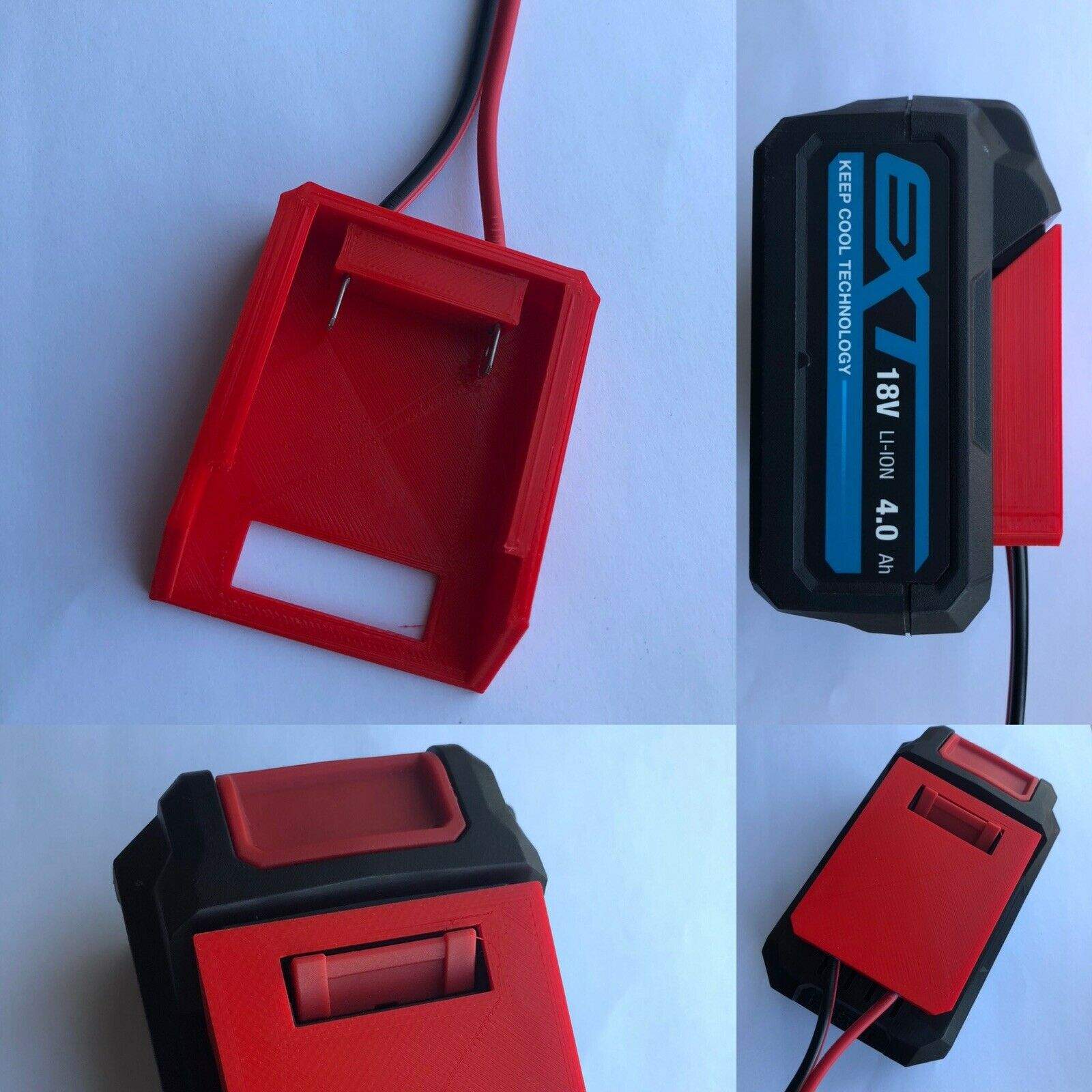
I have a cordless drill, impact driver, wood plane and inspection lamp all using the same battery type - and two 4Ah batteries and two 2Ah batteries. A guy on eBay is selling 3D printed sockets for the proprietary connectors. What I also like is the batteries have a built in bar display to see the charge state. No more running out of power mid-set for me!
 
  • Like
Reactions: Lostgallifreyan
I have a cordless drill, impact driver, wood plane and inspection lamp all using the same battery type - and two 4Ah batteries and two 2Ah batteries. A guy on eBay is selling 3D printed sockets for the proprietary connectors. What I also like is the batteries have a built in bar display to see the charge state. No more running out of power mid-set for me!

Excellent, it sounds to me like you probably have all the skills needed to consider the other notions I edited into that post, and you might end up with the kind of system others want to copy.
 
I've been using a TalentCell battery pack that has a 9V tap. It requires a phase inverter, but is otherwise completely straightforward. Last me months, but I usually only run a Tech21 Fly Rig and an OMEC Teleport for my iPad.
 
As an Amazon Associate, TalkBass may receive commissions from qualifying purchases made via links on this site.
  • Like
Reactions: Lostgallifreyan
I have found that most pedals will run on 12V just as well as 9V.

I have found this too, with several bits of 9V gear, though I'd add a single rectifier diode to minimise the chances of too much heat dissipation in something. For the same reason, you wouldn't best be doing any of this in 40 degree C heat..

In other business, I like your sig: "The world IS getting smaller, but I'd still hate to paint it." It reminds me of something I heard Laurie Anderson perform (via a live radio relay from New York) within a week of the WTC towers being destroyed. A hair-raising show, that one.
 
Unfortunately, the market for battery power supplies for musicians is too small for enough companies to be enticed into the business, because it's a very simple matter to develop a charge controller/voltage regulator that will go directly from standard Li-ion cells to 18 V/12 V/9 V/ whatever, rather than using a standard USB charger (which converts battery voltage to 12 V or 5 V) and then using another voltage regulator (the USB A to 9 V adapter).

Just as bad, or perhaps worse, is using a Li-ion "power station" that outputs 120 VAC: first your have the inverter to get from battery voltage to 120 VAC, then you are plugging in a power supply to down convert that back to 9 VDC. Every time you stick another conversion/regulation/inversion stage in there, you are introducing more loss.