• TalkBass has been independent since 1998. Add your voice.
    Create a free account to reply to discussions, view embedded media, and browse with fewer display ads.
    Join freeLog in
    Want zero display ads or expanded classifieds tools? Compare plans.

Double Bass Pegbox cracked - how to repair

Dear Forum,

my first post here, but I have been reading your helpful posts for a while.
I have been playing double bass for 2 years, a Bassico (german manufacturer) plywood bass, mainly blues and rockabilly/slap.

Unfortunately my bass tipped over (into the corner) and the pegbox broke off.
At Bassico they said new a neck would be about 1500€, the original price was 1700€.
As a skilled hobby craftsman, I am thinking about fixing this by myself.
I want to play again as soon possible.

I have studied diverse forums with divergent opinions on whether repair/glueing is simply possible like here
Scroll crack and break

to completely renew the neck.

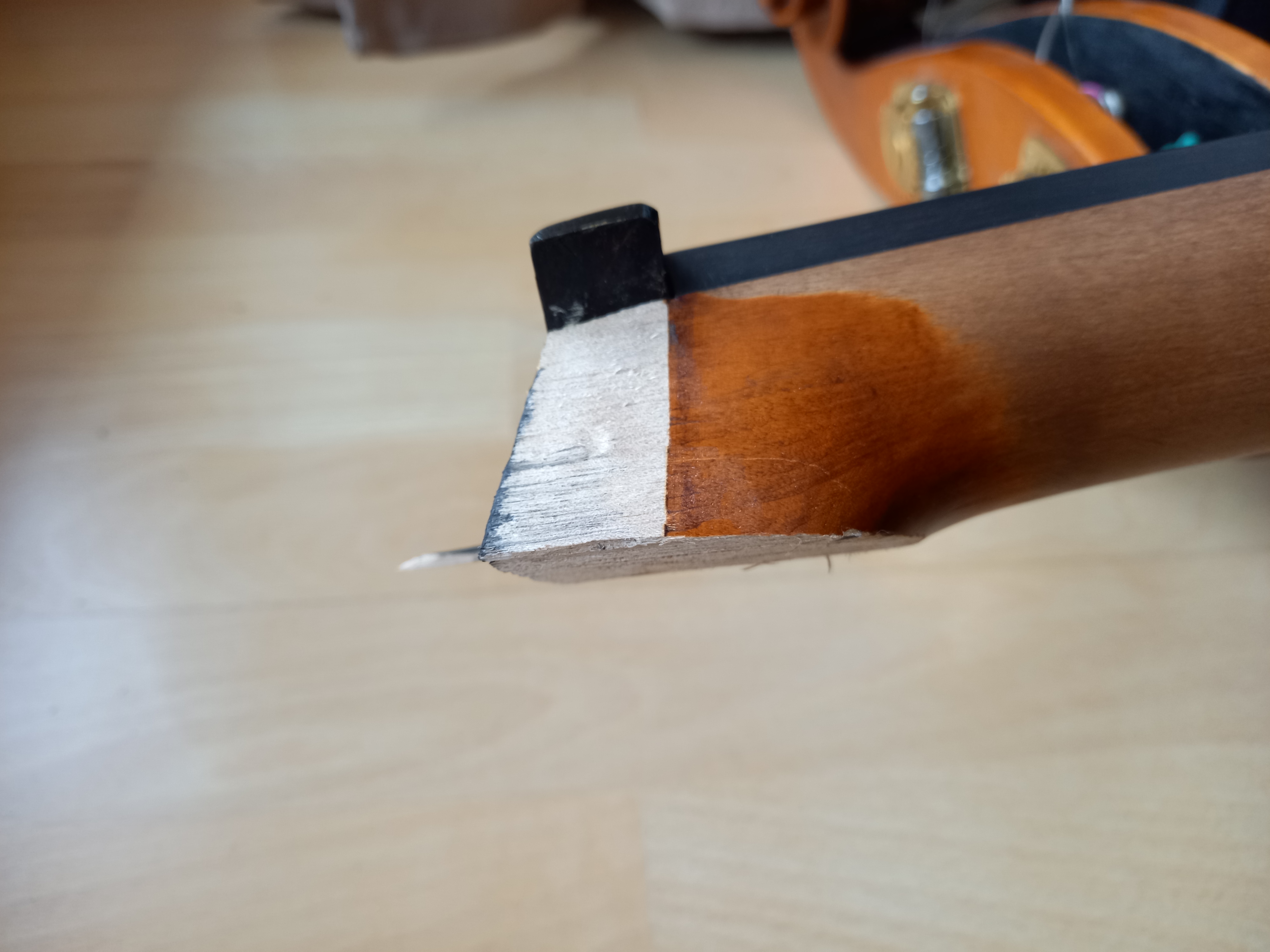
Here are 4 pictures of the damage:
upload_2023-8-13_9-47-10.jpeg

The torn pegbox has several cracks on the bass side. What glue is the best way to fix this or do I need a reinforcement of sheet metal or similar?

upload_2023-8-13_9-48-9.jpeg


Here is the torn pegbox. The break can be reassembled seamlessly, it should be possible to glue this with a good connection.

Here is my question: which glue to use? Bone glue and if so how much % and which supplier would you recommend?

Then the most difficult question:
if glued, will it hold the string force or would I have to reinforce this?
I have also read that dowels or similar can weaken the neck.

I found the following internet articles and would like to hear your opinion/experience on reinforcing with wooden dowels, screws, lamellos, metal or carbon fiber inserts.

I would tend to go with carbon fiber dowels as in the following post.
Wirbelkastenbruch | Kontrabass-Blog

or with a plate crosswise made of hardwood or carbon fiber or aluminum etc., but this is more complex.
bass and cello scroll repair

Then there is a much more elaborate method as described here:
The Scollard "Inner Sleve" Scroll Repair Method

What do you think, could this work and if so, which method would be best in terms of effort/durability?

Thanks for your support and have a nice weekend,

Alex
 

Attachments

  • 20230808_195007.jpg
    20230808_195007.jpg
    850.6 KB · Views: 66
  • 20230808_195007.jpg
    20230808_195007.jpg
    850.6 KB · Views: 54
  • upload_2023-8-13_9-47-10.jpg
    upload_2023-8-13_9-47-10.jpg
    850.6 KB · Views: 47
I had a bass break like that a couple years ago. Because it was a clean break, I used the strongest hide glue I could find (applied liberally to both sides), clamped it, and it's been solid ever since.
Hi, thanks for your response.
What kind of hide glue did you use and how could I identify "that it is the strongest hide glue"? What kind of mixture did you prepare, like 30% in water?

Thanks in advance,

Alex
 
Full strength epoxy. Not 5 minute epoxy. It's the only glue that will work. Yes could a pin into it from the side. You can use 1/4 metal rod, or the carbon fiber. Both are better than a wooden dowel
Hello and thanks for the fast reply!

1. Would you also glue the cracks in the pegpox with epoxy? This would mean to increase the cracks, fill them with epoxy and clamp them. Or would cyanoacrylate be sufficient? Or some liquid epoxy?

2. What epoxy glue would be the best? Araldite? Which one do you use?

3. A pin from the side like here ? In this example two pins were used.
Wirbelkastenbruch | Kontrabass-Blog

I included the dimensions of the cracked part: side length 1,5 cm, inside depth 5 cm, outside 7 cm.
Were exactly would you insert the pins and how deep / long? The peg pox has a width (outside) of 6,5 cm.
The person of the example above wrote about insering the pins in a slighty V-shape to increase pressure on the sides of the pegbox.

upload_2023-8-13_16-35-7.png


Sorry for not giving dimensions in inches!

Thanks in advance,

Alex
upload_2023-8-13_15-53-43-png.5156321
 
Last edited:
Yes, I used it before and already thought about preheating both sides before applying.
They do not offer this glue here in germany, I have to ask for something comparable.
Nevertheless this seems to have about the same strength than the strong epoxy glues.

Hide glue should be used for 99.9% of bass work. This is one time when you have to use epoxy. Hide glue isn't strong enough and you never want it to open up there again. Check the labels for the cure time on epoxy. Have no idea what's available for you. I uses West System epoxy. You have to clamp it over night. think the cure time is 30 minutes. Never open cracks to put in glue. I would work in hide glue since its thinner then epoxy. You should find a luthier to do this. You can fix it forever or ruin it forever
 
  • Like
Reactions: pmad_bass and JBarz
Hide glue should be used for 99.9% of bass work. This is one time when you have to use epoxy. Hide glue isn't strong enough and you never want it to open up there again. Check the labels for the cure time on epoxy. Have no idea what's available for you. I uses West System epoxy. You have to clamp it over night. think the cure time is 30 minutes. Never open cracks to put in glue. I would work in hide glue since its thinner then epoxy. You should find a luthier to do this. You can fix it forever or ruin it forever
Ok, will search for a luthier or alternatively do it myself using epoxy.
Regarding my question/image above: at what position would you introduce a pin to strengthen the construction?
 
First of all, that SUCKS. Sorry this happened, but look on the bright side — you’ll never do that again!

The old school way to repair a decapitated neck was to glue it with hide glue then drill and pin either through the cheeks or the button with a maple dowel. I own a bass that proves doweling through the cheeks is not a permanent repair.

You may wish to reach out to the American luthier Robert McIntosh, who devised a new repair called a shelf graft that is well spoken of and looks promising. It’s technically a challenge but exploits the physics of the instrument in a clever way.

Whatever you do, avoid contaminating the wood with skin oils or other foreign substances so your future glue joint has the best possible chance of success.
 
First of all, that SUCKS. Sorry this happened, but look on the bright side — you’ll never do that again!

The old school way to repair a decapitated neck was to glue it with hide glue then drill and pin either through the cheeks or the button with a maple dowel. I own a bass that proves doweling through the cheeks is not a permanent repair.

You may wish to reach out to the American luthier Robert McIntosh, who devised a new repair called a shelf graft that is well spoken of and looks promising. It’s technically a challenge but exploits the physics of the instrument in a clever way.

Whatever you do, avoid contaminating the wood with skin oils or other foreign substances so your future glue joint has the best possible chance of success.

Hi,
yes I wondered that it completely broke off by just a slow skipping move...
I am sure I will take more care in the future...

I will try to contact Rober McIntosh, thanks for the tip.

Do you think I should clean with some white spirit before glueing the parts?

Thanks,

Alex
 
No. I wouldn’t touch that joint with anything but a brush loaded with hot hide glue.

Petroleum-based glues have their uses, but unlike hide glue you only get one chance. If you epoxy the break and the pegbox cracks and you screw something up, you’ll never get a clean joint without removing wood. If you sink a bolt or a metal pin, the wood will compress around the metal as humidity and temperature change and the neck will need to be replaced.
 
First, very sorry that has happened. Next a key to getting a good joint will be keeping the current break clean. I would put plastic bags over the two ends until a repair is made.

I only have a modest level of repair experience so take that into account. That said, I would would be disinclined to use epoxy if you can get a good fit of the parts. Epoxy can help with gap filling but is usually too thick to really get the kind of coverage and penetration you need here. In addition, with epoxy you get one shot at it. Both epoxy and hide glue when properly applied should be stronger than the original wood.

What ever you use, practice the repair a few time before you do it.

You may want to get a quote from a luthier before deciding to do it yourself.
 
  • Like
Reactions: SAlcott
Ho Bassix,

the best type of hide glue would probably be called hasenleim in Germany. If done well I also think that would be the best way. Although I think professinal epoxy might also an option if you have more experience with that type of work
 
Hello All,

thanks for your valuable input!

in the past I was working with some type of hide glue. It was brown barrels that I dissolved at about 25% in a hot water bath and used it to restore an old secretary cabinet. I remember that I had problems with the glue cooling too fast and not filling gaps.
Here the application is different as the cracked parts fit very well together.

I ordered a bottle of "Titebond Hide glue" and some UHU Plus endfest 300. This is a heavy duty 300kg/cm2 epoxy.
I will do some experiments on some cracked beech wood and will see how I will get along with the materials.
How is your experience with the Titebond Hide glue? Will this fit my requirements?

Regards, Alex
 
  • Like
Reactions: Don Hergert
The Titebond hide glue doesn't have a good reputation among people who have instrument repair experience. It contains formaldehyde to preserve it and also to keep it from setting quickly, unfortunately that cancels many of the desired features of normal hide glue

If you're going to use hide glue, I'd suggest shelving the Titebond for other projects and getting the hide glue suggested by our luthiers here.

Here in the States, grocery store Knox gelatin is often used for more trivial hide glue repairs, but may not be strong enough for a scroll repair.

It's a high tension repair and you'll want everything in your favor.
 
Last edited:
  • Like
Reactions: RSBBass and SAlcott