• TalkBass has been independent since 1998. Add your voice.
    Create a free account to reply to discussions, view embedded media, and browse with fewer display ads.
    Join freeLog in
    Want zero display ads or expanded classifieds tools? Compare plans.

Double Bass Pfreshner

Bleecker

Supporting Member
Dec 21, 2006
2,432
4,578
57
Etown NY. USA
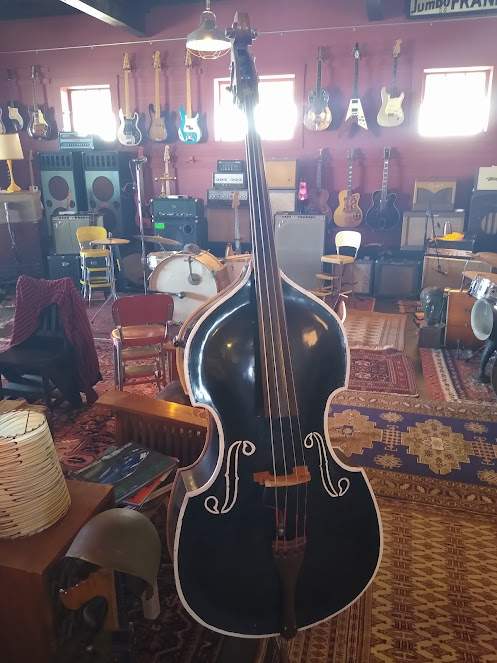
Hey all, This is my big ol' aluminum Pfreshner. I'm mainly a bass guitar player but I've fooled around with this one over the years. Just had it set-up, nice low action.

Is there a way to know what year it is? I'm guessing late 30s early40s...?

Thanks!

2688D585-A2E0-4DDA-A5D6-FF28F94CA655.jpeg
 
Congratulations on a great double bass!

Our own @james condino can provide more exact informatoin, he has handled more of these aluminum double basses than just about anyone living...

Generally the aluminum double basses were marketed at least in the USA for both Alcoa and Pfretzschner in the 1929 to 1934 timeframe. To my knowledge, the Pfretzschner aluminum double basses do not have serial numbers, but the Alcoa double basses do, so there is some tracking of dates by serial numbers with the Alcoas. Pfretzschner were also available in both flat back and curved-shape back configurations, but again I don't know if that indicated any particular age.

We do have a "club" thread for aluminum double basses here if you wish to peruse it.

(Edit: I did go back and correct my Pfretzschner spelling; so much for copy-and-paste :D . I usually just call them "Pfretz".)

Enjoy!
 
Last edited:
The correct spelling (Pfretzschner) will aid your research. :)

Mr. Condino summarized his knowledge in the Spring 2007 issue of American Lutherie magazine. (The article isn't online, but you can order back issues from their site.)

I just skimmed my copy of the story and didn't see a mention of production dates for Pfretzschner basses. Maybe James has learned more in the 16 years since he wrote that article.
 
Thx for the mention.

I believe the black & white bass has been for sale for a while; nice to find a new home for it.

That is a pretty old article! My perspective and knowledge is quite a bit different these days.

The bass was made circa 1930. The aluminum body was produced at the Rubner factory who was a subcontractor for the Pfretzschner family, who then added one of the stock Pfretzschner necks and did all of the setup work. Some of my most prized research data is the handwritten notes I have between the Rubner and Pfretzschner families detailing all of the inside dish about the specs and production, and then Wolfgang Pfretzschner taking about seeing them in the workshop when he was just a child during the depression.

If I can ever find someone to help me with the layout and publishing, I have everything needed for a fantastic book on the history of these basses.

Is that an original Ampeg Reverberocket I see hiding in the background?????
 
Last edited:
Thx for the mention.

I believe the black & white bass has been for sale for a while; nice to find a new home for it.

That is a pretty old article! My perspective and knowledge is quite a bit different these days.

The bass was made circa 1930. The aluminum body was produced at the Rubner factory who was a subcontractor for the Pfretzschner family, who then added one of the stock Pfretzschner necks and did all of the setup work. Some of my most prized research data is the handwritten notes I have between the Rubner and Pfretzschner families detailing all of the inside dish about the specs and production, and then Wolfgang Pfretzschner taking about seeing them in the workshop when he was just a child during the depression.

If I can ever find someone to help me with the layout and publishing, I have everything needed for a fantastic book on the history of these basses.

Is that an original Ampeg Reverberocket I see hiding in the background?????


Thanks for the info, I've owned this bass for 20 years, played blues on it for a short time early on...finally had it checked over and set-up.

I would say yes that is an OG Ampeg, my friend has a great vintage guitar and guitar amp collection.

Cheers!
 
Thx for the mention.

I believe the black & white bass has been for sale for a while; nice to find a new home for it.

That is a pretty old article! My perspective and knowledge is quite a bit different these days.

The bass was made circa 1930. The aluminum body was produced at the Rubner factory who was a subcontractor for the Pfretzschner family, who then added one of the stock Pfretzschner necks and did all of the setup work. Some of my most prized research data is the handwritten notes I have between the Rubner and Pfretzschner families detailing all of the inside dish about the specs and production, and then Wolfgang Pfretzschner taking about seeing them in the workshop when he was just a child during the depression.

If I can ever find someone to help me with the layout and publishing, I have everything needed for a fantastic book on the history of these basses.

Is that an original Ampeg Reverberocket I see hiding in the background?????

Let me ask you this, why/for whom did they start making the aluminum bass.?

Thanks again!
 
Let me ask you this, why/for whom did they start making the aluminum bass.?

Decades ago, I had an Alcoa bass (it was unplayable by humans and sounded like a 55-gallon drum with strings). The story I heard at the time was that Alcoa made an entire line of aluminum violins, violas, cellos, and basses for Interlochen, a summer music camp for youngsters. All but the basses were deemed unfit for making an acceptable sound... so if you find one that's not a bass, it's a real rarity.
 
  • Like
Reactions: Bleecker
My understanding from reading James' and other peoples' documentation is that schools were the targeted customer base and the goal was instruments that were more robust outdoors in difficult weather.

Contrary to many rumors, they were not made by Ford and were not made for the armed services.

While in their native form the tone of an aluminum double bass may be reminiscent of a washtub bass strung with parachute chord, in their defense, they can be toned down...

My Alcoa has been treated inside with acoustical paint, a custom sound post and is strung with fat synthetic strings, and really sounds no more metallic than a wooden double bass strung with steel strings -- unless it is bumped, and then it sounds like a very low frequency version of a Trinidad steel drum.
 

Latest posts