• TalkBass has been independent since 1998. Add your voice.
    Create a free account to reply to discussions, view embedded media, and browse with fewer display ads.
    Join freeLog in
    Want zero display ads or expanded classifieds tools? Compare plans.

Pickup Placement "Sweet Spots" Questions

Obese Chess

You Guys Are Getting Paid?
Supporting Member
Sep 4, 2005
4,713
5,595
Portland, OR
Howdy all,

I am considering my next custom bass and while I could, and will, ask my luthier in the process, it's a slow day at work, I had too much coffee, and I like knowing things, so I figured I'd ask here.

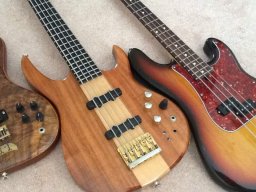
I find that most of the basses whose tones I know for being particularly punchy and aggressive, such as a Dingwall NG-2 and a Warwick Thumb, have their pickups very close to the bridge, as do the Zon BG-3 Bill Gould signature and a few other signature models for rock and metal bassists. However, the bridge pickup of my PJ and Jazz basses, which I would assume is around the same area, is not what I would call aggressive, and that same "aggressive" quality seems fairly hit or miss on Stingray-style basses.

I realize, of course, that there are any number of factors at play here, from wood choice to preamp to pickup wind, but this does seem to be a consistent them with regards to pickup placement.

I guess I am wondering what about the locations of these pickups lends themselves to that kind of sound, and, in a roundabout way, if I were going to design a bass to have a very aggressive tone and put hot pickups in it, where would I want to put those? I hope that makes sense.

Hmm, maybe this is a question for the Luthier's Corner.

Anyway, just curious! :)

Cheers!
 
  • Like
Reactions: Riff Ranger
I can't answer your question directly, but I recently built my first bass. I did pickup placement as one of my last steps before finishing. I mounted the pickup on two small blocks of wood so that I could place the pickup upside down over the strings and then plucked away while moving it to different positions until I found the spot I liked. It's nice and punchy. I think pickup and preamp play a big role as well as placement.
 
Pickup position is an important variable, but it's also really simple. (And, unfortunately, often over complicated when people try to explain it).

Think of pickup placement as an EQ effect. A pickup right in the middle of the scale length - at the 12th fret - picks up the "whole" signal of the string. As you move the pickup towards the bridge, the bass end of the signal is slowly rolled off. Of course, you can't actually put a pickup at the 12th fret, but that's good, because it would have so much low end it would be unusable mud. Pickups placed near the typical neck pickup position still retain a lot of low end, which gives them the big boomy voice we associate with neck pickups. But the bottom end is rolled back enough that they're clear and usable. As you move a pickup even closer to the bridge, you lose more low end, which creates the sensation of the mids sounding more emphasized. That's why most people associate bridge pickup locations as growly and middy, because the low end is rolled back enough that the mids are emphasized.

Most people building basses take a simple approach: Find a bass you like and copy the pickup locations, or tweak them a little if you want a slightly different result. That's a good approach, because the bass tones we've all grown up on and internalized as desirable were created by basses using those famous locations.

Don't ignore pickup selection too - you mentioned the classic stingray tone. That's at least as much due to the pickup and preamp as the pickup location. Ultimately there are a LOT of variables, and it can become easy to get sucked into optimizing one specific variable while unintentionally ignoring others. That's the real magic that an experienced builder will bring to the table, they can help you balance everything to get the result you want.
 
How were the sweet spot for a P, J, and Stingray conceived of originally?
I have always assumed it was derived mathematically based on string vibration on a 34" scale.
 
I think pickup placement is about 80% of the signature tone of most basses. But there are better and worse pickup designs to put in different places, and this is partially about preferences (and other variables, like strings). To really nail a sound from another bass, you have to get all the parts working in harmony.

If it was me, I'd build a test mule, kinda like Leo's Breadboard bass, and move pickups around. Yes, it will sound somewhat different in a different bass, but if you figure out the positions for the pickups you will use, you'll be pretty much there.

The other option is to just go with some proven formula (=positions from one of the basses you like) and pick a common shape (EMG or Bart soapbar) where you can then audition a few pickups with different designs inside.
 
How were the sweet spot for a P, J, and Stingray conceived of originally?
I have always assumed it was derived mathematically based on string vibration on a 34" scale.
Perhaps there was engineering and math involved, but it was probably tweaked for what sounded best for the pickup design.
For example:
The single coil P bass has it's pickup centered at 27 5/16" from the nut.
The neck pickup of a J bass is centered at 27 3/4". (The bridge pickup is anywhere from 31 5/16" to 31 7/8")
The split coil P bass has the center line of both coils at 28.5" (which is roughly one coil centered at 28", the other 29")
The Stingray is centered at 30.5" (one coil centered around 30 1/16" the other 31")
As you can see, each of these pickups keep getting closer to the bridge. The Stingray was pushed back towards the bridge as it gave a more aggressive mid bite. The low end lost by the pickup position was brought back up by the preamp. That's a trick I like to employ on my active J basses: solo the bridge pickup/boost the bass. It's a very aggressive tonality that is still full and supportive.
 
This would be the last guy I would trust with anything technical. Look at the videos of how they run that shop.

I believe it has to do with positioning due to nodes and harmonics as shown here:
Physics Tutorial: Fundamental Frequency and Harmonics
https://www.thegearpage.net/board/i...rmulas-to-determine-proper-positions.1959482/
https://www.frudua.com/pickups-placement-along-the-guitar-scale.htm

Go read the second link you posted. It does a good job of debunking the silly "it has to do with harmonic nodes" theory. Unless you invent a pickup that moves as you fret notes, the wavelengths of the harmonics change for every note you play. A pickup placed at the X harmonic for an open string won't be at X harmonic for any fretted note.

Not to mention the whole visual people seem to have about strings vibrating as standing waves with fixed harmonic nodes that don't move is completely wrong. The harmonic waves on bass and guitar strings travel up and down the speaking length of the string under normal playing conditions - the only time there is a standing wave with fixed nodes is when you artificially cause it to happen, i.e. you pluck a string with a finger touching a harmonic point to cause the harmonic tone we're all familiar with.

People have been inventing math-based explanations for why Leo did things for 70 years. I can understand why something as significant as pickup placement seems to demand a complicated theory, but none of the complicated theories people have invented hold any water. Don't over think this - the pickups were placed based on what made sense from a manufacturing process standpoint, and what made the instrument sound nice.

If anyone reading this doesn't believe it, then go build a test mule. Or take the pickups out of your favorite bass, lay it on a table, put some wood strips on either sides of the strings, and set the pickups on the strips facing down - you now have a test mule! Move the pickups. You'll get small, gradual changes in tone. Move them a little more. You'll get a little more change. There is no secret point at which the sound magically has a significant change. No math formula will tell you a specific point that sounds best.
 
Go read the second link you posted. It does a good job of debunking the silly "it has to do with harmonic nodes" theory. Unless you invent a pickup that moves as you fret notes, the wavelengths of the harmonics change for every note you play. A pickup placed at the X harmonic for an open string won't be at X harmonic for any fretted note.

Not to mention the whole visual people seem to have about strings vibrating as standing waves with fixed harmonic nodes that don't move is completely wrong. The harmonic waves on bass and guitar strings travel up and down the speaking length of the string under normal playing conditions - the only time there is a standing wave with fixed nodes is when you artificially cause it to happen, i.e. you pluck a string with a finger touching a harmonic point to cause the harmonic tone we're all familiar with.

People have been inventing math-based explanations for why Leo did things for 70 years. I can understand why something as significant as pickup placement seems to demand a complicated theory, but none of the complicated theories people have invented hold any water. Don't over think this - the pickups were placed based on what made sense from a manufacturing process standpoint, and what made the instrument sound nice.

If anyone reading this doesn't believe it, then go build a test mule. Or take the pickups out of your favorite bass, lay it on a table, put some wood strips on either sides of the strings, and set the pickups on the strips facing down - you now have a test mule! Move the pickups. You'll get small, gradual changes in tone. Move them a little more. You'll get a little more change. There is no secret point at which the sound magically has a significant change. No math formula will tell you a specific point that sounds best.
It was post #7 that suggested math could have been involved.
OTOH I greatly respect the views of @walterw which reinforces what you say.
While I think Leo got lucky on getting so many things right the first time, he was no slouch when it came to manufacturing or using the RCA tube manual and much of what was developed in WWII to make some amazing amps. There was engineering involved and not all trial by error.
Agreed that he took advice from musicians but @johnk_10 (who knew Mr. Fender) once said that the SR was so bright because he was beginning to loose high frequency hearing as we all do over time.
I find that the most amazing thing is that a non-musician changed the course of electric guitars and basses in less than 10 years assuming one agrees that 90% of his great ideas occurred between 1954 - 1964.
I wonder if he even had a slide rule?
 
Everyone already knows that.
What I don't remember anyone ever saying though, is that the pickup to bridge distance does NOT change.
Oh, never mind.

Sorry, friend, that was directed at the OP, not you.

I can see how maybe you thought I was replying to you (since my post was the next one after yours) but I assure you, I hadn't even read your post yet, at the time I made my reply. If I were replying specifically to you, I would quote you so you'd know it. (Like I did here) :)

You make a good point about the distance between the pickup and the bridge being constant. I have no argument with that.
 
  • Like
Reactions: LetItGrowTone