
Enjoy the benefits of a premium membership!
Upgrade Account
-
TalkBass has been independent since 1998. Add your voice.
Create a free account to reply to discussions, view embedded media, and browse with fewer display ads.
Join free Log in
Want zero display ads or expanded classifieds tools? Compare plans.
You are using an out of date browser. It may not display this or other websites correctly.
You should upgrade or use an alternative browser.
You should upgrade or use an alternative browser.
Double Bass Pictures at an exhibition
- Thread starter Andy Mopley
- Start date
More options
Who Replied?
- Jan 24, 2002
- 2,117
- 950
- Disclosures
- NS Design / AER Endorsing Artist
Yes, Paul (please forgive my ignorance)..Is the Ravel orchestration the more widely played version? Or different from the "standard"?
I played it in high school… so, about 20 years ago. I love the piece, but I don't remember a bass solo… I do remember other cool parts in it though that are a bit tricky, but not too difficult; Baba Yaga is fun, and those fast fourths going up the neck are a little tricky, and then there are those runs in "The Great Gate…"
Also, yes, the Ravel orchestration is by far the most common, though there are others which get played from time to time.
Also, yes, the Ravel orchestration is by far the most common, though there are others which get played from time to time.

I played it in high school… so, about 20 years ago. I love the piece, but I don't remember a bass solo… I do remember other cool parts in it though that are a bit tricky, but not too difficult; Baba Yaga is fun, and those fast fourths going up the neck are a little tricky, and then there are those runs in "The Great Gate…"
Also, yes, the Ravel orchestration is by far the most common, though there are others which get played from time to time.
I have played the Tushmalov orchestration.
Joe
I played it in high school too, but band, not orchestra. I played tuba. What a great piece of music.
Played it many times. There is no bass solo in the Ravel orchestration. There IS a unison/octave passage with the strings in the 6th movement you need to look at. The part is on IMSLP if you need it.
From same work, does this look correct (fingers and strings) , starting upbow and down on the g flat, second bar...Thanks!
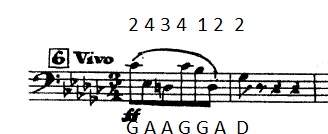

Thanks Carl, the thought had crossed my mind...but what is the "economic" alternative, play them along the G and D string only? (where D I'd play as open string)..And sorry, just noticed the d note is natural, as well...
Yes, do that. 4th finger on the first C flat and go from there. This is very fast, something like each measure = 80....but what is the "economic" alternative, play them along the G and D string only? (where D I'd play as open string)..And sorry, just noticed the d note is natural, as well...

Down (4 - Cb on G-string, 1 - Eb on D-string, open D); Up (4 - Cb on G-string, 1 - Eb on D-string, open D); Down (4 - Gb on D-string).
For the Samuel Goldenberg theme, I play it all on the G-string so there are lots of subtle, portamento smears. Rip into it in a very pompous manner as a contrast to the wheedling trumpet.
For the Samuel Goldenberg theme, I play it all on the G-string so there are lots of subtle, portamento smears. Rip into it in a very pompous manner as a contrast to the wheedling trumpet.
Down (4 - Cb on G-string, 1 - Eb on D-string, open D); Up (4 - Cb on G-string, 1 - Eb on D-string, open D); Down (4 - Gb on D-string).
Thanks bejoyous - can you please explain the down up bowing pattern though? At that (break neck speed) and also because the way the music is notated, shouldn't the first bar be in one bow motion only? Or is it that because of the speed you can actually bow down up without a noticeable difference? I must admit I hadn't thought about your bowing suggestion!
Unless you are principal, bow it as you are told to bow it. Doing your own thing gets you noticed - and not in a way you want to be noticed.

I am just practicing this piece 'cause I like it, so I guess I am the principal! 
Down bow for the slurs and use bejoyous' fingering. Use lower half of the bow to keep string crossings tight and move contact point a little closer to the bridge to compensate for less bow. Keep LH fingers low, only high enough to articulate clearly. Feel for a balance between LH and RH.
It will never be easy to play!
DP
It will never be easy to play!
DP

Down (4 - Cb on G-string, 1 - Eb on D-string, open D); Up (4 - Cb on G-string, 1 - Eb on D-string, open D); Down (4 - Gb on D-string)."
It's a good idea to play the notes on the page. Your second Eb on the D string is in fact a Bb on the G string, and should be played with the second finger. It's not an audition excerpt but deserves the correct pitches.
I have broken it up into two bows sometimes {bejoyous' bowing) with success, but I am a Frenchie and it may work differently for German bow. Reality is that it is so fast and the bass can't speak with full tone that quickly so just go for loud first and as many notes as possible in order to add weight to the other higher strings. As Principal be mindful of, but not blindly obedient to, the Principal Cellist's bowing. As Tutti player be versatile enough to follow your leader ASAP.
If you are studying orchestral parts for fun I am sure we could start a new thread of suggested pieces and why them.
Cheers, DP
If you are studying orchestral parts for fun I am sure we could start a new thread of suggested pieces and why them.
Cheers, DP


