• TalkBass has been independent since 1998. Add your voice.
    Create a free account to reply to discussions, view embedded media, and browse with fewer display ads.
    Join freeLog in
    Want zero display ads or expanded classifieds tools? Compare plans.

PINO PALLADINO SMOOTHIE FLATS

I just ordered an extra light Pino set and a couple of players that I know really like them.
My favorite flat wounds are the Italian Dogal Jaco Carbon Steel Flats but they are now well over $100.00 with shipping, thanks to the tariffs.
From the pictures I've seen, the EB's outer wrapping looks identical to the Dogal in terms of smoothness and hopefully feel.
I hope the Pino set turns out to be a good affordable alternative. I'm seeing vastly mixed reviews here.
I've used both. I would say that yes, the outer wrapping is actually very similar and that it has a slight matte, yet polished look and feel. The playing feel is very different though, in that the Pinos are much more old-school.
 
I think it's the sound what's meant to be "old-school"-out of the pack, they do not sound like new, bright flats, as many can. They are rather flexible, instead of the stiffer, old-style flatwounds that many do still use (because they still do sound good.) But they are not super sloppy or hard to control-if you have used the lighter gauges of the Dogal Jaco flats, you are probably not that far off (well, I have not used the Dogal, but am familiar with other very light sets.) I think the mixed reviews are because of the unique feel, and the confusion regarding their cobalt content-they are not an overpriced Slinky Flatwound with funny, random gauges, but rather its own, new product, different from Ernie Ball other flatwounds offerings. I honestly love both feel and sound, but we are all unique individuals with different needs and own preferences.

If used with four in-line, bass side tuners, I would highly recommend that you do not cut the D and G strings too short, leaving more string length than usual, as the lighter gauges + plus silks make them more slippery than the norm. Make it longer, so you can lock in place the string bent into the tuning machine post with an additional length of the string on top of it. I had no trouble, but the G did slip when I first installed these flats, and today, after installing some Hipshot HB3 tuners in lieu of the Mexican tuning machines, I also had to do the same with the D, as it started to slip as well while getting the string up to pitch. It does look odd as I ran out of string length, but it's now safely locked in place, so I don't mind it too much.
1000109869.jpg

I only needed to do the "string lock" with the D&G; the E&A are thick enough to not slip out of the tuning post.

The Hipshot tuners are great as usual! I will also install an incoming Xtender tomorrow- looking forward to seeing how it will work with the Smoothie Flats E.
 
I think it's the sound what's meant to be "old-school"-out of the pack, they do not sound like new, bright flats, as many can. They are rather flexible, instead of the stiffer, old-style flatwounds that many do still use (because they still do sound good.) But they are not super sloppy or hard to control-if you have used the lighter gauges of the Dogal Jaco flats, you are probably not that far off (well, I have not used the Dogal, but am familiar with other very light sets.) I think the mixed reviews are because of the unique feel, and the confusion regarding their cobalt content-they are not an overpriced Slinky Flatwound with funny, random gauges, but rather its own, new product, different from Ernie Ball other flatwounds offerings. I honestly love both feel and sound, but we are all unique individuals with different needs and own preferences.

If used with four in-line, bass side tuners, I would highly recommend that you do not cut the D and G strings too short, leaving more string length than usual, as the lighter gauges + plus silks make them more slippery than the norm. Make it longer, so you can lock in place the string bent into the tuning machine post with an additional length of the string on top of it. I had no trouble, but the G did slip when I first installed these flats, and today, after installing some Hipshot HB3 tuners in lieu of the Mexican tuning machines, I also had to do the same with the D, as it started to slip as well while getting the string up to pitch. It does look odd as I ran out of string length, but it's now safely locked in place, so I don't mind it too much. View attachment 7427224
I only needed to do the "string lock" with the D&G; the E&A are thick enough to not slip out of the tuning post.

The Hipshot tuners are great as usual! I will also install an incoming Xtender tomorrow- looking forward to seeing how it will work with the Smoothie Flats E.
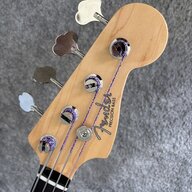
Suggest leave at least 13cm length measure from tuning post on both D and G string.
12 cm for A string and 11 cm for E string.

Thats the way i did on both EB Cobalt and Group flat plus the short honey moon Pino flat.
 
Suggest leave at least 13cm length measure from tuning post on both D and G string.
12 cm for A string and 11 cm for E string.

Thats the way i did on both EB Cobalt and Group flat plus the short honey moon Pino flat.
The damage is done! But bass is locked and "loaded." :D Generally, I haven't been "locking" strings with bass tuners, but these more delicate, thinner strings with silks reminded me why it's sometimes a good idea. At least the vintage style string retainer helps a lot in this particular case. D& G should indeed be longer.

Though I do also often make the A extra long when not helped by any string retainer in Fender style headstocks (as with the Vintera and many others), to avoid buzzes due to bad angles; just as a safety measure of sorts. And of course, not with all basses, just these ones with an ol' Fender headstock. I did this with the Smoothie Flats, that is why the A has more windings than the E string. Just nerdy stuff that helps me. :P
 
  • Like
Reactions: Kyle_S and Yahboy
The BT3 Hipshot Xtender works great with the Pino Smoothie Flats, as I was expecting. Lower tension in D does not matter, as it retains a similar feel, and doesn't become too floppy.

All Hipshot tuners and the Xtender work flawlessly, and tuning is now easier, because the tuning is way more precise than with the stock tuners (those were good to me and my bass for years, not too much to complain about, but as it often happens, sometimes they would overshoot by too much, and tune down by lots of steps-this doesn't happen with the Hipshot tuners.) The gear is larger, but surprisingly, despite the bulk of their mechanism, they have a slightly smaller footprint behind the headstock, and weight a tiny bit less (NOT light, just a tiny bit lighter than the MiM tuning machines.)

1000110017.jpg

1000110018.jpg
 
Obviously not even a month old, but still very impressed. Super fast feel on a 7.25 radius vintage style neck, everything is easy, and quite honestly, not floppy at all for my touch. Plenty of forgiving at times. Love them for real.

Their special power is their magical-to me-feel under the fingers. If it fits *you*, you are golden. I have no problem playing the thicker E vs the thinner A, though I imagine it could be too thin for some (the A), or too thick for others (the E.) Very effortless set, and the sound is really good and awe-inspiring. It has enough mids to sound clear, though they lean full and fat. The Extra Light set maintains very clear high position E string notes, despite all I have stated before about sounding "deader" while unplugged. The mids are not upfront, but they do not sound hollow there-not at all. But again, the feel is exhilarating, making everything better and easier (no "fight" vs the strings to make them do what you wish.)

If you can afford them, at least I very much recommend them to anyone that loves an easy to play flatwound set. Cannot speak for the Medium gauge, but I am too happy with the Extra Light set to give them a try. Superb feel, yet not too loose for my play style.

Wonder if they will rust for me over time, as it has happened to some of you? I am lucky to not have perspiration issues (i.e. string killing fingers), so am hoping for the best.
 
Wonder if they will rust for me over time, as it has happened to some of you? I am lucky to not have perspiration issues (i.e. string killing fingers), so am hoping for the best.
I have very dry hands and a mild body chemistry.
I had some cobalt flats on a bass for about 9 years. Around year 8 I took them off to do some minor fret filing and polishing. Noticed rust in the tight spaces between the wrap hidden on the fingerboard side of the string. Perhaps it started on the core wire? It was clearly the result of strings that stayed on the bass for so many years. I was able to get rid of the rust and the strings returned to their usual brightness. After another year or so, they were just physically worn out and replaced.
 
  • Like
Reactions: thrashingbass
Suggest leave at least 13cm length measure from tuning post on both D and G string.
12 cm for A string and 11 cm for E string.

Thats the way i did on both EB Cobalt and Group flat plus the short honey moon Pino flat.
Lol yea that string job irks me a little (sorry). I always leave 7.5 inches from the center of the tuning post (except the G doesn't usually have that much). The more silk, the better. Then, before tightening, push it down as hard as you can so it sits at the very bottom of the peg.

Here's a job I did this week:

unnamed.jpg
 
Lol yea that string job irks me a little (sorry). I always leave 7.5 inches from the center of the tuning post (except the G doesn't usually have that much). The more silk, the better. Then, before tightening, push it down as hard as you can so it sits at the very bottom of the peg.

Here's a job I did this week:

View attachment 7429633
I do not think that buying another set to make it look good is worth it. 😁 It's a good lesson for the future, especially with these flats. I haven't had slipping strings (I mean, slipping off the tuning post as I tune to pitch) in years, so I was expecting my similar method of having as least windings on the post as possible to work (save for the A, which I leave extra long as aforementioned as a safety measure to keep unintentional buzzing away.) DR used to advice about locking the strings, but I thought their step was a bit unnecessary-with the Smoothie Flats, it totally makes sense. If these strings were without silks, I bet they would have had enough friction, but they are both thin and have those soft, slippery silks. I am glad the set wasn't ruined due to me cutting them short, as I do with most other strings-they remain in tune without slippage, which is all I could ask for.
 
  • Like
Reactions: MIJ Fender Guy
I have very dry hands and a mild body chemistry.
I had some cobalt flats on a bass for about 9 years. Around year 8 I took them off to do some minor fret filing and polishing. Noticed rust in the tight spaces between the wrap hidden on the fingerboard side of the string. Perhaps it started on the core wire? It was clearly the result of strings that stayed on the bass for so many years. I was able to get rid of the rust and the strings returned to their usual brightness. After another year or so, they were just physically worn out and replaced.
That's a lot of years! So I think they more than served their purpose. Crossing my fingers I have similar results!
 
  • Like
Reactions: bigtone23
That's a lot of years! So I think they more than served their purpose. Crossing my fingers I have similar results!
I knew they were on there for a long time, thought it was more like 5-6 years. Saw the install date on the string package (in the case) when I restrung and was blown away by how long they lasted. Cobalts took about 5-6 months to break in and get some thump. Chromes take about 1-2 months. Hopefully the Pinos are closer to 1-2 months.
 
  • Like
Reactions: thrashingbass
I got my set of XL's from Sweetwater yesterday and installed them on my P bass last night.
I plugged the bass in with my headphones to check them out and they sound much better that I ever hoped for.
String to string balance is excellent, the tension is low but not floppy and the strings sound great all the way up the neck.
Chords and double stops sound even and balanced.
I start the musical Mama Mia for 6 weeks with first orchestra rehearsal coming this Sunday.
I'll let you know how they hold up over the run, they will ger a lot of use.
 
I joined the club yesterday and put Extra Lights on my Fender American Original 60s Jazz Bass. Quick first impressions:

I was surprised how much tension these strings still have at these lower gauges. I was also surprised by how dead they are right out of the package, and especially how much "plonky" attack they have. A very old school sound, reminding me of the bass tone from The Temptations' "Papa Was a Rolling Stone". I was expecting a tone and feel closer to the 40-100 Dunlop Flats.
 
  • Like
Reactions: thrashingbass
I got my set of XL's from Sweetwater yesterday and installed them on my P bass last night.
I plugged the bass in with my headphones to check them out and they sound much better that I ever hoped for.
String to string balance is excellent, the tension is low but not floppy and the strings sound great all the way up the neck.
Chords and double stops sound even and balanced.
I start the musical Mama Mia for 6 weeks with first orchestra rehearsal coming this Sunday.
I'll let you know how they hold up over the run, they will ger a lot of use.
Okay, been using these over a week, I'm sold. One of our guitar players, who is probably the best player in town, texted me during the show and told me my tone was killer and that my bass really cut through in the mix over the 4 keyboards, drums and percussion.
Then the house engineer said practically the same thing and how good the bass sits in the mix out front.
I using them on a bass P bass that I built with a Fender body, Warmoth roasted maple J neck, passive EMG Geezer P pickup and Gotoh hardware. The Pino's are definitely staying on this bass, I hope they introduce a short scale set, they would sound great on a Hofner, and a 5 string set too.
 
  • Like
Reactions: thrashingbass
Okay, been using these over a week, I'm sold. One of our guitar players, who is probably the best player in town, texted me during the show and told me my tone was killer and that my bass really cut through in the mix over the 4 keyboards, drums and percussion.
Then the house engineer said practically the same thing and how good the bass sits in the mix out front.
I using them on a bass P bass that I built with a Fender body, Warmoth roasted maple J neck, passive EMG Geezer P pickup and Gotoh hardware. The Pino's are definitely staying on this bass, I hope they introduce a short scale set, they would sound great on a Hofner, and a 5 string set too.
So glad they've been working well for your gigs! It would be hard to replace them with others on my P bass, some secret sauce in there. Love their feel and balanced tone. Best of luck!
 
The Extra Lights have the deadest G string on a set of flats that I have ever encountered, it nearly sounds like a full string dead spot or as if it were foam muted. Very little high end and sustain, and lower volume. The surface is also a bit rougher than that of the other strings. Is it just my set or does anyone here have a similiar experience?

There is a chance this is setup related, I only adjusted action and intonation and left the neck relief unchanged for now, as I am not yet fully comitted to keeping these strings on the bass. But it looks good, maybe a tiny bit too much bow. I'll wait for answers here before I get out the screwdriver and loosen the neck bolts to access the heel side truss rod nut.
 
Last edited:

Latest posts