• TalkBass has been independent since 1998. Add your voice.
    Create a free account to reply to discussions, view embedded media, and browse with fewer display ads.
    Join freeLog in
    Want zero display ads or expanded classifieds tools? Compare plans.

Double Bass Play loudly and buzz? Or play more softly and amplify?

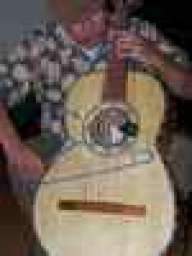
Some of you may be aware that I've been in the long process of converting a Mariachi guitarrón into a rather strange instrument for playing blues and jazz upright in a DB style. My guitarrón has almost the same range as a DB (E1 to F4), it's strung with flatwounds, and it has a flat fingerboard (lengthwise and crosswise).

Well, I've reached a cross-roads in this odd quest: I now have the action low enough for comfortable jazz play, and I really don't want to raise it much. But if I try to play loudly I get a some buzzing on several notes. I've had a good luthier working on that, but he may have done all he can do now. (Not quite sure yet.)

I can alleviate a lot of the buzz by pizzing further down toward the bridge, and I can eliminate all of it by playing more softly. Not extremely softly, but light-to-moderately. But that's still playing too softly to make a loud-enough sound to accompany anyone without amplification--although the tone itself is really good when played softly.

So, I could amplify the thing--either with an internal pickup or just a mic--and always play it more softly. (I'm pretty sure that will work.)

Or I could continue with the struggle to shape the fingerboard, raise the nut (or bridge? That'd be a chore since it's fixed), or whatever to try to eliminate the buzzing even when pizzing loudly, i.e., loudly enough to accompany someone without amplification. (Which I'm not yet sure will work.)

So, my question for you guys is: Is it acceptable to have a bass like this that always has to be amplified to play with anyone. (That's always true of slabs, isn't it?) Or would I be better off pursuing the goal of a non-buzzing guitarrón that I can pizz loudly unamplified.

Remember, please, that I have no ambitions to play professionally--just with other amateurs in somebody's living room once a week. Also, I'm well aware that I'm trying to make a silk purse out of a sow's ear, so you needn't remind me of that--that's part of the fun of the project, anyway.

Thanks in advance for your input.
 
Even for my electric basses, I try to set the action high enough that I can dig in reasonably hard without buzzing (even if I don't usually play that hard on the slab) because you never know when you'll want to. As long as the buzz isn't because of the neck warping or because of unevenness on the fingerboard, I would try and find a way to raise the bridge slightly. Who knows, you could invent the adjustable bridge guitarron!
 
Well, Fletch, you really got me thinking:

Thirty-five years ago, I had a friend named John Cockerham who was a proponent of what I call the "Cockerham Approach" to any problem that you don't know can be solved:

First, you ask: "Is there a solution?"
Then you immediately answer, "Yes, there is."
Then you ask, "Okay, then what is it?"

It's amazing how fast you can come up with a solution once you forceably propel yourself past the block of wondering whether a solution exists.

So, after your spurring and after applying the Cockerham Approach, I think I already have a quick and easy way of transforming my bass's fixed bridge into a simple adjustable one. I'm going to show the sketches to my luthier as soon as I get a chance.

Thanks for the kick in the ass, young dude!

Edit: Actually, the bridge is going to be effectively adjusted upward, but not adjustable. And I think I can do this job myself.
 
I think it is fine to play amplified all the time in your situation. Its not a double bass, and shouldn't be treated as one, and everyone I know that plays an acoustic bass guitar amplifies that when play with anyone. Its not like the amp has to be a big thing either if you are just playing around the house with some friends, plus as you said trying to set it up differently is somewhat of a gamble, and the end result may just be that it would be harder to play and still not loud enough on its own. Sounds like aside from the volume you are happy with the sound which is good, hopefully amplified it would retain as much of that character as possible.
 
I think it is fine to play amplified all the time in your situation. Its not a double bass, and shouldn't be treated as one, and everyone I know that plays an acoustic bass guitar amplifies that when play with anyone. Its not like the amp has to be a big thing either if you are just playing around the house with some friends, plus as you said trying to set it up differently is somewhat of a gamble, and the end result may just be that it would be harder to play and still not loud enough on its own. Sounds like aside from the volume you are happy with the sound which is good, hopefully amplified it would retain as much of that character as possible.

haha, well sounds like you made up your mind!

No, not entirely, since I'm still very interested in amplifying this thing, which I know I'll probably do someday, whether I mess with the bridge or not. (Besides, my luthier might nix the adjustable-bridge idea for some reason. [Edit: No, he won't 'cause I'm going to do the job myself.]) And, as you suggest, the amp'll probably be something small, perhaps in the nature of a practice amp combo (an Acoustic B20, maybe? [Edit: More likely an Acoustic AB50]), since I'll never be playing in a big venue anywhere. And even if the adjustable bridge does work, as you say I might like the amped instrument better with the bridge adjusted back down. [Edit: Actually, the new bridge is really going to be a "saddle" added to the nut side of the existing bridge, and won't be adjustable.]

So, I'm very glad to have your input, doberman. What do you think: Should I just be looking at a mic (if so, which one) or should I be thinking about maybe a K&K Pure Bass pickup and pre-amp, and go that route? And you may have better ideas than either of these.
 
You might take a close look at your right hand technique. Instead of plucking the strings parallel to the instrument's face, some folks tend to press the strings toward the face, or hook the strings and pull them up. This increases the likelihood of buzzing.
yes!

there are ways of hitting the string that produce decent energy without too much buzz.

otherwise, a proper fret-level and raising the saddle height a bit should fix this problem.
 
Yeah, I think a pick up is your best bet, the mic thing would open a whole new can of worms that may be more trouble than its worth. To get the mic really working for me (and I do use it all the time without a pick up) on double bass I really need to put out a lot of sound and even still it can be difficult with a loud drummer and such, with a quieter instrument it would probably be even more of a problem.
 
You might take a close look at your right hand technique. Instead of plucking the strings parallel to the instrument's face, some folks tend to press the strings toward the face, or hook the strings and pull them up. This increases the likelihood of buzzing.

yes!

there are ways of hitting the string that produce decent energy without too much buzz.

otherwise, a proper fret-level and raising the saddle height a bit should fix this problem.

I play it upright, sitting behind it cello style, and I have experimented with the right-hand action. I play it with a pizz action more like a DB--off the side of my index finger in what I hope is something like a Ray Brown style of action. I can try for lateral string movement, but it doesn't just stay that way. When I pizz in the warmer section of the string, about at the half way point of the string, it buzzes very quickly with increase in volume. When I pizz down toward the bridge, I get away with putting more volume into it, but the tone changes to a harder sound.

Edit: I've now raised the effective bridge height with a temporary "saddle" installation, with excellent results. The buzzes disappeared. It even got rid of a loud "clack" sound that occured when, e.g., my right finger came off the A string and slapped the E string into the fingerboard. (Same problem with the D string and A string.) That used to happen only when I was also depressing the E string while playing the A string--never while the E string was open. I thought I was just going to have to learn to live with NOT ever depressing the E string while playing the A string, but with the effective bridge height raised, no more "clack." And the string height under my left hand has increased only minimally.

Now to make the new bridge height permanent, and get on with the matter of amplification anyway.
 
So what method are you going to use to raise the bridge height? I'm interested to know. Your instrument has frets correct? How is the intonation with the bridge raised?

No, no frets. Based on the test, I don't think it's going to shift the finger positions more than about 1 or 2 millimeters at the nut end of the fingerboard.

The existing bridge is the simplest, crudest type of bridge imaginable: It's a 1"x1"x10" dark wood block with only an insignificant amount of shape to it, glued to the top. (See my avatar, upper left.) The flat-wound BG strings I'm using actually go though inch-long holes in the bridge and are stopped on the endpin side of the bridge by the BG balls at the end of the strings.

Stupidly, I failed to notice that switching from loop-ended guitarrón strings to ball-ended BG strings had a collateral consequence: The new strings had no saddle. See, each loop in the original strings had been acting as a saddle for its own string--defining the lower end of the vibrating string scale. When I switched to ball-ended strings, there was no saddle at all. The ball itself may have been the saddle for some strings, effectively changing their scale length from 26" to 27", while for other strings that may have been contacting the sides of the holes in the bridge, the scale length still may have been 26", or something in between. Like a dummy, it took me a couple of months before I realized this.

So, I'm going to make a "saddle" by carefully enlarging the bridge holes upward on the nut side with a round file, then I'll install a thin (2mm) saddle flush against the nut side of the bridge in such a way that the strings will come out of the holes, then up and over the saddle. This will be only about a 2mm or 2.5mm height increase in the strings, but according to the crude temp job I tried that should be enough to solve all problems.

Edit: The temporary "saddle" I tried was a 2mm thick brass strap (I just happened to have) jammed under the strings. The strap was wide enough to raise the strings a couple of millimeters. It worked great; no buzzing anywhere, not even from the metal-to-metal contact between the "saddle" and the strings. The guitarrón even seems to have a louder sound to it. There are a couple of ways I could permanently affix the saddle--haven't decided on that yet.

Further edit: Well, even though I have a bone saddle blank on order, the brass strap is working so perfectly I'm not going to mess with it. It will be my permanent saddle unless problems develop from it. So far, there is no indication that it is damaging the steel flatwounds; if it does, I'll try the bone.

You luthiers out there: Does this sound crazy or what? I've got to tell you, though, this is a gas! :p
 
Thanks for your interest, ding_man. I should have at least a temporary pick-up installation in place in a week--two weeks at the most. (Say by March 1) Then I'll take a set of pix and put some of them up here on this thread. Maybe a couple of small audio or video files, too, amplified and unamplified.

I've got zero chops on this thing yet, so the sound samples will probably be just a simple 12-bar blues line that I probably still won't play very well. But at least you'll be able to hear the sound if it.

From surfing the web, I know that others have modified guitarróns for various genres of music, but I haven't seen a description of a modification that has been quite as extensive as this one. That wasn't the objective--it just kinda grew into this of its own momentum. I know this modified guitarrón will never sub for any existing bass instrument, but this project has been a real gas, and playing the thing is just plain fun.
 
Just a quick update:

I've now permanently installed some Stanley solid-brass mending plates (straps) for a new bridge, which effectively has converted my former bridge into a tailpiece, if I put this in DB terms. [In BG terms, I installed a brass saddle in front of the bridge. But it's fretless and upright and I pizz it like a DB using Simandl/Shmucklovsky fingerings, so I use DB terms.] The brass straps are 1/2" (12.7mm) wide and they raise the strings at the bridge end by 2-3mm. The straps are only about 1.5mm thick, so they don't appreciably affect the scale length, except that for the first time all six strings now have a uniform 26" (660mm) scale. The instrument is finally sounding in tune with itself.

I also bit the bullet and bought a K&K Pure Bass pickup for 5-String, a K&K XLR Preamp, and an Acoustic AB50 combo, which has an mp3 input for playing with play-alongs and other CDs. I'll install all of this stuff this weekend. I've had to come up with my own installation procedure for the pickups since neither of K&K's alternative instructions will work for my bizarro instrument.

The only thing I'm worried about now is that in a couple more days this two-year-long instrument-optimization project will be complete and I'll no longer have an excuse for not shedding. (At least I won't in 19 more weeks, when I retire.)