• TalkBass has been independent since 1998. Add your voice.
    Create a free account to reply to discussions, view embedded media, and browse with fewer display ads.
    Join freeLog in
    Want zero display ads or expanded classifieds tools? Compare plans.

Playing a fourth down/up a string

Hi,
I'm quite a beginner bassist and I have some problems with playing fourths on the same fret/neighboring string, especially in lower position.

For instance, I'm learning Vulfpeck's "New Beastly".
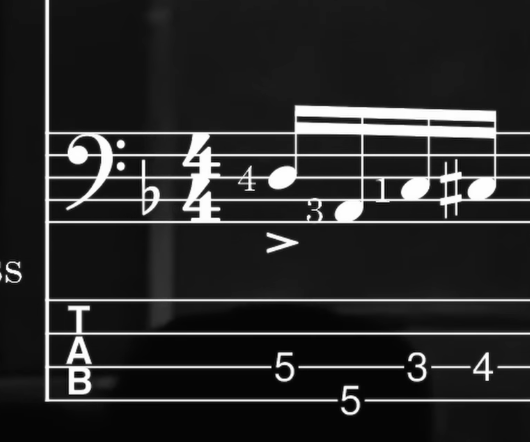
1747588110308.png

The first 2 notes d and a played on the fifth fret. I play them with pinky and ring finger. Now my questions are:
  • Would you rake or alternate the A and E strings? Joe seems to be playing staccato here if that matters.
  • I keep hearing unwanted ringing on the A string after I played the first note and I'm playing the second note. I figured so far, to minimize it, I can make sure to completely lift the pinky off the string to mute it, and maybe to try to place the index finger on it, since it's free
  • Any tips in general for minimizing fret clank when playing these pesky fourths?
Thanks in advance.
 
  • Like
Reactions: MrVentures
I figured so far, to minimize it, I can make sure to completely lift the pinky off the string to mute it,

IME this is not the right way. It is better to keep the finger in contact after the string leaves the fret. Once the finger is no longer is contact it is making no contribution to muting!! ADDING the Index, rather than REPLACEMENT, is a much better plan. It is possible that the ringing you hear is a harmonic because your point of contact for the mute is actually at a harmonic node* - having two (or more) points of muting on the string will eliminate this source of noise.

* There are significant open string nodes at the 12th, 7th, 5th, 4th frets, between 3rd/4th and two between 2nd and 3rd. There are more but they get progressively quieter as they go up in pitch. My point is that if you must use a single-finger mute, you must also avoid muting at these specific positions.
 
Last edited:
IME this is not the right way. It is better to keep the finger in contact after the string leaves the fret. Once the finger is no longer is contact it is making no contribution to muting!! ADDING the Index, rather than REPLACEMENT, is a much better plan. It is possible that the ringing you hear is a harmonic because your point of contact for the mute is actually at a harmonic node* - having two (or more) points of muting on the string will eliminate this source of noise.

* There are significant open string nodes at the 12th, 7th, 5th, 4th frets, between 3rd/4th and two between 2nd and 3rd. There are more but they get progressively quieter as they go up in pitch. My point is that if you must use a single-finger mute, you must also avoid muting at these specific positions.
Thanks. I actually didn't make myself clear, I was lifting the pinky but only off the fret, and keeping it in touch with the string.
 
Technique questions are much easier to answer if you can share a video or even a photo to see your hands and finger positions. Muting technique can be very simple (IE touch the string!) or very complicated (EX: U Can't Hold No Groove). A 10-second phone video could be uploaded to YouTube as "unlisted" so only people you link here can find it, but it would probably get more direct answers to your question.
 
  • Like
Reactions: Les Fret
The first 2 notes d and a played on the fifth fret. I play them with pinky and ring finger.
(It's how I play that riff.)

Due to my "laziness," I place all my four (left hand fingers) on the A string and play the note D with my Pinky.
My left hand Ring finger is, kind of, glued to the Pink finger.


D note.png


Now, I slightly move up my "two-finger" combination - The Ring and the Pinky (kind of, "pivoting" on the Index finger on the note C (A string) and play the A note with the Pinky (while my Ring finger is "attached" to the Pinky.
My left hand Index finger is tightly muting the A string - no sound on that string while playing the note A on the E string.
And my resting/pivoting left hand Index finger is ready to play C, followed by the Middle finger playing C#.

My Right hand is "raking" those D and A notes.
For that purpose, I us my Ring finger.


A note.png
 
Last edited:
With tech these days, I like to watch it in action (vs when many of us were first learning before Youtube and having to guess how it might have been played)!
He appears to use alternating finger plucks pretty consistently throughout the line and lifting his fingers to mute notes. Raking seems natural for this one note movement out of context, but given the driving pulse of the line as a whole the alternating finger approach feels much more natural to me. As mentioned already, I suspect the "ringing" may be due to the 5th fret harmonic- there is a harmonic that will sound at the 5th fret when not pressing down. These types of harmonics can be particularly troublesome on a fretless instrument where you play right one the harmonic positions, but can become an issue on a fretted instruments too at times, and especially for a beginner. To minimize this harmonic, make sure you are playing adequately behind the fret (so your finger misses the harmonic location right at the fret), and definitely try to utilize your other fingers as possible behind the note to dampen the A string while hitting the E string (also useful to use the pointer/index to help mute the higher strings that could sympathetically vibrate, especially the open D string which could ring sympathetically when you hit that D note). It may seem like a lot to think about at first, but once you get the feel for it and the hand positions that make it possible then it will become second nature. Muting is arguably one of the trickiest parts of finger style bass playing to master IMO, but vital to clean sounding lines.
 
Last edited:
  • Like
Reactions: Wasnex

Using the following left-hand fingers for that particular riff as Finger 4 D and finger 3 for A looks nice but it's not comfortable - it puts too much stress on my Index and Ring fingers. What's more, if (for this/that reason) the riff modulates/moves to the note of C on the A string, G on the E string - the Ringer finger, and you play the note of Bb (on the A string) with the Index finger...
My "lazy ergonomics" does not like it, but...
It's only my personal opinion.
 
  • Like
Reactions: MechaSparky and WRM
Using the following left-hand fingers for that particular riff as Finger 4 D and finger 3 for A looks nice but it's not comfortable - it puts too much stress on my Index and Ring fingers. What's more, if (for this/that reason) the riff modulates/moves to the note of C on the A string, G on the E string - the Ringer finger, and you play the note of Bb (on the A string) with the Index finger...
My "lazy ergonomics" does not like it, but...
It's only my personal opinion.
Really comfy for me, personally. Although, I am a fan of developing alternate fingerings that mostly use only index and middle fingers, too.

2212 works pretty well for me, too. Lol
 
  • Like
Reactions: Whousedtoplay