• TalkBass has been independent since 1998. Add your voice.
    Create a free account to reply to discussions, view embedded media, and browse with fewer display ads.
    Join freeLog in
    Want zero display ads or expanded classifieds tools? Compare plans.

Playing live in F#

I owned an ERB that was 35" scale and had not only a B string but an F# string. at 35 scale it was outstanding and sounded great.

Personally I feel that a 34" scale can do it too, but yes you need at least a B string gauge to work at all for such a low note, and possibly more.

Considering I don't like to go above 120 or 125 for my B strings, because thicker sound horrible to me and don't blend with the rest of the instrument, I suspect that a 130 or 135 would do just fine.

But I like thinner strings (for all reasons - tone, playability, sustain, playing up the neck, overtones, flexibility at tuner/bridge bends).
 
Looking at Meshuggah, I would not be adverse to trying to tune UP actually, and get "above" the guitars. Might not work for everyone though, suddenly you can hear the bass player! Shocker!

F# is tricky, but bands like Bongripper etc. make it work (they're in F last I heard). EQing correctly will be your friend in that scenario.
The bongripper guy plays that aluminum bass down in sub-F-standard. That's pretty cool. But, I mostly think that adding a bass note an octave below the chug isn't adding much to the music. Adding a nice, defined bass note to all that distorted chug, however, does make everything come together. It's also always a transcendent moment when a bass melody or counter-melody rises above the chug for a little time in the limelight. In a band like this, the thing that your instrument adds isn't necessarily the lowest note, but the tone, timbre, and pitch-definition from that nice long string.
 
F-sharp below open E. Holy Smokes.

You're gonna need one of these . . . .

%2fstyles%2fdesktop__1486_x_614%2fpublic%2fmain_images%2fuss_shark_ssn-591_underway_in_1985.jpeg.jpg
 
Looking at Meshuggah, I would not be adverse to trying to tune UP actually, and get "above" the guitars. Might not work for everyone though, suddenly you can hear the bass player! Shocker!

F# is tricky, but bands like Bongripper etc. make it work (they're in F last I heard). EQing correctly will be your friend in that scenario.

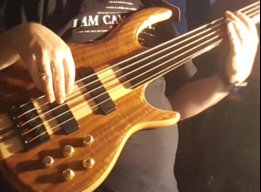
The bongripper guy plays that aluminum bass down in sub-F-standard. That's pretty cool. But, I mostly think that adding a bass note an octave below the chug isn't adding much to the music. Adding a nice, defined bass note to all that distorted chug, however, does make everything come together. It's also always a transcendent moment when a bass melody or counter-melody rises above the chug for a little time in the limelight. In a band like this, the thing that your instrument adds isn't necessarily the lowest note, but the tone, timbre, and pitch-definition from that nice long string.

Agreed...that's why if it were me I'd be paying more attention to F#1 than F#0, and then deciding how much lower than that I'd want to go (C, C#, etc).
 
Once my bass is set up well, I can play in any key with good results.

All my basses, including uprights have a proper setup.
Hm. My electrics all have a proper setup but I set up my upright improperly.

Just kidding.

I think the OP plays in bands where the members use alternate string tunings to achieve certain audible effects. He's looking for a bass where the low string would be the F# below E as an open string. I think it's a metal thing.

Of course we should all be capable of playing in the key of F# when the song calls for it. I don't think that is exactly what the OP is saying his goal is.
 
  • Like
Reactions: Cal03 and bigjames
Maybe someone already posted this, but here is an old thread on this topic.

Low F# on a 7-string?

I recall an article in Bass Player years ago about a guy who played for a circus show and used a 7 string string F# to C and it seemed to work well for him. Personally, in the same situation, I think I would stick with standard tuning on a 5 string (B-G); you get the B and a solid F# on the E string that has clarity and sounds solid through most speakers. If I was a 4 string player and played a lot in D or C I would likely grab a 5 string, but notes below B in my experience are few and far between and I would want to be really sure that notes played below B (on the F# string) were tight and clean...otherwise, they might just be gimmicky. my 2 cents.
 
  • Like
Reactions: SoCal80s
Also, Drop-B kind of makes sense to me, tuned B-F#-B-E-A. Use the sub-octave pedal as needed, but you might not need it so much - stuff just tends to not be very musical below a A-0. Those super-lows are more of a sound effect, best used sparingly. Even the subs in rap music don't really go below C1 very often.

I agreed on all points. Even with my 5 and 6 I seldom use the low B even.
 
What kind of band? It really helps to say what the genre is.
If it is technical death metal/hardcore..etc you will need that F# to ring out as an open string most likely.

Bands that play this low have their basses set up for it. Super thick strings, high action..etc. I have played some of their setups and F'ing hated it, but thats just me.
 
  • Like
Reactions: bigjames
Wow! WAY DOWN... can you link to any recordings using a bass guitar for that?
I tuned a 5-string down two steps to "drop-A" once ( because the song needed a low-D open pattern, and the 5-ver was handy) and to be honest the low A (which i did find a place to use here and there) was almost just percussion, not really a focused note. I can only imagine how a bass string sounds even a couple semitones lower! This was at an outdoor show with 5,000 people in a natural ampitheatre, and a very good PA crew... probably best possible acoustics for bass guitar
 
  • Like
Reactions: GodsLove66
What does an open F# even sound like? That's only 23hZ.

It'll sound like a woofer valiantly trying to reproduce something that it simply can't. Bass guitar cabinets don't accurately reproduce the fundamental on an E string - the market forces to make them small and loud mean they are optimized for something else - they simply don't do an open E string justice. An open B string; they're completely out of their element, but with a high pass to protect them, they can kinda do something - the reproduce the harmonics, which isn't the same, but it makes noise. You really need top grade subwoofers in the PA to really do a B string justice - that can be awesome. An F#, you're just pushing things, and you're never really gonna get there - nobody makes even Pro Audio stuff that goes down that far.