• TalkBass has been independent since 1998. Add your voice.
    Create a free account to reply to discussions, view embedded media, and browse with fewer display ads.
    Join freeLog in
    Want zero display ads or expanded classifieds tools? Compare plans.

Playing unlined fretless

Don't think Jaco said it that way. On a fretted bass you should not play on the fret but right before it. On the fret gives a muted sound.

Nitpicking. You play as close to being ON the fret as possible right at the point where the fret is without introducing a buzz or a muted sound. Playing with too much pressure right on/at the fret often introduces more of a 'mute' than anything else. He addresses this specifically, and quite clearly is playing ON the fret wire. Let's go to the video tape!

 
Last edited:
  • Like
Reactions: 12BitSlab
I learned on a fretless double bass with no frets, no fret lines, and no positioning dots, just a Simandl book and a music stand.
Granted, that was a long time ago, but it is still a great way to learn to play while seldom looking at the fingerboard. And it pays huge dividends when sight-reading.

The physical landmarks for positioning on double bass aren't there on electric. At some point, everyone has to look on electric.
 
I learned on a fretless double bass with no frets, no fret lines, and no positioning dots, just a Simandl book and a music stand.
Granted, that was a long time ago, but it is still a great way to learn to play while seldom looking at the fingerboard. And it pays huge dividends when sight-reading.
I have great respect for people who learned on upright, and even more respect for people who can sight read proficiently. I learned in increments over a very long period of time starting in 1972, without benefit of instruction, until a couple years ago when I picked it back up again after very long hiatus. The vast wealth of instructional material now available via internet has been a treasure trove. I referenced mostly upright teachers' material for learning how to walk lines. Picking up lined fretless over past 8 months, also a huge boost. Unlined board now - - so far, so good.
 
The physical landmarks for positioning on double bass aren't there on electric. At some point, everyone has to look on electric.
Yep. Me, too.

All it takes to position my fingers correctly is usually a glance. But, I keep looking because I use my fingerboard/fretboard as a tactical map of sorts, and it provides analog mental mapping of the harmonic structure that enables me to play with far less uncertainty, probably because my playing concept involves visualizing the changes more than individual notes, i.e., once I know the key signature and changes, my hands shift by themselves as needed to play the upcoming chords, and when my hands are in position, my fingers press the strings as each note is needed. My intonation seems more dependent on good hand position than finger placement. This is one of the gifts I received from Simandl and my pro jazz double bassist, Pop, who guided me along the path.
 
Last edited:
  • Like
Reactions: BassicJazzy
Nitpicking. You play as close to being ON the fret as possible right at the point where the fret is without introducing a buzz or a muted sound. Playing with too much pressure right on/at the fret often introduces more of a 'mute' than anything else. He addresses this specifically, and quite clearly is playing ON the fret wire. Let's go to the video tape!


I don't see it as nitpicking. He is not playing on the fret wire but right before it. The right side of the finger is touching the fret. On lined fretless you play on the lines (most of the times). So there is a slight difference. Probably you mean the same but for beginners reading this it might be confusing.
 
Last edited:
I'm on day 3 of playing unlined fretless, after playing lined for over 8 months. Today I discovered the trick to it, which others have said on TB before but quite frankly I did not understand until now. When I first started on the lined board, it was confusing to me because I saw lines where the frets would be and had to adjust technique and learn to control intonation. When I switched to the unlined board, which has tiny side dots at the major intervals, barely visible in a dimly lit room, I found that trying to map my mental "picture" of the board onto the physical board was confusing and slow. Kept trying to draw the lines in my mind, figure where my fingers should land. However, when I just looked straight ahead and either read a chart or just thought of what I wanted to play in my head, it came immediately to my fingers. That intermediary step of trying to map fingers to the physical board was unneeded and only slowed me down. Ears were just as effective as eyes in keeping me in tune, and aligned on shifts.

This is of course what people have been saying, "just play in the dark." I just didn't understand why until today.

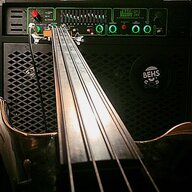
Here's the side view of the board. Dots are not as visible as the camera makes them appear. Sadowsky Metroexpress.
I went straight to unlined (other than trying a lined Ibanez in a store to see if I actually liked playing a fretless). I don't try to visualize the fret lines but I do know the note positions and which dots have one or have two intermediate notes. When I got my bass the intonation was a mess but after I fixed that it was easier to play.
 
  • Like
Reactions: BassicJazzy
I don't see it as nitpicking. He is not playing on the fret wire but right before it. The right side of the finger is touching the fret. On lined fretless you play on the lines (most of the times). So there is a slight difference. Probably you mean the same but for beginners reading this it might be confusing.
The perspective of the footage might make it seem that way. I trust my personal experience while playing as well.... where playing ON the fret works just fine. What COULD make a difference is the kind of frets and how they are crowned. Smaller, vintage frets would make variations on this technique less discernible in a video without a perfect angle from overhead to truly verify.
 
Yep. Me, too.

All it takes to position my fingers correctly is usually a glance. But, I keep looking because I use my fingerboard/fretboard as a tactical map of sorts, and it provides analog mental mapping of the harmonic structure that enables me to play with far less uncertainty, probably because my playing concept involves visualizing the changes more than individual notes, i.e., once I know the key signature and changes, my hands shift by themselves as needed to play the upcoming chords, and when my hands are in position, my fingers press the strings as each note is needed. My intonation seems more dependent on good hand position than finger placement. This is one of the gifts I received from Simandl and my pro jazz double bassist, Pop, who guided me along the pat
My mind works in a similar fashion. I learn things and see them visually rather than in a linear fashion. When studying economics in college, I learned via graphs but equations didn't really do it for me, so never went on to become an economist. Same applies to bass, I can play tab just fine but not notation. Same comment about bass teachers who use patterns, that just doesn't work for me. Interrelationships between intervals works fine, I can see it and hear it in my mind, and then transcribe it to the board.

Another day yesterday of not looking, much, and the blank board is not proving to be an issue. The rough SS rounds are more of an issue, and the factory set-up is a little too high for my taste, but I'm going to live with both for a little while longer.
 
  • Like
Reactions: Jazzdogg
to me the whole deal with fretless is it presents an alternative to 12tet, in this sense the lines don't really mean that much and imho aren't to be trusted
Indeed, they are not to be trusted, and sometimes they simply cannot provide. Try this on a fretted instrument!
1774530640475.png
 
  • Haha
Reactions: Les Fret