

Enjoy the benefits of a premium membership!
Upgrade Account
-
TalkBass has been independent since 1998. Add your voice.
Create a free account to reply to discussions, view embedded media, and browse with fewer display ads.
Join free Log in
Want zero display ads or expanded classifieds tools? Compare plans.
You are using an out of date browser. It may not display this or other websites correctly.
You should upgrade or use an alternative browser.
You should upgrade or use an alternative browser.
Double Bass Poll on use of tablets / Ipads
- Thread starter AndyMopley
- Start date
More options
Who Replied?
I much prefer paper parts, but if the ensemble/personnel manager/MD/band leader/whatever isn’t giving me printed charts then I’m probably not going to print them out myself for environmental reasons (read: I’m cheap), so I’ll reach for the tablet. Also sometimes you’re playing Theraps and you’ve got seven pages of black with no rests, so your choices are either a tablet or a veritable forest of music stands.
I only very rarely play straight ahead gigs these days, but short of maybe helping to keep track of a non-standard form of an unfamiliar tune, I probably wouldn’t use iReal Pro on a gig. I’m pretty good at playing songs I don’t know, anyway, and I got screamed at enough as a young man for bringing a book to a gig that the shame runs deep.
I only very rarely play straight ahead gigs these days, but short of maybe helping to keep track of a non-standard form of an unfamiliar tune, I probably wouldn’t use iReal Pro on a gig. I’m pretty good at playing songs I don’t know, anyway, and I got screamed at enough as a young man for bringing a book to a gig that the shame runs deep.

JazznFunk
Supporting Member
There are tablets that are “paper white” or similar. Accompany those with a Bluetooth page turner footswitch, and you won’t miss paper much.
I’ll grant that there is occasional utility in being able to look ahead to an open page while reading the current page. But the reality is that even with paper, you frequently don’t have that available.
Unless you pre-tape the charts and can spread them out easily without anything falling off or overlapping.
Multi-page handwritten charts should ALWAYS be taped together...by the handwriter, in the correct order.Unless you pre-tape the charts and can spread them out easily without anything falling off or overlapping.
IMFO&E, of course.
Thanks.
Last edited:


I've used Forscore and a foot pedal turner for years, from rock n roll (e-bass cheat sheet chord charts) to in my orchestra (cello). Totally reliable. A nice larger font paper part is still easier on the eye and outside I use paper due to the glare on iPad. fyi, soundslice.com ($5/mo, browser based, on laptop not ios) is a service I've become fond of recently. Upload the treble clef parts and transpose down into tenor or bass clef, export the pdf, download into Forscore. On cello, I read treble ok at pitch in thumb position, but transposing down on the fly is tough. Using the soundslice service I was able to more quickly get playing the heads and harmonies on a load of fiddle and mandolin tunes sent my way for my newest trio.

Have you converted? I am about to...
I resisted, kicking and screaming, until a series of outdoor gigs with my 9-piece showband, where dealing with a stack of 2- and 3-page charts whose order changed from night to night plus high winds convinced me that paper sheet music was a liability. No matter how many technological nightmares might befall a tablet, it couldn't be worse than that
...right? I'm about to find out also.
Had one rehearsal with the band and my new rig last week -- 13-inch Apple iPad Air in a Targus impact-resistant sleeve (because, see above re: high winds), the forScore app, and a Coda Music Technologies STOMP Mini Bluetooth page-turning footswitch -- and everything worked perfectly at rehearsal!
Tonight is the first gig with this setup. Three 45-minute sets, about 35 songs total. Outdoors, again.
Wish me luck.
P.S. I'm still gonna have my 1" thick folder full of paper charts, arranged in order, a couple of giant lucite clothespins, and a stand light all sitting nearby onstage just in case! But hopefully I won't have to resort to them.

Maybe the first choice was supposed to be the question, but I answered "do you use for concerts / gigs."
I've been using a tablet for a few years, and recently got a large iPad from my employer as a gift for good behavior. I also have an Apple Pencil and a page turning pedal. I'm kind of following my kids, who are both classical musicians. Among my uses:
1. My main band is a big-band. First rehearsal of every cycle I use the paper charts, then I scan them and use the tablet for the second rehearsal and the gig. One band mate just takes a picture of each chart with his iPad and puts the charts back in the book.
2. Another band is a quartet with mostly original tunes and arrangements. The bandleader circulates PDF charts, I bring them to rehearsal on my tablet, and make annotations.
3. Other bands that I play with: If they send out PDF's, then I use them. If they use paper, I bring a regular music stand (always keep a folding stand in my bag of spares). If they're playing standards, I have the lead sheets on my tablet but rarely need them.
Many years ago I quit using fake books, because I was sick of hauling them around. So I've had to learn how to make my way through a gig when the band might call up an unfamiliar tune or two. Perhaps because I've gotten older, I like to have the tunes or changes handy, just in case, but also don't want to be saddled with that pile of books. A tablet is less hassle to transport, and can be unobtrusive on stage unless I need it, so it's an acceptable compromise.
I've been using a tablet for a few years, and recently got a large iPad from my employer as a gift for good behavior. I also have an Apple Pencil and a page turning pedal. I'm kind of following my kids, who are both classical musicians. Among my uses:
1. My main band is a big-band. First rehearsal of every cycle I use the paper charts, then I scan them and use the tablet for the second rehearsal and the gig. One band mate just takes a picture of each chart with his iPad and puts the charts back in the book.
2. Another band is a quartet with mostly original tunes and arrangements. The bandleader circulates PDF charts, I bring them to rehearsal on my tablet, and make annotations.
3. Other bands that I play with: If they send out PDF's, then I use them. If they use paper, I bring a regular music stand (always keep a folding stand in my bag of spares). If they're playing standards, I have the lead sheets on my tablet but rarely need them.
Many years ago I quit using fake books, because I was sick of hauling them around. So I've had to learn how to make my way through a gig when the band might call up an unfamiliar tune or two. Perhaps because I've gotten older, I like to have the tunes or changes handy, just in case, but also don't want to be saddled with that pile of books. A tablet is less hassle to transport, and can be unobtrusive on stage unless I need it, so it's an acceptable compromise.

I find it interesting and a little weird that many players seem to have experienced and absorbed prejudice against using charts onstage. In fifty years I've encountered one leader who gave me stick about it, because he wanted to call whatever standard crossed his mind, count in and play, right now. This in the context of a 60-buck pickup restaurant gig where essentially no one was listening, in a region that's home to very few musicians with that kind of facility in any genre. I've taken many calls for all kinds of gigs, without rehearsal or even advance set lists, and for me there's no shame in counting on charts as part of preparation, whether from a leader's book or my own fake library, and anyone implying that I'm less for doing so is saying more about himself than me.
Yes, I carry a 12" tablet containing something over 12,000 pages of material, including my regular band book, and I compose a two-hour set every week and maintain a band library in the cloud for other members and subs to use on their pads or download and print if they prefer. I play a lot of it from memory, but at age 69 I know better than to rely entirely on memory for anything. Other band members have varying skills in that regard, from one who must have a chart to one who never does (he's blind).
Yes, I carry a 12" tablet containing something over 12,000 pages of material, including my regular band book, and I compose a two-hour set every week and maintain a band library in the cloud for other members and subs to use on their pads or download and print if they prefer. I play a lot of it from memory, but at age 69 I know better than to rely entirely on memory for anything. Other band members have varying skills in that regard, from one who must have a chart to one who never does (he's blind).
Last edited:

That's not the case for me. It was more like an experiment to see if I could live without the books. That was something I started before the iPad came out. A pet peeve of mine is that bands are still playing the same limited repertoire today. The "contemporary" tunes in the Real Book are 50+ years old. I would rather play gigs that explore a wider variety of repertoire, including obscure, original, and arranged material, but that require reading.I find it interesting and a little weird that many players seem to have experienced and absorbed prejudice against using charts onstage.
I'm not against charts, but I think there are things about them that can be obnoxious. This includes the band members wasting time between tunes, flipping through their private towers of Babel to choose the next tune to play. I once wrote a Haiku about it:
What shall we play next?
Flip, flip, flip, flip, flip, flip, flip...
Let's play "Blue Bossa."
For me, the tablet provides the good things about charts, including the use of fake books, but eliminates some of the obnoxious things. The digital format should in principle make the entire repertoire searchable. Bandleaders can distribute PDF's before each gig, or a set list. These days before each gig, if there's a set list, I will look through it to make sure I'm prepared.
With that said, playing without charts is a different experience, and one that I enjoy.


I once wrote a Haiku about it:
What shall we play next?
Flip, flip, flip, flip, flip, flip, flip...
Let's play "Blue Bossa."
I am literally "laughing out loud" at that one.
For the last few decades I've played Americana/bluegrass originals in bands that built their setlist organically as new songs were written and introduced. A few years ago I joined a band that was already playing 3-set patio gigs of mostly originals, and had to use charts for the first time. After a comic misadventure with wind and paper, I moved that band's charts to an iPad and haven't looked back.
Watch out, a band-mate had a misadventure with wind and his tablet at an outdoor gig. Paper is cheaper.For the last few decades I've played Americana/bluegrass originals in bands that built their setlist organically as new songs were written and introduced. A few years ago I joined a band that was already playing 3-set patio gigs of mostly originals, and had to use charts for the first time. After a comic misadventure with wind and paper, I moved that band's charts to an iPad and haven't looked back.

That's why my tablet is in a protective case.

Currently I draw the line between paper and plastic at page turns. I’ve seen some pretty epic page turn fails at classical gigs where the foot switch either stops working or turns too far and the player can’t find their place. I was even a part of one where I was in the rhythm section of a Claude Bolling transcription for trombone and jazz rhythm section and the page turning device malfunctioned and my colleague had to a fair bit of improvising and dancing with the pedal while the piece was still going on. At least he had a sense of humor about it.
A more amazing case is that of one of the accompanists at the U, who has been using a tablet for years now but doesn’t use a page turning device because her feet are always busy with the piano pedals. She seems to have mastered the art of finding a way to take one hand or the other off of the piano to touch the tablet to turn the page just in the Nick of the time, even in busy passages. It’s pretty spectacular to watch, actually.
A more amazing case is that of one of the accompanists at the U, who has been using a tablet for years now but doesn’t use a page turning device because her feet are always busy with the piano pedals. She seems to have mastered the art of finding a way to take one hand or the other off of the piano to touch the tablet to turn the page just in the Nick of the time, even in busy passages. It’s pretty spectacular to watch, actually.
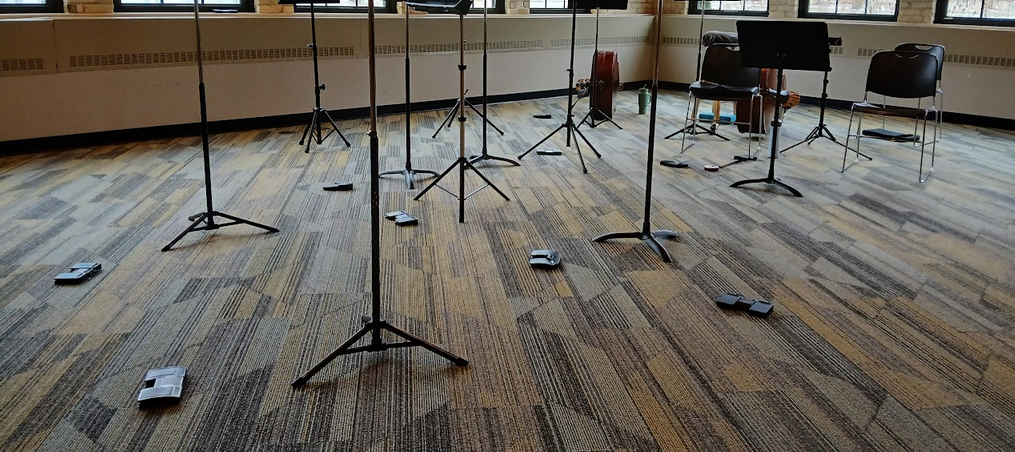
This is just before one of my daughter's gigs: I told her I should have snuck up and switched all of the page turning pedals around.
Also, having made my own page turning pedal, it is no mean feat to get a pushbutton switch to do exactly what you think it should do. It took a few iterations before it stopped doing things like turning more than one page, etc.
Also, having made my own page turning pedal, it is no mean feat to get a pushbutton switch to do exactly what you think it should do. It took a few iterations before it stopped doing things like turning more than one page, etc.
A more amazing case is that of one of the accompanists at the U, who has been using a tablet for years now but doesn’t use a page turning device because her feet are always busy with the piano pedals. She seems to have mastered the art of finding a way to take one hand or the other off of the piano to touch the tablet to turn the page just in the Nick of the time, even in busy passages. It’s pretty spectacular to watch, actually.
A couple months ago I was hired to record an evening of chamber music at a venue in NYC, and of the three pieces being performed, two of them were on tablets and one was on paper. But in all three piecs the pianist did not do any of their own page turns; there was the humble and diligent Page Turner Person seated next to them, who, on the paper piece was turning pages, and on the iPad pieces was simply tapping the screen.
Currently I draw the line between paper and plastic at page turns.
btw, I just got back from my first gig ever reading off of digital sheet music, and while I could rhapsodize enthusiastically about the many ways it was superior to using paper charts, page turns were definitely the thing that I mentally flagged as "Gotta Work On This".
Some of our charts lend themselves to the "half-page turn" where the bottom of Page 1 remains at the bottom of the screen, but the top of Page 2 appears at the top of the screen...and some of our charts would be better served by a traditional "full-page turn". Then the question becomes: Do I switch the status of the Bluetooth controller between half- and full- as necessary, during the gig? Or, do I spend some time repaginating some charts so that I can then use one type of page turn command for the entire show?
Ideally I wouldn't have to deal with any of this! Stupid multi-page charts!

JazznFunk
Supporting Member
A pet peeve of mine is that bands are still playing the same limited repertoire today. The "contemporary" tunes in the Real Book are 50+ years old. I would rather play gigs that explore a wider variety of repertoire, including obscure, original, and arranged material, but that require reading.
Bandleaders can distribute PDF's before each gig, or a set list. These days before each gig, if there's a set list, I will look through it to make sure I'm prepared.
This.... and this. If you're doing originals, charts are a must. And, prepping set lists is a must as well to ensure everyone is prepared. Basic good bandleader stuff. I hate seeing groups that show up on a dedicated gig (not a jam session) and flip thru charts/books like they didn't prepare ahead of time... because they didn't.

Smooth_bass88
vaxx!
- Oct 31, 2006
- 12,122
- 16,796
- Disclosures
- have been on nationally released albums, charting on the Billboard 200
I find that the tablet works better for me in dark mode, reading white notes on black. Many people can't get used to this, but it reduces eyestrain and eliminates the Boris Karloff effect from a lighted stand.... my eyes get fatigued from even just a small amount of screen time.
Last edited:


