• TalkBass has been independent since 1998. Add your voice.
    Create a free account to reply to discussions, view embedded media, and browse with fewer display ads.
    Join freeLog in
    Want zero display ads or expanded classifieds tools? Compare plans.

Double Bass Positions and pivots on 34” scale EUBs?

What position/fingering system do you use on a 34” scale EUB?

  • Something else (reply below)

    Votes: 0 0.0%

  • Total voters
    6
  • Poll closed .
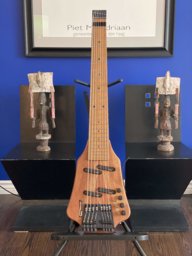
Hello all, I have a 34” scale EUB. It happens to be an NS Design Omni Bass, but I suspect that my question applies to everyone playing EUBs with a 34” scale.

it’s an upright bass, but… It has the scale length of a bass guitar, and thus many of the limitations of the 41” scale do not apply. For example, it is easy to use one-finger-per-semitone if you want. It’s possible to pivot in first position and cover an entire perfect fifth if you want.

Are those of you on 34” scale EUBs sticking with standard bass left-hand technique? Standard bass guitar technique? Mashing things up? Let us know, thanks!
 
I only used my Omni as an air travel bass when I didn't want to deal with my 3/4 size case, which was not very often. But, because of that, I used whatever technique I had on the 3/4 DB with an easier reach. I started with Simandl but I've evolved into a pretty serious pivotor because of my limited exposure to Rabbath, and, I plan to sell my Omni but if I do use it for some reason, I wouldn't alter my technique just because of the scale length. I think I'd want to make a stronger commitment to the Omni as its own instrument before I would do that. I like the Omni for what it is but I'm not ready to give up the arco of an acoustic 3/4 DB as my primary instrument.
 
Last edited:
  • Like
Reactions: Reg Braithwaite
I'd say use whatever fingering you want, but if you want to sound like double bass, practise playing without looking at the fingerboard. We sometimes forget that crucial part of practising scales, shifts or pivots is mental: you build your inner hearing, your personal pitch sequences - and then you choose your notes according to what you can mentally pre-hear. Practising helps to draw apart the mists of uncertainty, but there's always some mist remaining. Eyes give you a feeling of objective exactness, which however leads to bass guitar choice of notes = bass guitar sound.