• TalkBass has been independent since 1998. Add your voice.
    Create a free account to reply to discussions, view embedded media, and browse with fewer display ads.
    Join freeLog in
    Want zero display ads or expanded classifieds tools? Compare plans.

Post CBS Fender Year 1966

I bought a 66 P many years ago, then came across a good deal on a 64. I owned them both for several months and they both played and sounded great. I actually like the SB finish on the 66 a little better than the 64. Finally sold the 64 just last spring.
People have mentioned the stockpile parts thing already...it was actually CBS that went out and bought a bunch of parts. They bought so many pots in 66 that you find instruments well into the late 60's with pots dated 66.
 
I'm thinking about disassembling mine to learn the details of the guts and take some pics to document it.

Is there any risk to disassembly? i.e. unbolting the neck, etc.

Not really, just do it slowly-cautiously and re-assemble the same way.

I have a 2002 Precision and a 2010 Precision V and I have never taken them apart. But, they play nice and there's no reason.

Once in a while, I borrow a 'classic' from a collector friend of mine. The set-ups are usually lousy with dead strings to boot. I usually end up taking these apart (sometimes to shim) and cleaning them (not harshly) and then re-assemble them and set them up.

He always gets back a better instrument than he loans me. I sometimes restring it too.

This ritual just reinforces my like of new stuff. The objective is getting the notes out of them. In the easiest and enjoyable way.
 
Yeah, there's no harm in opening it up to take a quick peek...it's the only way to get the actual neck date and pot dates.

I absolutely love '66s. You wanted to know what makes them special and I'll tell you what I think makes them special.

Firstly, the pickups. Fender changed the pickups in mid-'64 and from the vintage P-basses I've played the ones from mid'-64 through '66 with the grey-bottomed pickups are by far my favorite sounding pickups. I've tried like heck to find that tone in any currently made pickup and haven't exactly found it yet. This is really the main difference that sets apart this era of Fender P-basses for me.

Secondly, it seems that the fretboard wood on '65-'66 P-basses has much more reddish hue to it. I don't know much about species of woods, but I think these reddish rosewood boards are really cool.

Other important details (to me) that carried over from the pre-CBS era and were still present in '66 basses, but changed by '68 were the nitro finishes and C-width necks (nominal nut width of 1 3/4"...changed to 1 5/8').

Let's see...other cool details that I like:

a) Veneer fingerboard (present on Fenders from '62 through the CBS era).

b) 7.25" radius (present on all Fenders through the CBS era)...I much prefer this to the current 9.5" standard.

c) The headstock logo is virtually still the same as the logo used starting in '64 (with maybe an additional patent number)...much different from the "TV" style headstock logos that came in '68.

d) These '66 P-basses still used the old reverse tuners that had been on Fender basses all through the pre-CBS era. I actually prefer the '68-'75 style tuners, but the reverse wounds are cool and have a definite pre-CBS vibe.

My favorite P-basses I ever owned were an Oct. '64 and a Feb. '66 and it's not even close. They were both worlds apart (for me) from any other era of P-basses.
 
Awesome feedback. Thanks. I'm going to open it up today. One thing I notice is several of the tuners are very hard to turn. Any remedy for that?

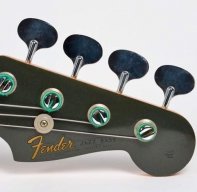
On my 63 I had a similar issue. Not wanting to use anything that would infringe the integrity of the patina of 50 years, I used a soft toothbrush and some canola oil to scrub out the gunk from the worm gears/ tuner stems. Worked nicely. Once I had them free of green gunk, dried them with paper towel and then placed a drop of CLP break-free on all the contact points. Worked the tuners until they felt "right".:bassist:
 
Wow, looks like you got an especially clean all original '66 from your pics! '66 P's are essentially the same exact bass as a '64/65. AFAIK, the only real difference is Fender started machine-winding their pickups circa late '64. Those old hand wound pickups are one reason why some collectors are only about pre-CBS Fenders. I have personally owned 2 '66 Jazz basses and I think they sounded as good as any pre-CBS Jazz I've ever heard though.

The main change for 1966 (as far as the basses go) was the Jazz got binding on the neck. I'm a huge fan of the way these bound necks feel, especially when they get nice and worn in and the edges get rounded. I personally see the '66 Jazz as an improvement over the pre-CBS's (from a player's standpoint) because of the bound necks, but that's just a personal preference.

For the first half of '66, they still had dots on the fretboard with the new binding. By June or so of '66, the Jazz got the big blocks, and that was standard through the end of the '70s. The bound/dot '66 Jazzes are very collectable and they generally command about $1000 more than a later '66 in the same color.
 
Yes. Super clean. Looks like a year or so heard old bass really. No fret wear, one little mark on body. One owner bought in late 66 who was a guitar player. Left under his bed. Only played occasionally by his uncle during family events. Love those story's, can't really imagine 48 years of sitting there unused under his bed.

This last several months I have really been lucky finding some treasures. I found an amazing 1961 Ampeg B15 that goes along great with this bass. I also found a super nice Rickenbacker 1970 4001 21 fret which has a balance and neck to die for.

The 1970 Rickenbacker 4001 appears to have been more "hand made" compared to the 66p when I examine the guts.

How was Rickenbacker compared to Fender back in the mid 60s to early 70s?
 
I haven't haven't owned any '60s Rics, but I've had a couple '70s ones. The fit and finish on Rics from that era seems to be really good. They were definitely made in smaller quantities than Fenders, so that probably contributes to their hand-made feel.

Another difference that came about in the Fender factory in about spring '66 was they started using medium jumbo frets as opposed to the vintage banjo frets that all Fender instruments had before '66. I personally think the larger frets make the necks feel and play slightly different than pre-CBS's. I can see from your pics that your '66 has the jumbos (which would make sense since it's a May neck). I think May was the month they changed over because my '66 Charcoal Frost Jazz was a March neck with banjo frets. My '66 Oly White Jazz and a buddy's CAR '66 Jazz are both May necks and both have jumbos like yours.
 
As an Amazon Associate, TalkBass may receive commissions from qualifying purchases made via links on this site.
Here's my theory on the best year for vintage Fender basses ('66):

I believe 66 is possibly the best year for Fender basses based on what I've played (probably over 10 Pre-CBS basses versus 10-20 Transition (~65/66) basses. Here's my theory: Fender had the longest time under Leo Fender by 65/66 to be producing the best products, learning from their mistakes/experience, etc, and with CBS buying Fender in January 5th, 1965 (IIRC), presumably the aquisition was known for months or even a year+ by people in the factories. By 1966, CBS was probably on the floor, and considering what changes to make, while still using parts that were manufactured carefully* to Leo Fender's full specifications...

* Now I say "carefully" here because, as someone who's worked at an engineering company during an acquisition, I can tell you that many employees are nervous about their jobs at this time, and trying to proove to the new owners how indispensable they are... My theory is that Transition basses (all of 65 and 66; possibly also late 64 and early 67, though I am not certain) are the best Fender vintage instruments because they have the benefit of Fender's experience with the added fire under the employee's feet from CBS to make the best bass they ever made with each piece coming down the assembly line (or however they were manufactured at the time).

I'm no vintage fender expert, I probably know about as much as the average Fender collector or guy who sells vintage Fender gear, but not much more. This is just based on my playing and comparing Pre-CBS and transition basses, especially recently, and my knowledge of human nature, engineering companies (I am a computer engineer) and having lived through an acquisition or 2.

As a side note, I own a '74 P in original Sunburst (all original I think) that has the most buttery neck and sounds frikin awesome with Flats. Not sure if 74s are generally good though, but I suspect yes.