• TalkBass has been independent since 1998. Add your voice.
    Create a free account to reply to discussions, view embedded media, and browse with fewer display ads.
    Join freeLog in
    Want zero display ads or expanded classifieds tools? Compare plans.

Post CBS Fender Year 1966

JPMcGuire

Supporting Member
Jul 13, 2008
2,328
3,463
Lake Orion, Michigan
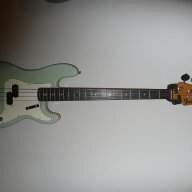
Hey all just got a near mint 1966 precision. Fantastic action, 8.7lbs, zero dead spots. Quality seems fantastic.

Being also a history nut Im very interested to learn more on the Fender factory transition year of 1966 when this bass was made. We're the same manufacturing people, practices, and quality control in place?

Love to hear any cool facts, stories from this year.

Peace.
 
THE FENDER SALE TO CBS

"In early 1965, Leo Fender sold his companies to the Columbia Broadcasting System, or CBS for $13 million. This had far-reaching implications. The sale was taken as a positive development, considering CBS's ability to bring in money and personnel who acquired a large inventory of Fender parts and unassembled guitars that were assembled and put to market. However, the sale also led to a reduction of the quality of Fender's guitars while under the management of "cost-cutting" CBS."

"Several cosmetic changes occurred after 1965/1966, such as a larger headstock shape on certain guitars. Bound necks with block shaped position markers were introduced in 1966. A bolder black headstock logo, as well as a brushed aluminum face plate with blue or red labels (depending the model) for the guitar and bass amplifiers became standard features, starting in 1968."

"Regarding guitars, in the early 1970s the usual four-bolt neck joint was changed to one using only three bolts, and a second string tree for the two middle (G and D) strings was added in late 1972. These changes were said to have been made to save money: while it suited the new 'improved' micro-tilt adjustment of the neck (previously requiring neck removal and shimming), the "Bullet" truss rod system, and a 5-way pickup selector on most models, it also resulted in a greater propensity toward mechanical failure of the guitars. CBS-era instruments are generally much less coveted or collectable than the "pre-CBS" models created by Leo Fender prior to selling the Fender companies to CBS in 1965. The so-called "pre-CBS cult" refers to the popularity of Fenders made before the sale."

"After selling the Fender company, Leo Fender founded Music Man in 1975, and later founded the G&L Musical Instruments company, which manufactures electric guitars and basses based on his later designs."

BassHappy
www.innertainment.net
 
Did you see this one too?

Best,

BassHappy
www.innertainment.net

Fender and the CBS Takeover

Published Jan 14 by Dan Orkin

For most vintage guitar collectors and enthusiasts, 1965 stands as the single most important year in the history of Fender. It was in 1965 that management of Fender transferred to the CBS corporation who had purchased the company from Leo Fender for 13 million dollars (that’s two million more than they paid for the New York Yankees the year before). Fender guitars and basses from before 1965 are collectively referred to as Pre-CBS Fenders, and are considered far more desirable than anything Fender has built since.


But what actually changed? How did the transfer of management really impact the instruments coming off the line in Fender’s Fullerton, California factory?

Overall, the CBS-era changes can all be described as a shift to a more mass-production style of guitar making. Things began to change in late 1964 and the period from then until the beginning of 1966 is usually considered the “transition” period. Guitars from this era can be identified by their use of a serial number beginning with an L. The stretch from about 1966 until the early ‘80s is considered the true CBS-era and the low-point of Fender quality. Guitars and basses from late ‘65 to the mid-’70s, can be identified with a serial number that begins with an F.

Below are some of the changes that occurred as a result of the CBS takeover. Some of these changes were gradual and some were immediate, but for collectors, they are all considered steps in the wrong direction:

New Pickguards Materials

From 1954 until 1959, most Fender guitars and basses used a pickguard made of a single piece of celluloid. Starting in 1959, most Fender pickguards consisted of three layers of celluloid with a top layer that added a certain greenish hue. In 1965, the switch was made from celluloid to ABS or vinyl; these guards are considered far less attractive by most collectors.


Less Sculpted Contours

With the introduction of the Stratocaster in 1954, Fender set a precedent for sleek body contours that would carry through the Jazzmaster, Jazz Bass, Jaguar and beyond. The sports car-esque curves set Fenders apart from many other builders, but as CBS management took further control of production, the shape of most Fender designs becomes noticeably less curvaceous as another result of a more mass-production oriented production approach.

Polyurethane Lacquers

By 1968, polyurethane replaced nitrocellulose as the primary finish used on Fender instruments. While some earlier Fenders had already used poly, as the CBS era wore on, it was made standard on more and more models. Polyurethane is thicker than nitro and has a generally heavier gloss.

Pearloid vs Clay Dot Inlay Markers

One of the early changes prompted by the CBS purchase of Fender was a switch in the material used for fingerboard inlays. Starting as early as late 1964, Fender fingerboards were inlayed with Pearloid dots where previously they had used clay.


Later Changes Under CBS

Changes implemented by CBS did not end with the ‘60s. A series of major design changes came in 1971 including a switch from a three bolt neck-plate replaced the earlier four bolt design. Also in 1971, Fender changed many of its bridges and saddles to cheaper, heavier designs, and introduced the ‘bullet’ truss rod system. All of these changes were implemented to reduce production costs.

The CBS Legacy

The changes brought about by the CBS purchase of Fender created a sharp divide in the history of the one of world's most iconic guitar makers. Post-1965 Fenders are automatically accepted as inferior instruments, and there are many collectors who simply will not consider purchasing anything made after the buyout.

But that’s not to say that all post-CBS Fenders are of no interest to collectors. A number of new models were introduced during the CBS period that have since become absolute icons in their own right. The semi-hollowbody Thinline Telecaster, for example, didn’t launch until 1968. Also in this period, Fender launched a number of radical new models like the Coronado and Starcaster. CBS ownership lasted until 1985 when the company was sold to a group of Fender employes led by Bill Schultz.
 
I work as a head of quality actually for a large automaker plant. My opinion is the new fender is what the accountants during cbs era actually wanted but didn't have the right people, experience, and key activities to full fill the vision. There are 4 types of quality which Leo and team had an understanding of: Perceived, dislike, ordinary, reliability. After many years in manufacturing, someone with quality and engineering gift has to run a manufacturing based company from my experience.

The curious years for learning for me are what was going on in 65 and 66 from a quality and manufacturing standpoint. Not much specifics on these years.
 
I think the bill Shultz and others did not revert back to old fender. They modified the cbs strategy to focus on training and quality. Most likely adopted quality gate philosophy tied to employee performance. They still had to focus on modernizing manufacturing techniques using new technology to remain cost competitive-eliminating manual labor from processes.
 
Fender's year 1966 is not ancient history, I'm sure there's someone around who was there in 1966 who could give you a little better recollection of what (if any) production changes were implemented in that year.

But, most likely (IMO) the CBS bean counters were just mucking around looking for things to "fix" for several months. I'd bet the parts bins were still full of "PRE-CBS" components that had to get used up, so an early '66 would be pretty much the same stuff as a late '65.

I could be wrong, but I've been through a few company buyouts, and this is how it worked each time.
 
A 66 bass would have had some slight modifications to it, such as the lolipop tuner on the jazz bass.
However, overall when CBS bought Fender they also bought stockloads of parts. So the parts were all likely pre-CBS parts anyways.
As far as personnel I am not sure who transitioned over with them.
 
Cool. I love it so far just put a set of la bella flat wounds and it has one if the best tone and dynamics ive ever played. It had been sitting for years in an older mans home. Amazing it was basically in tune and truss rod has never been adjusted-action perfect.

Would love to hear more from someone working at fender in 65 to 70 time frame. We have been working at our own quality renaissance where I work at one of the big three us automakers. I really enjoy studying these other industries for lessons learned read across
 
My 66 is serial number 147577. The neck has not been taken off. Is there a way to tell the month without taking off the neck? I would imagine it has to be very similar to a 64/65.

Sounds like the parts and quality/manufacturing methods didn't change much in 64 to 67. 68 sounds like it started to change significantly?
 
I have a 1966 Jazz bass that I chose over 3 or 4 Pre-CBS basses I was looking at the time (a friend of mine used to own a vintage shop and had a stockpile of pre early 60's Jazz basses that he let me take home and test out- very lucky for me to be able to do that.)

The 65-66 is really a kind of special year for the Jazz bass- I know that Jaco and few others kind of emblazoned that early 60's pre-CBS desire in a lot of bassists- for good reason, but I think that this discussed 65-66 era is a really overlooked one. I am not sure why, the above mentioned ideas about build quality and parts remaining steady for those few years in this transition make sense to me, but the rubber meets the road on this era being great. These basses are great players.

Look at the great johnk_10. At his website, his choice of vintage jazz to replicate as his flagship bass is this exact era. And he is a luthier who does EVERYTHING for a reason. I bet he could weigh in pretty solidly on what makes these special.
 
I have 66 P in great condition. I have a few pre-cbs jazz basses and the 66 seems to be made with similar materials as well as fit and finish. The neck is a C and feels big. Fender was using Fullerplast for the base yellow coat so the grain is less visible. The fingerboard is Brazilian rosewood.
 
Fender guitars from '66 are exactly the same , quality-wise, as those of preceding years. Your '66 is, for all practical purposes, of identical quality to a '62.

Concur. I got my '66 P-Bass this past June. I've been a P-Bass fan for some years, and really wanted a "birth-year bass", so I started looking at '66s. As I compared them to '62-'65s, I couldn't see any differences beyond the things that vary from bass to bass (wear, mods, sound, playability, etc.) They were the same...except for their prices, which jumped considerably for a pre-CBS. I'm pretty sure this bass has pre-CBS parts, built by the same dudes, in the same factory, within a few months of those basses.

My 66 is serial number 147577. The neck has not been taken off. Is there a way to tell the month without taking off the neck? I would imagine it has to be very similar to a 64/65.

Sounds like the parts and quality/manufacturing methods didn't change much in 64 to 67. 68 sounds like it started to change significantly?

My serial number is 165208, and it was neck-stamped "5 OCT 66", so yours is a bit older...maybe March(ish). Incidentally, March is my birthday, so your bass is actually closer to the same "born-on date" than mine!