• TalkBass has been independent since 1998. Add your voice.
    Create a free account to reply to discussions, view embedded media, and browse with fewer display ads.
    Join freeLog in
    Want zero display ads or expanded classifieds tools? Compare plans.

Powered cabs / power amps

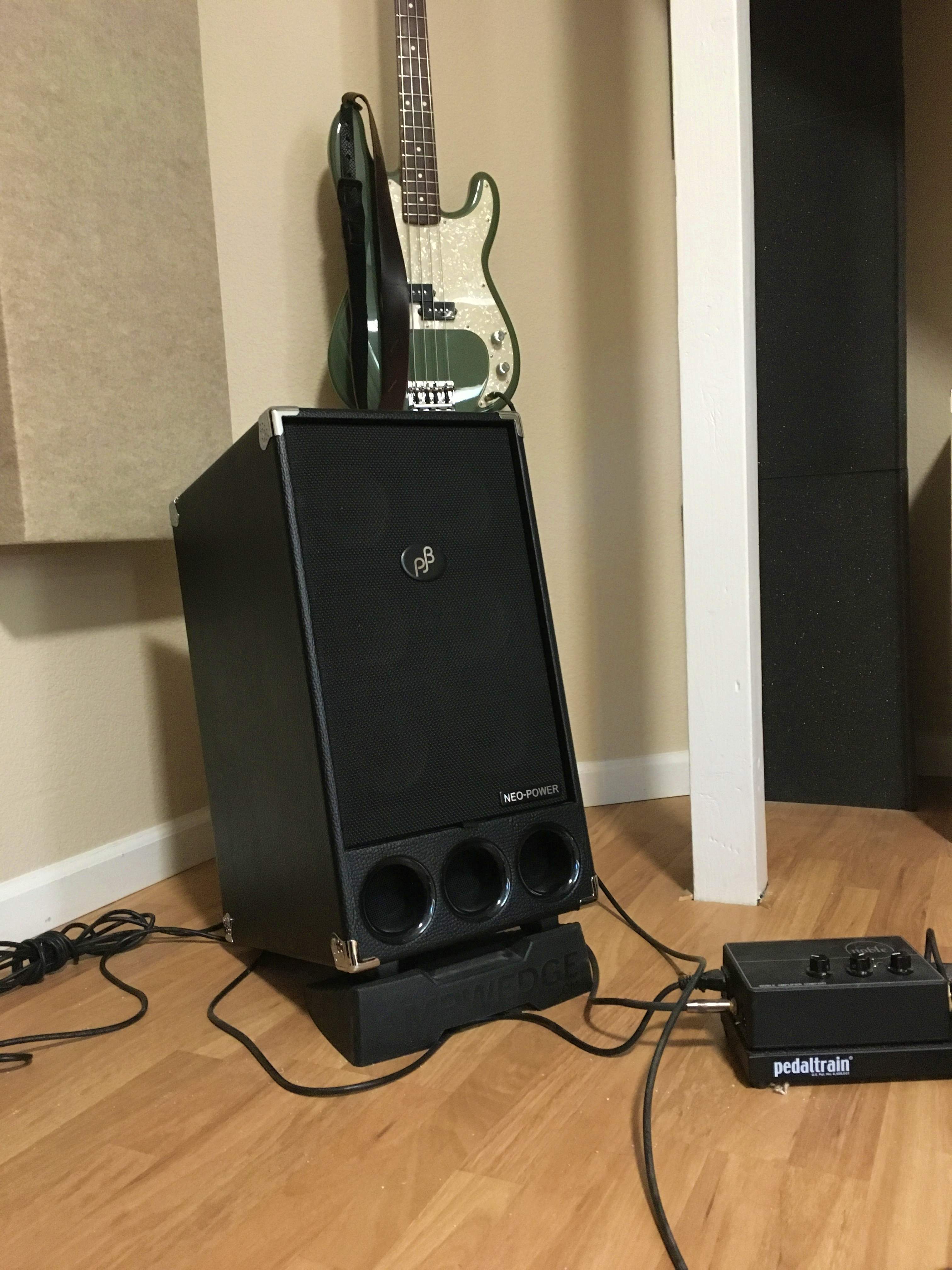
I use a powered cab that is no longer manufactured. It's a Phil Jones PB-300 with a 250-watt amp and six 5-inch drivers. It really is "flat" as the original audience of players (I believe) was double bass. Line input: 40Hz -120KHz and a built-in Low Cut Filter: 24dB/Octave at 40Hz. I play a passive P-bass into a Noble tube preamp/DI on the front end, which plugs directly into the cab. Nice small, light form factor and excellent tone and build quality. Wouldn't have it any other way!

PB-300 on AmpWedge.JPG
 
2u. Everyone makes 2u amps. Suitable for far more than just a bass guitar.

Also, powered PA speakers and monitors, are powered cabs.

Also, combo amps, are powered cabs.

Most 2U power amps these days are designed for PA / installation audio use, not bass guitar, and the vast majority are either low wattage local distribution amps, or high wattage PA that is overkill (over 1kw).

Most are 2-channel stereo, only a handful (like the Demeter and GR amps mentioned in this thread) are mono. If you're not bi-amping with a crossover that's useless extra weight and cost.

Combo amp ≠ powered cab. Combos have preamps which shape tone / add gain. As others have mentioned, no preamp circuit is ever truly "flat" so if your tone is from an external preamp, you're getting unwanted coloration or frequency scoops, etc.

Powered cabs are simply that: Cabinets with power amps, not preamps. Ideally you're getting clean, uncolored amplification from it.

If a combo offers a preamp bypass (power amp in) that's useful, but now you're paying for a preamp that you're not using. I suppose better to have it than not, but I wish more amps had a simple bypass switch for this use case.
 
  • Like
Reactions: BlueTalon
I believe that there are many small class D amps that negate the market need for a 3-500 watt class D standalone power amp. I currently use a Quilter BB800; 8x7 inches, 3.7 lbs, 800 watts, balanced line in for preamp bypass. I use this amp both as a power amp only when needed as well as a full-feature bass amp. I'm sure that there are many others that can be used the same way with the effects loop to bypass the internal preamp if desired. I tried the Sumo and found it lacking (unbalanced input, so there was significant loss of signal level). i could maybe see the benefits if/when technology gets to the point where a 5-800 watt power amp can fit comfortably on a pedal board, but until that time I don't see the benefit. Even then I think that I'd prefer a standard bass amp for the occasional gig done without a pedalboard.

Others have already hit my reasons why I would not consider powered cabs. 1) I have two cabs that I mix and match depending on need, and it would be redundant to have them both powered - 2) weight

The Quilter looks interesting. I wouldn't be interested in a pedalboard amp per se, just a simple, small power amp 'head' I could use with a variety of cabinets. I like the idea of a powered cab for simplicity and modularity - like another poster mentioned, I would probably go for PJBs as they stack up nicely :)
 
I personally wouldn't want a powered cab: it's too tightly coupling two components without providing a huge advantage over the existing options. It's effectively a combo amp that you can't use on its own and it wouldn't cost enough less to justify the fact that you could never use it on its own.

Regarding the 1u power amp, I have a Monoprice 1u 300 watt stereo/500 watt bridged power amp. The 150w stereo channels can be daisy chained if you don't have the specially wired bridge speakon cable (which I don't but would pick one up if I needed the extra wattage). Cost around $125 new, I think? The downside is that the fan sounds like a semi is idling in your rack.

Usually I run into my Warwick Gnome. No way to bypass the preamp, but it doesn't massively affect me: I can run my pedal preamps into the instrument in and tweak until it sounds good enough; run from the bypass of my preamp pedals into the Gnome and not worry about the fact that my stage monitor is different from the house; or like what I'm doing tonight and just leaving my pedal preamps at home and using the amp's preamp. I wouldn't want to buy a micro amp without a preamp at all, but I would consider paying a little more for an effects loop.

Although, honestly, that already exists in the Harley Benton Block 800.

But being able to use the Gnome on its own and stash it in the pocket of my gig bag makes me doubt that I would ever choose a powered cab over, for example, a Jay Ganz.
 
Most 2U power amps these days are designed for PA / installation audio use, not bass guitar, and the vast majority are either low wattage local distribution amps, or high wattage PA that is overkill (over 1kw).

Most are 2-channel stereo, only a handful (like the Demeter and GR amps mentioned in this thread) are mono. If you're not bi-amping with a crossover that's useless extra weight and cost.

Combo amp ≠ powered cab. Combos have preamps which shape tone / add gain. As others have mentioned, no preamp circuit is ever truly "flat" so if your tone is from an external preamp, you're getting unwanted coloration or frequency scoops, etc.

Powered cabs are simply that: Cabinets with power amps, not preamps. Ideally you're getting clean, uncolored amplification from it.

If a combo offers a preamp bypass (power amp in) that's useful, but now you're paying for a preamp that you're not using. I suppose better to have it than not, but I wish more amps had a simple bypass switch for this use case.
Ashdown does. They have a switch that bypasses the entire eq section, but still let's you use the additional features of the amp. Compressor, tubes, octaver, etc.

Great feature for using a preamp pedal. You can run it into the front end, and not get the coloration of the amp's preamp, but still use the features of the amp. Where as, plugging into the return of any other normal amplifier, negates all the features of that amp.
 
Last edited:
  • Like
Reactions: hooky_marr
Although GK said that in their marketing, when I owned an MBP 212 it worked perfectly with every preamp I tried. I used it with a Noble, a Mesa, and several others with no issues at all.

Interesting, none of my preamps had enough output to drive the one I had. It was a 112. I mean you could hear it, but it wasn't loud at all. Have you driven your cab with a matching GK head or a Plex? You may find that it can be twice as loud and didn't realize it!
 
I use a powered cab that is no longer manufactured. It's a Phil Jones PB-300 with a 250-watt amp and six 5-inch drivers. It really is "flat" as the original audience of players (I believe) was double bass. Line input: 40Hz -120KHz and a built-in Low Cut Filter: 24dB/Octave at 40Hz. I play a passive P-bass into a Noble tube preamp/DI on the front end, which plugs directly into the cab. Nice small, light form factor and excellent tone and build quality. Wouldn't have it any other way!

120kHz? Perhaps a typo?

Most 2U power amps these days are designed for PA / installation audio use, not bass guitar, and the vast majority are either low wattage local distribution amps, or high wattage PA that is overkill (over 1kw).

Most are 2-channel stereo, only a handful (like the Demeter and GR amps mentioned in this thread) are mono. If you're not bi-amping with a crossover that's useless extra weight and cost.

Combo amp ≠ powered cab. Combos have preamps which shape tone / add gain. As others have mentioned, no preamp circuit is ever truly "flat" so if your tone is from an external preamp, you're getting unwanted coloration or frequency scoops, etc.

Powered cabs are simply that: Cabinets with power amps, not preamps. Ideally you're getting clean, uncolored amplification from it.

If a combo offers a preamp bypass (power amp in) that's useful, but now you're paying for a preamp that you're not using. I suppose better to have it than not, but I wish more amps had a simple bypass switch for this use case.

There are plenty of 2U pro audio power amps in the power range that's appropriate for bass guitar. Mono or stereo doesn't matter, if using 1 cab, then use 1 channel, using 2 cabs then use 2 channels, additional combinations can use 1 or both channels.

Interesting, none of my preamps had enough output to drive the one I had. It was a 112. I mean you could hear it, but it wasn't loud at all. Have you driven your cab with a matching GK head or a Plex? You may find that it can be twice as loud and didn't realize it!
This is not uncommon, many preamps can not provide a balanced line level signal capable of driving a +4dBu balanced line level input. His example of the Subway pre-di is a pedal that can in fact drive a line level balanced input at >+4dBu.
 
I believe that there are many small class D amps that negate the market need for a 3-500 watt class D standalone power amp. I currently use a Quilter BB800; 8x7 inches, 3.7 lbs, 800 watts, balanced line in for preamp bypass. I use this amp both as a power amp only when needed as well as a full-feature bass amp. I'm sure that there are many others that can be used the same way with the effects loop to bypass the internal preamp if desired. I tried the Sumo and found it lacking (unbalanced input, so there was significant loss of signal level). i could maybe see the benefits if/when technology gets to the point where a 5-800 watt power amp can fit comfortably on a pedal board, but until that time I don't see the benefit. Even then I think that I'd prefer a standard bass amp for the occasional gig done without a pedalboard.

Others have already hit my reasons why I would not consider powered cabs. 1) I have two cabs that I mix and match depending on need, and it would be redundant to have them both powered - 2) weight

I have a Grace Alix preamp that I love for my URB. I originally ran it into the power stage of a Microtubes M900 which was great but I wanted to go more minimalist so replaced the MT with a Baby Sumo.

Bad idea. It sounded fine - quite transparent - but the first time I used it for a loud gig in an Australian summer it overheated and shut down. Even when I wasn't playing it got quite hot. I couldn't get any help from the maker on controlling its temp so replaced it with a Quilter BB800.

I couldn't be happier with the Alix/Quilter combo. I often double URB with BG, so I can plug my Fender into the front of the amp - it's quirky 2-knob EQ works surprisingly well - and run the XLR Out from the Alix into the XLR Line In on the back of the Quilter. Both bass' signals get mixed into to the power amp and to the DI out. As a bonus, even though the BB800 is technically 100w less powerful than the Microtubes, the sound 'feels' more solid, and I love having so much dynamic headroom.
quilter_grace-alix.jpg
 

Attachments

  • 7426771-d5fdbe754ebb56b10f9b7ca176b248b1.jpg
    7426771-d5fdbe754ebb56b10f9b7ca176b248b1.jpg
    2.8 KB · Views: 16
Last edited:
  • Like
Reactions: Diplock and gtirard
I have a Grace Alix preamp that I love for my URB. I originally ran it into the power stage of a Microtubes M900 which was great but I wanted to go more minimalist so replaced the MT with a Baby Sumo.

Bad idea. It sounded fine - quite transparent - but the first time I used it for a loud gig in an Australian summer it overheated and shut down. Even when I wasn't playing it got quite hot. I couldn't get any help from the maker on controlling its temp so replaced it with a Quilter BB800.

I couldn't be happier with the Alix/Quilter combo. I often double URB with BG, so I can plug my Fender into the front of the amp - it's quirky 2-knob EQ works surprisingly well - and run the XLR Out from the Alix into the XLR Line In on the back of the Quilter. Both bass' signals get mixed into to the power amp and to the DI out. As a bonus, even though the BB800 is technically 100w less powerful than the Microtubes, the sound 'feels' more solid, and I love having so much dynamic headroom.
View attachment 5092802
Awesome rig!