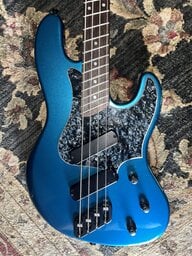
Hello usually when i practice scales i repeat the octave when going down. for example on the major scale i will start C-D-E-F-G-A-B-C-C-B-A-G-F-E-D-C or should i be practicing like C-D-E-F-G-A-B-C-B-A-G-F-E-D-C ( removal of repeating and fretting the octave twice). Which way should I be practicing?

Enjoy the benefits of a premium membership!
Upgrade Account
-
TalkBass has been independent since 1998. Add your voice.
Create a free account to reply to discussions, view embedded media, and browse with fewer display ads.
Join free Log in
Want zero display ads or expanded classifieds tools? Compare plans.
You are using an out of date browser. It may not display this or other websites correctly.
You should upgrade or use an alternative browser.
You should upgrade or use an alternative browser.
Practicing scales
- Thread starter bassist0981234
- Start date
More options
Who Replied?
Both ways are fine. I am reminded from my school band days that when the tonic was not repeated, we often played our scales in the "long tonic" style, where it was held twice as long as the other notes. And that's another side of this, I guess, that with a scale pattern there are so, so many rhythmic variations one can do with them, repeated tonic or not.

- Apr 1, 2000
- 17,398
- 9,830
- Disclosures
- Endorsing Artist: Roscoe Guitars, DR Strings, Aguilar Amplification

Id like to share with you the method I believe is the best way to not only practice scales, but to learn the fingerboard of your bass, and really start getting your ears together. This is the method taught to me by my teacher and I want to share it with all of you. This method applies to all electric basses, regardless of the number of strings. For the examples, however, well use the 4-string configuration. Additionally, all examples will be in the key of C major, but it is very important to practice these exercises in all keys once youve gotten the concept down.
One of the...
One of the...
- Pacman
- Replies: 543
- Forum: General Instruction [BG]
I will give you the perspective of two classic books.
The F. Simandl Double Bass book does repeat the octave when going down.
The Hanon piano book does not repeat the octave when going down.
I agree with others that just going up and down scales is not the best way to practice them.
The F. Simandl Double Bass book does repeat the octave when going down.
The Hanon piano book does not repeat the octave when going down.
I agree with others that just going up and down scales is not the best way to practice them.

Either method is fine, personally I don't repeat a note unless that's part of the exercise, and playing your full scale in groups (IE CCC-DDD-EEE, etc.) is really good practice, especially to keep your right hand in alignment with the left.Hello usually when i practice scales i repeat the octave when going down. for example on the major scale i will start C-D-E-F-G-A-B-C-C-B-A-G-F-E-D-C or should i be practicing like C-D-E-F-G-A-B-C-B-A-G-F-E-D-C ( removal of repeating and fretting the octave twice). Which way should I be practicing?
It's also important to practice positional scales. For example, with C on your 3rd fret (A string) you can play from C to high C (5th fret G string) but that's not every note in the scale that you have access to in that position. So, I would practice from the lowest note I have access to without shifting, in this case G, and I'd play up and down the full position, every note I can reach without shifting, then walk back to the tonic and end with the root, so my ear has a clear context and resolution.
From there the next step should be arpeggios, then playing the scales out of order and in patterns that shift and/or skip strings, to really get your fingers used to moving in every direction and not just straight up and down.
Both are valid, it depends on what you are trying to do. Repeating the octave gives you the flavor of the entire scale. Not repeating it gives you a sort of up-down riff that is a single thing of its own. No right or wrong. I do feel that going up and down scales is a highly valid exercise, as are several octaves of scales, scales in thirds, arpeggios, 1234-2345-3456 etc.. And in different rhythms. There are a million other things to do to. Enjoy.

I play scales partly so I don't have to look at the neck, and partly to show my pinky who's boss.

There's a hundred different ways to skin the cat, but for me, practicing scales but NOT starting on the '1' of the key seemed more like the ways I'd use them in real playing situations. In other words (while we're beating a C scale to death), start you C scale on a D, an F, anywhere but the root. And I always played them heading down the scale instead of up, which we all seem to do for some reason.
Diabolical in a way, but more like the way they'd come up in a song or improvising.
Diabolical in a way, but more like the way they'd come up in a song or improvising.
There's a hundred different ways to skin the cat, but for me, practicing scales but NOT starting on the '1' of the key seemed more like the ways I'd use them in real playing situations. In other words (while we're beating a C scale to death), start you C scale on a D, an F, anywhere but the root. And I always played them heading down the scale instead of up, which we all seem to do for some reason.
Diabolical in a way, but more like the way they'd come up in a song or improvising.
iow natural modes