• TalkBass has been independent since 1998. Add your voice.
    Create a free account to reply to discussions, view embedded media, and browse with fewer display ads.
    Join freeLog in
    Want zero display ads or expanded classifieds tools? Compare plans.

Double Bass Project bass

I recently bought a bass on Craigslist that I hope to bring back to life. I felt bad for this poor torture victim, so I bought it cheap.

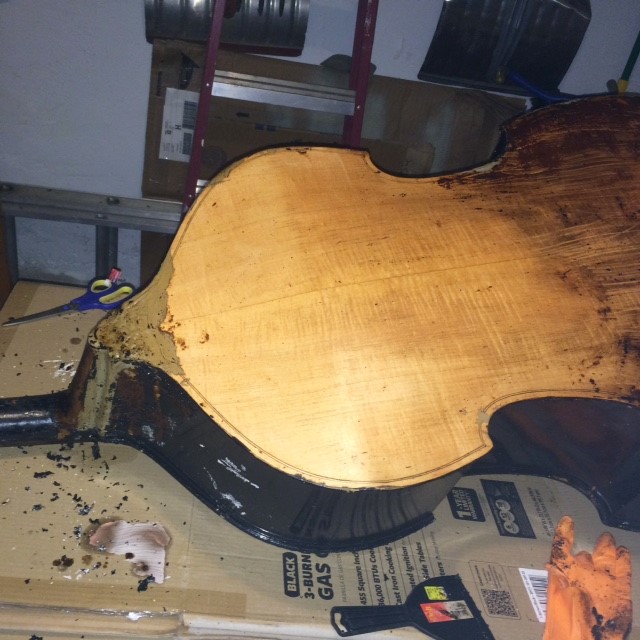
The bass was a mess. The heel area had been crudely repaired with with Bondo and the entire bass painted black. The bridge's feet had been sawed off and the bridge moved closer to the fingerboard. The base area of the pegbox has been "repaired" with three wood screws.

This plywood bass has a "made in West Germany" sticker inside and a decent looking, fairly thick rosewood fingerboard with Romberg bevel. I stripped the paint off the front and back with Citrusstrip today and was disappointed to find that in addition to the crude Bondo heel repair, Bondo had been used on the top and around the edges, as well. Also, there are cracks in the top near the soundpost and bridge.

I would like to hear opinions from the experts on whether this bass has much of a future. Below are pictures taken while stripping the paint on the top and back. Any suggestions would be appreciated. Thank you in advance!


ATTACH]
top_zps3z0jrzqc.jpg

Upper%20back_zpsycsqfhkz.jpg

Soundpost%20cracks_zpswckx5bzx.jpg

screws_zpsesj6pqe6.jpg
 

Attachments

  • top_zps3z0jrzqc.jpg
    top_zps3z0jrzqc.jpg
    120.3 KB · Views: 1
Yow!
I guess a lot of it depends on just how deep the damage is, and what is really left to repair...and, finally, just how far you want to go with it.
If the damage was primarily cosmetic (missing veneers, for example), then I would say you can take the bondo back off (using acetone) and start figuring out how to replace the missing wood.
The neck looks as though it could be more of a challenge...and the heel looks the worst, from here.

Looks like a fun project...or a nightmare, depending upon one's perspective.
 
Last edited:
Yow indeed. Or maybe even: yikes.

That Bondo (a trade name I don't know) looks like the type of polyester filler used in car body work. On a top, applied like that, it was probably applied to even dents and/or 'fix' cracks, prior to painting it black. Acoustically it will act as a damper and is to be avoided. Removing it would be on my list, but not at the top; I would first like to hear what the instrument sounded like before removing it.

It looks like you have the following issues:
  • Possibly soundpost-induced cracking (maybe why they moved the bridge up). If that is so, it needs fixing.
  • Heel joint: poor repair. If it holds, I would let it be for now.
  • Neck-pegbox: poor repair. If it holds, I would let it be for now.
  • Bondo.
  • Cosmetics. The wood below looks quite nice, but it is masked by the paint. And if you take the paint off, you get Bondo... I would let it be for now. But that paint is also likely to impede acoustic performance.
  • Any other surprises found underneath the paint.
If you're sure it is plywood, there is not much value in the instrument, and in commercial terms it is a total write-off. But you can still repair it as a hobby project, and a learning experience. I'd first see what it does with a normal bridge & SP, to assess how bad the cracks in the SP area are. If that entire area is indeed cracked, as it appears to be, that would be my #1 priority. To fix it properly the top needs to come off, and the entire area reinforced.

But if you put in that investment in time, you would want to know about the other poor issues. In all it will be a big project, but if you take it 1 step at a time, it need not cost you much other that your own time. I would first assess/fix the SP crack, then get inspiration from the sound & address the other issues suitably (which might be doing nothing, or a proper repair). When the thing is open, have a good look at the neck block & other potential issues.

Good luck!
 
Thanks so much for the replies, 1st Bass and Ortsom.

The bass came with plain gut E, A, and D strings with a metal G, and it didn't sound too bad. The man I bought it from was a guitarist, so I assumed he had moved the bridge to make it easier to play. The SP cracks were covered by the paint, but I agree that the cracks are probably why he moved the bridge.

It sounds like a daunting project, but it could be a good learning experience for me.

Thanks again!
 
Those cracks in the SP area (pic #3) do not really look like a normal SP crack to me. It is difficult to see where exactly the SP was when the top cracked over it, and why it would get all those other cracks in the wider area. Best first check how bad it really is. Slim chance, but you might be lucky.

Conceivably this entire area is cracked because the thing was tensioned-up without a SP, in which case the inside would might be worse.

Are you really certain it is plywood? Can you see the layers at the edge of the top?
 
Last edited: