• TalkBass has been independent since 1998. Add your voice.
    Create a free account to reply to discussions, view embedded media, and browse with fewer display ads.
    Join freeLog in
    Want zero display ads or expanded classifieds tools? Compare plans.

[Project Diary] Ric inspired short scale bass

Did you find this useful? I've always wondered about whether the "sweet spot" is real or a myth. The length of the string and its shape and vibration are going to move depending on what note you are fretting. So it seems impossible to find a single sweet spot. My suspicion (and I have not tested this) is that the "sweet spot" has more to do with lining the pickup pole pieces directly under each string than anything else.
I don't know yet, because there is too much difference between the 2 pickups (one humbucker and a "High Gain" single coil), I will try again after replacing the Toaster by a second High Gain.

From my first experience, I believe there's no "absolute sweet spot" (for the same reasons as you).

Also I couldn't hear any difference when I moved a pickup slightly, like the difference between the "Jazz 60's" and "70's" position.

But there is a noticeable difference when I move a pickup a few centimeters left or right, so I'm confident it will help me finding my favorite pickup placement.
 
I can't speak for bass guitars, but I have changed pick ups, and pick up placement, many times on 6 sting guitars, with scale lengths from 24" to 25"1/2". Moving pickups definitely changes the overall tone of any pick up. That said, a 'sweet spot" would be in the ears of the beholder, it is subjective. Regarding correct pole piece placement under the strings, that should be a given. One way around that, is using a blade type pick up.
 
Last edited:
Did you find this useful? I've always wondered about whether the "sweet spot" is real or a myth. The length of the string and its shape and vibration are going to move depending on what note you are fretting. So it seems impossible to find a single sweet spot. My suspicion (and I have not tested this) is that the "sweet spot" has more to do with lining the pickup pole pieces directly under each string than anything else.
I think u may be missing that fact the the pick up, dose exactly what the name implies it "listens", picks up the vibration of the string over its magnetic pole pieces. A bridge jazz placement is not going to vibrate as much as a neck position. Wide tonal differences
 
I remember back in the 80's Steinberger era, when all kinds of "minimalist" bass designs were popular, there was one that had rails a movable pickup would slide along, I think it was a Westone? It's been tried on a number of basses over the years, but none of them seemed to get any traction commerically, which makes me think this may be a solution in search of a problem. Again, as soon as you fret a note, the string harmonics change, and the pup position in now out the window, but I suppose if you optimise the locations to sound best where you spend the most time, like the first 5 frets, it could have some benefit. I slavishly copied the theoretical 24th and 36th fret positions on my Ric clone builds, and they do indeed sound just like a Ric, but I couldn't say how much of that is down to using Hi-Gains vs. where they are placed.
 
Two great news
  1. Problem #2 solved: John East support answered to my email, explaining that one of the pickups was probably out of phase, causing the center position of the mix knob to lack volume, we just had to reverse the polarity of one pickup… and it works perfectly now (it was our stupid mistake). Lesson learned.
  2. As I decided to replace the Toaster by a second High Gain pickup, @Kendescending super kindly offered to send me a High Gain pickup he's no longer using - it's on its way. Thank you so much! :) It would be really nice (if it works) to know that my bass is using a part form a fellow Talkbasser.
@Gilmourisgod, @Old Ozzie Guy

I went the breadboard route in order to experiment, have fun, and most of all LEARN. We'll see. The objective is NOT to have a sliding pickup like the Gibson Grabber, not even to find the perfect pickup position ("sweet sport") that would make this instrument incredibly better, it's much more modest than that: understand how important it is, how it affects the tone, and find my prefered pickup position before the luthier builds the final instrument (=before he makes the pickups cavities). The idea is to compensate my ignorance by patient testing and learning. I know it won't be night and day, I know it's not a matter of millimeters, but I already noticed that moving the pickups significantly actually makes a small difference in tone, so why not experiment? In the end, I might conclude that I was overthinking this, but it's fun anyway.

Last, I've forgotten to tell you the best part of the story: my amateur luthier friend happens to be also the drummer of my band, and he works in his basement where he also has his drum kit, so he's playing the drum parts of our songs while I'm testing the breadboard with the bass lines - I do all the tests in context.

Fun times ahead

:hyper:
 
I've always wondered how Leo Fender came up with the pup positions for the original P and J basses, and if it was based on some real tone experimentation, or just what looked right, and then that particular set of locations got burned into our collective ears and eyes, same with Rickenbacker, Gibson, and all the rest of the first and second generation bass builders of the 50's and 60's.
 
  • Like
Reactions: gtirard
I think it's brilliant that your adventurous enough to try new things. To me, that spirit , is what makes a true "artist "!
Experimenting can only add, progress a musian, whether it be with instruments, associated gear, or how we perform, or the lines we play..
More power to you.
Thanks a lot, it's too much but thank you anyway.

Next time I meet my friend after I have received the second High Gain pickup and he has installed his Velcro system, I plan to try 3 songs (bass & drums):
  • One for the bridge pickup alone, in order to compare the Jazz Bass and the Ric 4003 bridge position.
  • One for the neck pickup soloed, in order to compare the G&L L2000 and the Ric 4003 neck position
  • One for both pickup, in order to compare the 4 combinations
Hopefully I can film or record the session?
 
Last edited:
This looks like a very cool project. gtirard says the design is still in development. For fun I played with lower horn (on the right)View attachment 7184862

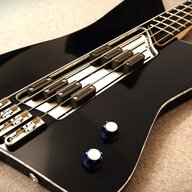
I've reworked on the lower horn following @RLK's suggestion, and François (the luthier) told me we would need a pickgard for these pickups.

pickgard-v1.jpg


Thoughts?
 
Hi @gtirard

Cool project! I really like your R&D approach. I've built two basses with moveable pickups and will definitely continue down this path (parts for two basses on order). If you're looking for a specific sound for your specific songs, it's definitely worth looking for the optimal pickup position. It's really interesting how small changes can affect the sound. And it depends on your playing style.

So I suggest you keep experimenting, especially in your band setting!

I look forward to seeing how your project evolves!

IMG_20250402_181212.jpg


IMG_20250402_181140.jpg
 
Hi @gtirard

Cool project! I really like your R&D approach. I've built two basses with moveable pickups and will definitely continue down this path (parts for two basses on order). If you're looking for a specific sound for your specific songs, it's definitely worth looking for the optimal pickup position. It's really interesting how small changes can affect the sound. And it depends on your playing style.

So I suggest you keep experimenting, especially in your band setting!

I look forward to seeing how your project evolves!

View attachment 7192086

View attachment 7192085
Thank you but wow, you are boxing in a different league. I had seen the first one in a « bass of the week » review, it’s amazing.
 
Thank you but wow, you are boxing in a different league. I had seen the first one in a « bass of the week » review, it's amazing.

Thank you! But not really... It was my first scratch build and I'm otherwise a data scientist with hardly any woodworking experience. Some patience and madness might make up for that ;-)


If you like several positions for your pickup that are relatively close to each other, you can also make the routing wider and use a suitable pickguard depending on the position of the pickup. This will make it easier to change the position later.
 
  • Like
Reactions: gtirard
Hi @gtirard

Cool project! I really like your R&D approach. I've built two basses with moveable pickups and will definitely continue down this path (parts for two basses on order). If you're looking for a specific sound for your specific songs, it's definitely worth looking for the optimal pickup position. It's really interesting how small changes can affect the sound. And it depends on your playing style.

So I suggest you keep experimenting, especially in your band setting!

I look forward to seeing how your project evolves!

View attachment 7192086

View attachment 7192085
Both stunning looking instruments!
Iv never seen a bass tremolo unit, reminds me of 80s Khaller (thats probably the wrong spelling) type.
 
Catching up on this thread. Love the experimentation!

The whole “sweet spot” concept ignores the subjectivity of what sounds “best”. It also ignores all of the other factors that make a bass sound the way it does:
  • Style of pickup
  • Specifics of pickup (magnet type and field, wire type and resistance, any eddy currents due to structure, etc)
  • Electronic control circuit
  • Strings
  • Overall structural stiffness
  • Overall mechanical resonances of the structure
  • Amp
  • Cabinet
  • Room

Why do you “need” a pickguard? I strongly dislike all pickguards on principle. I especially dislike the graceless pickguard that Rickenbacker settled on for the 4001/4003 basses. I recommend just screwing the pickups down directly, and not covering your bass in tacky plastic.
 
Both stunning looking instruments!
Iv never seen a bass tremolo unit, reminds me of 80s Khaller (thats probably the wrong spelling) type.
Regarding a scratch plate, it's either a scratch plate on the front, or control cavities on the back.. the exception being bespoke instruments such as 13ghosts's amazing green machine. A scratch plate just makes economical sense. (Time, and $s).
Thanks you!

Yes, it's a Kahler tremolo.
 
  • Like
Reactions: Old Ozzie Guy