• TalkBass has been independent since 1998. Add your voice.
    Create a free account to reply to discussions, view embedded media, and browse with fewer display ads.
    Join freeLog in
    Want zero display ads or expanded classifieds tools? Compare plans.

PROOF! That fingerboard wood makes a difference.

If it can be demonstrated empirically that fretboard wood makes no difference in the tone coming out of a bass, as many assert, then it seems logical to conclude that the material in which the frets are seated does not affect the tone and therefore a fretboard made of dried mud (or bacon, or crusty gym socks, or cork) should sound exactly like one made of rosewood, ebony, maple, etc.
You got it backwards. The burden of proof falls on anyone claiming that wood does make perceivable differences in tone. I wouldn't say wood makes doesn't make a difference. I'm just not convinced that it does.
 
well the thing is ... Fender maple fingerboard are cover with lacquer while a rosewood fingerboard is bare wood. I know other brand like EBMM use somekind of mate sating finish which I guess is well dense and breath a little more than a direct laquer

So in the end whatever


No two piece of wood will ever sound identical
Yes. Rosewoods are naturally full of oils. And then we add more to them once or twice a year so they don't dry out. If you excessively oil something, like a maple cutting board, it will over time get softer and somewhat spongy. I see it all the time in the thrift shops I frequent.
The maple fretboards on the other hand have to have a hard clear coat on them in order to mitigate atmospheric moisture going in and out and potentially warping them. I wonder if these surface finish treatments, along with oil impregnations, are behind the sound differences?
 
You have no idea why the maple necked bass sounds mildly brighter. It could be eq. It could be strings.
If they did so than the test has no meaning ... since the test was arranged to verify that there is an inherent tone difference between the two materials, I have to presume that the eq was thd same and that the test has actually revealed the e istrice of s different tonal response characterising these two kinds of wood
 
To be honest, however, there's s video comparison between a Fender Steve Harris P bass (maple) and a Nate Mendel (rosewood) ... the latter has got SD quarter pounder onboard whilst thd Steve Harris has got SD SB-P 4 which in theory should sound crispier .
This in addition to thd maple fretboard should make the Steve Harris more high mids oriented than the Nate Mendel ... however in that video thd Nate Mendel seems to have a more aggressive tone
 
The total harmonic distortion, or THD, of a signal is a measurement of the harmonic distortion present and is defined as the ratio of the sum of the powers of all harmonic components to the power of the fundamental frequency.
 
In my experience, if it makes a difference in tone, it's far less than my ears are capable of detecting. Fretless basses, on the other hand, do seem to sound considerably different depending on fingerboard wood. There really in no good way to prove or disprove it, there are just too many variables. I say play whatever you like, even if there were pretty big tonal differences they wouldn't be anything not easily tweaked out with eq.
 
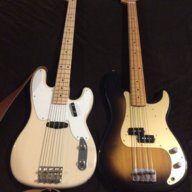
IMG_7950.JPG
 
My rosewood fretboards sound, and can get, as bright a tone as my maple ones (and listen to them both unplugged) coming from playing basses since 1972. But then maybe I've not learned or heard anything in 44 years of playing. Pish Posh indeed. Means nothing IME.
But, you can convince yourself of anything if you cannot be truly objective about it.
Hardly anything I care about.
 
  • Like
Reactions: Garret Graves
When it comes to sound and the slight variances in tone, never ever say 'proof positive' or 'absolutely sure'
on TalkBass. It will disrupt the delicate space-time continuum in the music world and cause untold damage to the fabric of space.
Short of finding a wormhole or a time traveller, you'll be stuck in an infinite loop.
That said and at the risk of harming the universe, my maple neck bass has a different feel and IMHO, brighter tone than my rosewood neck bass...but it could all be in my mind.....besides they are not similar models.

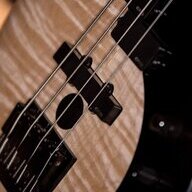
aaa1.jpg
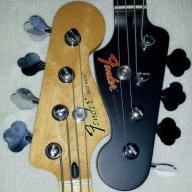
aaa2.jpg
 
Yeah, it's interesting where true blind sound tests are done, the whole tonewood debate goes haywire. We "hear" a lot with our eyes. It's a purely aesthetic decision. I don't like lacquered boards tactily, and maple has to be sealed or it looks grungy, so rosewood, ebony, or other naturally oily wood for me. The Ric 4003w is one of the few maple neck basses I like visually, and that's lacquered, go figure.